

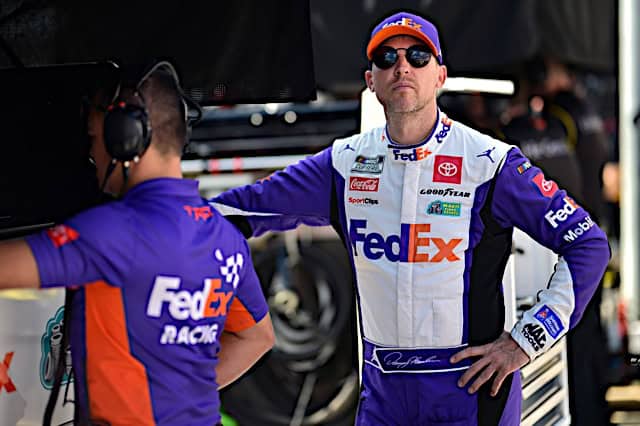
Will Hamilton Leave Joe Gibbs Racing if FedEx Doesn't Renew with No. 11 Team Next Year?
If FedEx is about to exit the NASCAR Cup Series, will Denny Hamlin also leave Joe Gibbs Racing?
The Sports Business Journal reported on September 24 that JGR No.11’s long-term sponsor may further reduce sponsorship amounts or completely withdraw from NASCAR after the 2024 season.
It is well known that FedEx, as Hamlin’s sponsor, has significantly reduced its investment. It went from being a primary sponsor for the entire season to sponsoring only 12 races last year.
In this year’s 36-point races, after 29 races, FedEx was the main sponsor in just nine instances. However, at this weekend’s race in Kansas Speedway, FedEx will be on the hood and may sponsor a few more races before the season ends.
Despite this, it seems that the logistics company is about to exit. Nevertheless, it’s worth noting that FedEx has lasted ten years longer than its competitor UPS.
If 2024 truly marks FedEx’s last season, this could mean Hamlin’s time with JGR No.11 is limited.
Before everyone gets too excited, I want to clarify: Hamlin will still be in the Gibbs team for 2025. He has a contract and any change now would be too late for both Hamlin and JGR; neither could start from scratch.
NASCAR contracts are quite vague these days, but Hamlin signed an extended multi-year contract in September 2023. This means that 2024 is the first year of his contract term, and 2025 is the second year, making it a multi-year deal. Whether he will still be part of the team or have options for 2026 remains unclear, but given Hamlin’s good relationship with Joe Gibbs and his loyalty to this long-time boss, I doubt he would break his contract with the team.
Of course, Hamlin might retire after the 2025 or 2026 season. After all, he will be 46 years old in 2027.
If the future NASCAR Hall of Famer wants to continue racing after his contract ends, it’s likely that he would drive a car other than JGR No.11 for the first time.
So, what impact does FedEx’s potential departure have on all this? First, Hamlin has repeatedly stated that he wants to keep one number, one sponsor, and one team throughout his career. The departure of FedEx will erase one of these variables.
More importantly, few expected Kyle Busch to leave JGR, but the successful partnership ended after long-term sponsor M&Ms left. Like Busch and Matt Kenseth, retaining Hamlin for JGR is more expensive than signing a new or less renowned driver. Both Busch and Kenseth would not accept pay cuts to stay with Gibbs. If Hamlin faces the same situation, will he accept a pay cut?
If Hamlin leaves JGR, where would he go? The answer is simple: his own team, 23XI Racing.
Hamlin has previously stated on Kevin Harvick’s show that he wants to end his career with Joe Gibbs Racing because he wants to remain loyal to the person who gave him a start in racing.
“I have some reservations,” Hamlin said. “One of them is I want to finish my career at Joe Gibbs Racing, because I want to be loyal to the people who gave me an opportunity.”
“But there’s definitely a part of me that wants to drive for 23XI Racing, absolutely. I’m sure I will race for 23XI Racing at least once.”
So, in simple terms, if everything goes according to Hamlin’s wishes, he would stay with JGR for a few more years and then retire from full-time racing while participating in some races with 23XI Racing, similar to Martin Truex Jr.
The problem is that things rarely end as athletes expect them to, no matter how great they are. Jeff Gordon, Jimmie Johnson, and Dale Earnhardt Sr. were exceptions in recent years. There have been more instances of sports legends ending their careers earlier than desired (such as Rusty Wallace, Ryan Newman, Greg Biffle) or finishing their careers without the most successful team (like Kenseth, Tom Brady, Joe Montana, Brett Favre, Mark Martin).
JGR has no precedent for a driver staying with them throughout his entire career. The three champions that this organization has won – Busch, Tony Stewart, and Bobby Labonte – all left at some point. Of course, Hamlin seems to have a closer relationship with Gibbs than these three.
My prediction is: when Hamlin’s current contract expires, he will be asked to accept a pay cut (unless JGR can find sufficient funding to replace FedEx’s sponsorship) or advised to retire. When that moment comes, there are three possible outcomes:
- Hamlin accepts the pay cut and remains loyal to Gibbs.
- Hamlin retires from full-time racing and starts driving for 23XI Racing part-time.
- Hamlin believes he still has what it takes and switches to full-time with 23XI Racing.
The key factor in decision-making will be what JGR offers him and his performance on the track. If Hamlin stops winning races and misses the playoffs, he may retire from full-time racing.
But if he continues to win races and compete for championships, he might prove that he still has potential. If JGR believes Hamlin no longer has potential but he himself thinks otherwise, then the third scenario could occur. This situation usually happens when a team feels that a star athlete is past his prime, while the athlete believes he still has several years left.
Even last year, moving from JGR to 23XI Racing was seen as a step down. Now, it’s completely on par. After all, Tyler Reddick just won the regular season championship and has more wins in the past two years than both of JGR’s drivers combined.
No one can be certain what will happen when Hamlin’s current contract expires, but I guarantee it will be one of the most talked-about topics at that time.
Now, let’s cherish the last few times we see Hamlin racing in FedEx colors. Once this era ends, a significant chapter in NASCAR history will truly come to an end.
About the Author
Michael Massie
Content Director
Michael Massie joined Frontstretch in 2017 and has served as Content Director since 2020. This Richmond native not only covers NASCAR but also IndyCar, SRX, and CARS Tour. In addition to being a Virginia Tech graduate and minority shareholder of the Green Bay Packers, he can often be seen cheering on his beloved college teams and the Packers.
Source website:


