

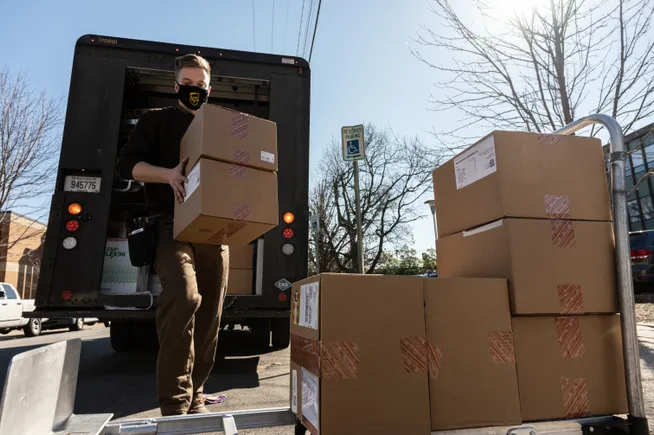
VP Daniel Gannon Tells Supply Chain Dive the Company Aims to Meet Ambitious 2026 Goals Through Acquisitions and Organic Growth
# UPS’s Double Growth Plan in Healthcare Logistics
Through acquisitions and organic growth, the company aims to achieve this ambitious goal by 2026, according to Daniel Gagnon, UPS’s Vice President of Global Strategy & M&A.
Published on October 7, 2024
**UPS is enhancing its healthcare logistics business through internal expansion and external acquisitions in order to develop its parcel delivery activities within a more profitable and less volatile sector.**
This strategy has a simultaneous aim: the company hopes to reach $20 billion in annual healthcare revenue by 2026—double that of 2023.
“To be honest, there is some anxiety around this goal,” said Daniel Gagnon, UPS Healthcare’s Vice President of Global Strategy & M&A. “So it’s really a very big ask.”
However, Gagnon stated that the UPS Healthcare team is confident in doubling revenue by striking an appropriate balance between organic and inorganic growth.
In terms of organic growth or expanding its network and capabilities on its own, UPS has targeted Europe for this year. The company opened its first dedicated healthcare facility in Ireland and expanded its flagship facility in the Netherlands with ultra-low temperature storage capacity to meet the needs of complex biopharmaceutical products.
A recent series of acquisitions or inorganic growth cases have involved multiple suppliers with strong cold chain capabilities across various countries.
###### Recent UPS Healthcare Logistics Acquisitions
| Acquisition | Capabilities |
| — | — |
| MNX Global Logistics | Radiopharmaceutical and temperature-controlled logistics |
| Bomi Group | Temperature-controlled facilities in 14 countries |
| Medical logistics division of Transports Chabas Santé | Temperature-controlled transportation solutions for pharmaceuticals and medical products in Southern France |
| Frigo-Trans* | European temperature-sensitive and time-critical pharma logistics |
*The acquisition of Frigo-Trans is expected to be completed in the first quarter of 2025.
Organic growth and inorganic growth each have their unique advantages, but Gagnon notes that UPS typically relies on inorganic healthcare growth when rapid expansion or development of local expertise not yet possessed is needed.
“There are actually 27 EU countries, and each has a different interpretation of how to execute things, whether it’s regulatory or from the customer’s perspective,” said Gagnon. “So this local knowledge is very important.”
Acquisitions require additional work to understand customers transferred from previous owners. When UPS acquires new shippers through acquisitions, they meet with them to better understand their business priorities—whether expansion or cost reduction—and develop logistics strategies that align with their goals.
This extra effort is worthwhile for UPS because healthcare offers higher-profit delivery compared to other customer groups such as e-commerce. The company’s CEO Carol Tome stated at the investor day that healthcare service margins are in the high double digits. Increased healthcare deliveries can offset revenue pressure from e-commerce shippers like Temu and Shein.
Healthcare also provides more stable demand compared to retail, according to Gagnon. Retailers surge delivery networks with packages during peak holiday shipping seasons but are equally susceptible to economic fluctuations.
“Healthcare tends to be very stable,” said Gagnon. “It’s not recession-proof, but it has recession resistance, so its changes are typically less than the economy.”
Other carriers have also been attracted by these healthcare industry characteristics and thus strengthened their own logistics capabilities. FedEx saw over $500 million in “premium” healthcare business during fiscal year 2024 and strong demand for this area within its FedEx Surround service, which provides real-time shipping visibility. DHL launched a new cold chain service in 2023 used by industry giants such as Siemens Healthineers and Eli Lilly.
Gagnon mentioned that UPS uses its end-to-end service suite to attract large manufacturers in medical devices, pharmaceuticals, etc. Although the top healthcare clients have varying needs, they typically seek logistics partners who can provide high levels of visibility and consistent on-time delivery.
One product that meets this demand is UPS Premier, which uses RFID and cellular sensor technology to notify network operators about urgent or temperature-controlled materials inside packages. It also provides precise location information, such as the position of a package within an aircraft, in case of adverse weather conditions or other issues during transit, enabling intervention. This can help deliver potentially life-saving goods under difficult conditions.
“This allows me as an operator to ensure that every package is on its way to the next destination,” Gagnon said.
—
Source: Supply Chain Dive


