

Maersk has upgraded its full-year 2026 financial guidance, projecting underlying EBITDA of $8–$10 billion — up from $4.5–$7 billion — citing strong Far East container demand and rising spot market rates. The revision follows geopolitical disruption from the U.S.–Iran conflict beginning February 28, which closed the Strait of Hormuz and triggered emergency surcharges. Maersk now forecasts $2–$4 billion in underlying EBIT, reversing prior losses of $1.5–$1 billion, and narrows negative free cash flow to $1.5 billion from $3 billion. Global container volume growth is revised to ~4% for 2026, up from 2%–4%. The company will report Q2 earnings on August 13.
Wartime economy: Maersk lifts full-year guidance on strong demand
Higher rates, Asia demand spur upward revision
Revised financial outlook
Big Blue is forecasting a big finish in 2026. And it has the unsettled Middle East in part to thank.
Maersk revised its financial guidance sharply upwards as peak season demand swells out of Asia and spot market rates continue to climb.
“Continued strong demand in the container market, particularly in the Far East, and a recent sustained increase in spot market rates means that A.P. Moller–Maersk (OTC: AMKBY) upgrades its guidance for full year 2026,” the Copenhagen-based company said Monday.
The world’s second-largest container carrier now expects underlying earnings before interest, taxes, depreciation and amortization (EBITDA) in a range of $8–$10 billion. That’s up from previous estimates of $4.5–$7 billion.
Maersk forecast underlying earnings before interest and taxes of $2–$4 billion, up from a loss of $1.5–$1 billion. The company narrowed expectations of negative free cash flow to $1.5 billion from $3 billion.
“This is based on a volume growth outlook for the global container market of about 4% (previously 2%–4%) for full-year 2026,” Maersk stated.
Geopolitical catalysts
Ocean carriers got an unexpected boost from the effects of the U.S. war with Iran in the Persian Gulf that began Feb. 28. The closing of the Strait of Hormuz and Iranian attacks on refining choked global supplies and sent the price of crude oil and fuel soaring. The conflict trapped thousands of ships in the Gulf region, helped push up rates, and led carriers to implement an array of emergency surcharges.
Rates were also buoyed by frontloading by shippers anxious to avoid tariff chaos and expected price hikes by Asia manufacturers.
Maersk in the weeks after the start of the war petitioned the Federal Maritime Commission to waive its 30-day waiting period for the implementation of emergency fuel surcharges. But the U.S.-based regulator three times rejected Maersk’s requests.
Earnings timeline and context
The company will release second quarter earnings on August 13.
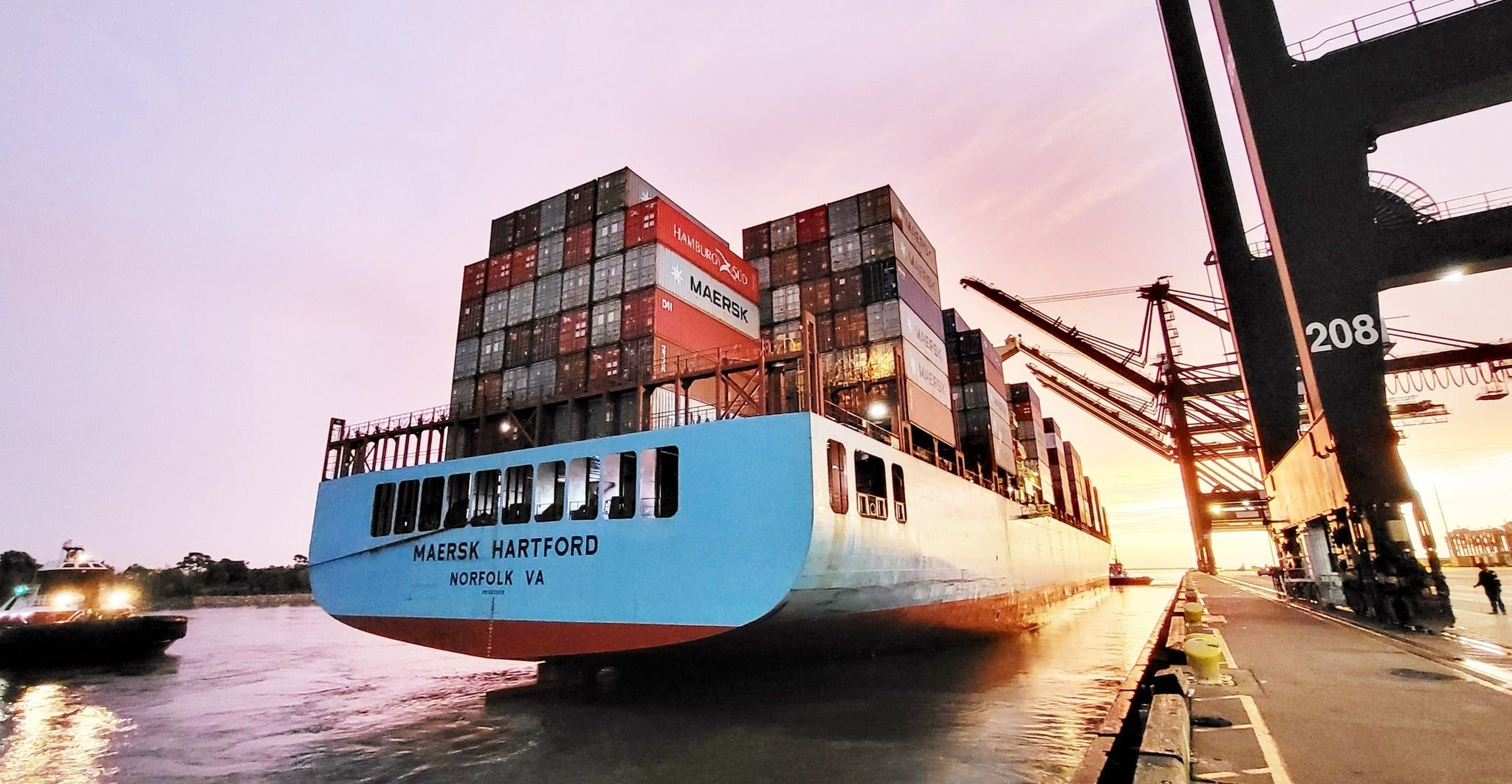
Maersk Hartford, one of Maersk’s U.S.-flagged ships, was photographed operating under U.S. registry — a detail underscoring the carrier’s strategic footprint amid evolving maritime regulatory and security dynamics in the Middle East and Strait of Hormuz.
Additional context from FreightWaves reporting includes: containers lost at sea nearly tripled in 2025; top container lines are buying into major European terminals; Maersk shifted Southern California import containers to Union Pacific from BNSF; California saw its first International Longshore and Warehouse Union strike against a sugar giant in decades; and Oregon’s port approved a federal rail grant agreement for a multimodal project.
Upcoming industry events
Supply Chain AI Symposium, scheduled for July 15, 2026 at The Old Post in Chicago, IL, will convene operators, founders, and enterprise leaders focused on deploying AI in supply chain operations.
F3: Future of Freight Festival takes place October 27–28, 2026 at The Signal at Chattanooga Choo Choo in Chattanooga, TN, featuring industry-defining keynotes, rapid-fire technology demos, and the inaugural F3 Awards Dinner revealing FreightTech and ShipChoice honorees.
Source: FreightWaves
Compiled from international media by the SCI.AI editorial team.


