

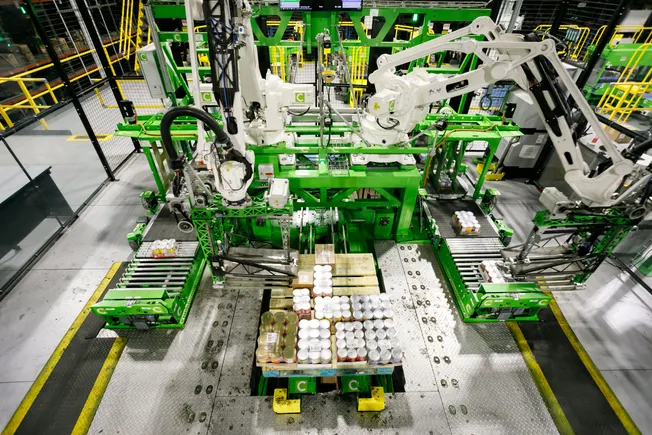
Walmart announces supply chain automation investments will peak this year and next, with 23 distribution centers undergoing automation retrofits and 60% of U.S. stores benefiting from smart logistics systems, significantly improving inventory management efficiency.
Walmart’s Supply Chain Automation Strategy Enters Critical Phase
Walmart, the world’s largest retailer, recently announced that its supply chain capital investments will “probably peak this year and next year,” with increasing use of automation being a key component of that spending. President and CEO John Furner stated on an earnings call that the company is accelerating automation retrofits across its distribution centers to improve operational efficiency and reduce costs.
Key Data: In the U.S., 23 of Walmart’s 42 regional distribution centers are currently being retrofitted with automation, with the eventual goal of upgrading all locations. Approximately 60% of Walmart’s U.S. stores now receive a portion of their freight from automated distribution centers, and roughly half of e-commerce fulfillment center volume is automated.
Core Objective: Reducing Marginal Costs Through Automation
Executive Vice President and CFO John David Rainey emphasized that technology-enabled productivity benefits are critical to Walmart’s ability to grow its core omni business at lower marginal cost. Automation not only helps limit shipping costs but also significantly improves inventory management efficiency.
Walmart’s global inventory increased by 2.6% year over year in Q4, about half the rate of sales growth—what Furner called “an impressive number” aided by automation. Through automation, Walmart has been better able to manage its two largest expenses: inventory and labor costs.
Technology Innovation: From Sensors to Computer Vision
Walmart’s supply chain automation investments span multiple cutting-edge technologies. The company has deployed inventory-tracking sensors providing automated alerts and equipped distribution centers with robotics to boost shipping capacity and speeds. More importantly, over 1 million U.S. associates now have handheld devices using computer vision to map inventory, knowing exactly what they have, where it is, and how it’s deployable.
These technological innovations enable stores to play a growing role as fulfillment nodes in Walmart’s supply chain. Due to their proximity to customers, stores enable faster delivery speeds on online orders. In Q4, Walmart delivered 35% of store-fulfilled orders in under three hours.
International Expansion: Automation Technology Goes Global
Beyond automation upgrades in the U.S. market, Walmart is also in the early stages of deploying supply chain automation in select international markets. John David Rainey revealed on the call that the company is in the early phases of international automation deployment, marking the globalization of Walmart’s automation strategy.
This international expansion has significant implications for Walmart’s competitive position in the global retail market. By replicating automation models proven successful in the U.S. to other markets, Walmart aims to achieve comprehensive operational efficiency improvements worldwide.
Industry Impact: Accelerating Retail Supply Chain Automation Trends
Walmart’s automation investments reflect the broader trend of supply chain transformation across the retail industry. As labor costs rise and consumer expectations for delivery speeds increase, traditional retailers are ramping up automation technology investments. As an industry leader, Walmart’s large-scale automation practices set a benchmark for the entire sector.
Analysts note that Walmart’s automation strategy not only affects its own operational efficiency but may also drive technology upgrades across the entire supply chain ecosystem. Suppliers, logistics partners, and related technology providers will all benefit from this trend.
Future Outlook: Long-term Value of Automation Investments
Although automation investments will peak over the next two years, their long-term value will continue to be realized. Furner emphasized that Walmart’s enterprise portfolio is anchored in growth, especially digital channels, with an emphasis on having inventory close to the customer to maximize delivery speed. Automation technology will be key to achieving this strategic objective.
As automation technology matures and its application scope expands, Walmart is poised to further enhance customer experience while maintaining cost advantages, solidifying its leadership position in the global retail market.
Source: Supply Chain Dive


