

Returning Six Years After Bankruptcy, This Boston-Based Company Prepares to Launch New Collaborative Industrial Robots
Six years ago, Boston-headquartered Rethink Robotics attempted to sell industrial robots that could work alongside humans but eventually went bankrupt.
But now Rethink is back. The once-prominent company has been acquired by a German industrial firm and plans to return to Boston with an entirely new line of collaborative robots or “cobots,” which bear little resemblance to Rethink’s original machinery.
“We are currently looking for a location where our employees can work,” said Julia Astrid Riemenschneider, Vice President of Business Development at United Robotics Group, Rethink’s parent company. Currently, Rethink has set up temporary offices in the MassRobotics innovation center in Seaport District and is recruiting talent in robotics and software development.
Rethink was a sensation when it started. Founded in 2008 as Heartland Robotics, the company received $150 million in funding from General Electric, Goldman Sachs, and Jeff Bezos, founder of Amazon.com. Its co-founder Rodney Brooks is a professor at MIT and also a co-founder of iRobot, the first robotics company to profit from selling consumer automatic vacuum cleaners (Brooks declined to comment).
Based partly on Brooks’ research at MIT, Rethink developed robotic arms equipped with electric motors that would stop immediately upon contact with an obstacle, making the robots safe enough to work alongside humans. The company built two robot systems based on this technology.
However, industrial clients were not convinced. They wanted Rethink’s robotic arms for precise operations such as welding, metal cutting, mechanical assembly, or packaging finished goods. Rethink’s safety mechanism included shock-absorbing springs to mitigate the impact of accidental collisions. Unfortunately, these springs caused slight bending in the robot arm, making it unsuitable for many industrial tasks that required high precision.
Meanwhile, several other companies launched more successful designs. This includes industry leader Universal Robots, a Danish company owned by North Reading’s Teradyne. Since its founding in 2005, Universal Robots has sold over 75,000 collaborative robots.
By 2018, Rethink had run out of funds and customers. The company sold its intellectual property to Germany’s Hahn Group, which formed United Robotics Group to market collaborative robots.
“We saw that this [Rethink] robot was very different from all the other robots on the market at the time with great potential,” said Riemenschneider. However, when United tried to promote these robots, they faced the same issues as Rethink. “We quickly realized that the product wasn’t robust enough for industrial environments,” she added.
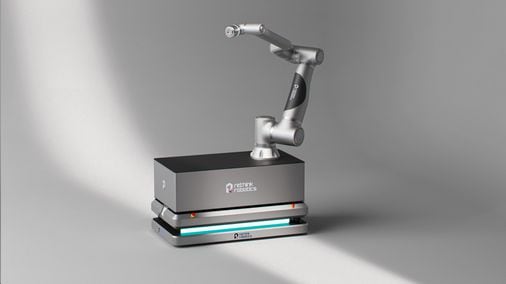
Therefore, the company developed an entirely different product line and unveiled it last week at a robotics trade show in Chicago. The products include an independent robotic arm and an autonomous mobile vehicle equipped with an arm on top, which can move from one workstation to another within a factory. It is suitable for various tasks ranging from shelf stocking to mechanical assembly.
Riemenschneider stated that Rethink’s robots will be manufactured in Germany. However, if there is sufficient demand for these robots, final assembly may eventually shift to the U.S.
Hiawatha Bray can be reached at (email address removed). Follow him on @GlobeTechLab.
Source: BostonGlobe.com


