

Efforts by Mature and Emerging Enterprises in Developing Robust Digital Tools Are Influenced by Market Demand and Technological Innovation
The Transformation of Freight Brokerage by Generative AI
Established brokerage firms adapt to evolving technology and economic downturn challenges.
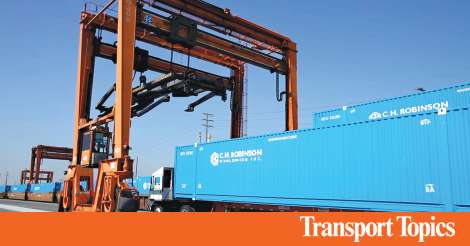
C.H. Robinson has automated “almost every step in the transportation process” with generative AI. (C.H. Robinson)
With news of new tech-first players entering the digital freight brokerage space, market demand and technological innovation—including artificial intelligence, particularly generative AI—are shaping efforts by both established and emerging firms to develop robust digital tools, experts say.
Executives at Atlantic Logistics, C.H. Robinson, and Echo Global Logistics indicate that technology has always been a critical component of their operations, continuously developing and refining proprietary and acquired software systems. C.H. Robinson and Echo Global Logistics rank 2nd and 22nd respectively on the North America’s largest logistics companies list in Transport Topics Top 100.
“Echo and other companies—these incumbents—have been digital for years,” Doug Waggoner, CEO of Echo Global Logistics, told Transport Topics, referring to firms like J.B. Hunt and C.H. Robinson. “We have optimized our processes from quoting to sending invoices to clients and everything in between.” J.B. Hunt ranks 3rd on the North America’s largest operating carriers list in Transport Topics Top 100.
Waggoner and others note that the speed and nature of digitalization are changing. “While we do it organically, now there are third-party software companies building pools of tools that small brokers can use,” he said, adding that these companies are creating effective solutions. Waggoner also pointed out that the emergence of such technology is driving further automation across the brokerage industry.

Waggoner
Brokers believe that when digital companies enter their industry and grab the spotlight, their technological sophistication is overlooked. Echo Global Logistics founders come from a tech background, with most software engineers hailing from Google, Amazon, and Microsoft, Waggoner noted.
“I just want to formally state that we believe we are the original veterans,” he joked.
Tech Leadership
Megan Orth, Senior Director of Digital Connections at C.H. Robinson, explains that in terms of digital freight brokerage, industry incumbents have already embarked on long-term and ongoing digitization and automation projects.
“The consolidated freight industry is one of evolution rather than revolution or disruption,” she said via email. “Unlike other industries where digital startups successfully captured the market, in freight, they encountered participants who were already well-technologized.”
Orth points out that Airbnb gained dominance by digitally connecting small business owners (those with B&B, small hotels, or rental rooms). In freight, companies like C.H. Robinson had been digitally connecting extensive carrier and shipper networks long before purely technological freight brokers emerged. “A common misconception is that startups invented freight technology,” Orth said. “They entered the freight tech space after us, not vice versa.”
Orth added that any technology used for smarter decision-making relies on large datasets.

Orth
“Over time, the more data you add shows, the more tools learn and become smarter,” she said. “Our Navisphere platform captures 19 million freight transactions annually.”
Orth noted that C.H. Robinson has automated “almost every step in the transportation process” with generative AI.
“Generative AI is used to handle large amounts of data and create new content—such as translating languages or generating email responses,” she said, adding that even the most tech-savvy shippers still prefer doing business through quick email exchanges, which means someone must read and reply to these emails. “Within a workday, we receive over 11,000 emails requesting truck freight quotes. This is just one type of email.”
Orth explained that C.H. Robinson’s technology categorizes incoming emails, reads them, and replicates the steps a person would take to meet customer needs. The technology responds to more than 2,000 quote request emails daily—sometimes over 3,000—automating any transaction conducted via email.
Orth reported that generative AI also helps C.H. Robinson “unlock value from the 500,000 unstructured data points we receive daily.”

“Echo and other companies—these incumbents—have been digital for years,” Doug Waggoner, CEO of Echo Global Logistics, said. (Echo Global Logistics)
Unstructured data, such as text files, images, and videos, is described as “data that cannot be neatly organized into rows and columns,” making it more challenging to organize and analyze for both computers and humans.
Nathan Lease, a Research Vice President at Gartner, noted in回顾货运经纪事件时,Gartner的研究高级总监Nathan Lease指出,几年前,数字货运网络是想要革命市场的数字经纪公司。他认为,货车市场的规模、分散性和复杂性使其“不是单凭技术就能革命化的”。(此处翻译不完整,请继续提供剩余的中文文本以完成翻译)


