

Visual Capitalist Collaborates with Greenbrier to Explore U.S. Railway Freight Trends and Key Commodities Transported in 2023
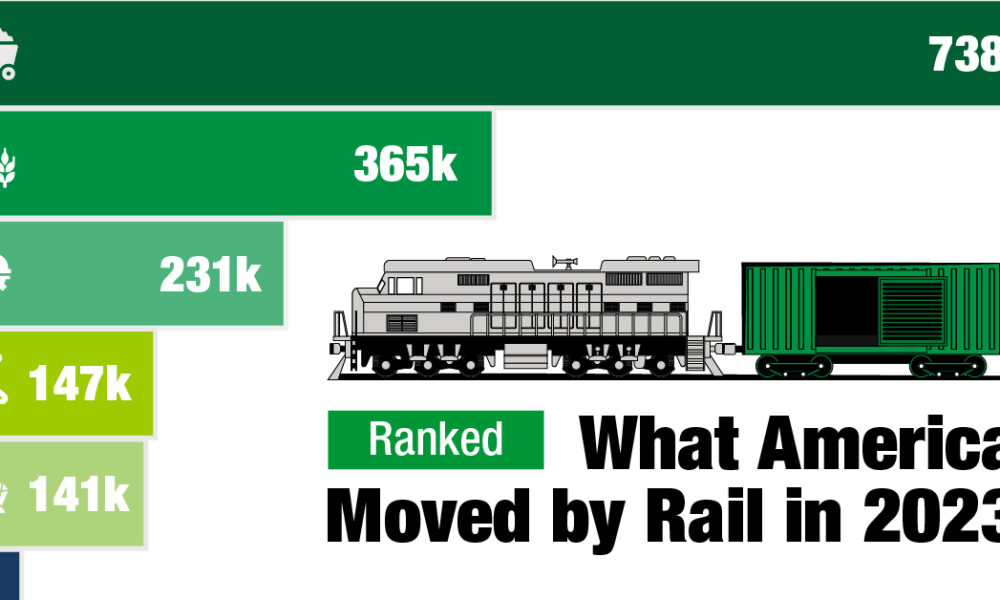
Ranking: Freight Transported by Rail in the USA in 2023
Published on
September 24, 2024
Author
Alan Kennedy
Ranking: Freight Transported by Rail in the USA in 2023
Rail freight is a cornerstone of U.S. infrastructure, transporting millions of tons of various materials and connecting numerous ports and cities across the nation to facilitate domestic and international trade.
So what material was transported most via rail in the United States in 2023?
To answer this question and explore the importance of railways to the U.S. economy, Visual Capitalist collaborated with The Greenbrier Companies to create this infographic.
What Does American Rail Freight Transport?
Multimodal capability is one of the greatest advantages of rail transport. In 2023, rail freight transported nearly 18 million tons of various materials across a network spanning over 140,000 miles—from wood and chemicals to automotive parts and waste products.
However, energy products, particularly coal, oil, and natural gas, were the most transported materials.
| Ranking | Category | Transport Weight (Metric Tons) |
|---|---|---|
| 1 | Petroleum, Coal, and Natural Gas | 738,000 |
| 2 | Agricultural Products | 365,000 |
| 3 | Building Materials | 231,000 |
| 4 | Chemicals | 147,000 |
| 5 | Minerals | 141,000 |
| 6 | Lumber, Pulp, and Paper | 61,000 |
| 7 | Waste Products | 42,000 |
| 8 | Vehicles and Parts | 23,000 |
| 9 | Other | 14,000 |
| Total | 1,762,000 |
Note: Categories are classified and simplified according to the Bureau of Transportation Statistics. Data is rounded to the nearest thousand. The “Other” category includes but is not limited to electronics, precision instruments, and miscellaneous goods.
Why Choose Rail?
Rail transport is a highly versatile mode that promotes growth in many industries and across the entire U.S. economy by serving as a link between trucking and maritime shipping.
However, rail’s safety record and sustainability make it stand out.
Data from the Federal Railroad Administration shows that since 2000, railway accident rates have decreased by 27%, with accidents involving hazardous materials falling by 75%.
Despite transporting 40% of long-haul freight, rail accounts for only 1.8% of greenhouse gas emissions in the U.S. transportation sector. This is due to its high fuel efficiency and continuous improvement in performance.
In fact, in 2023, American railways reduced fuel consumption by 709 million gallons compared to 2000.
Transporting Essential Goods
Railways play a critical role in supporting many U.S. industries by transporting various materials domestically and connecting ports to facilitate international trade.
The Greenbrier Companies, with over 120 years of history, has become a global leader in freight rail wheel services, maintenance, and parts, ensuring railways keep the economy running smoothly.
Interested in how railways can serve your business?

Learn about rail advantages
Source: Visual Capitalist


