

Walmart Continues Efforts to Equip Entire RDC Network with Robotics and Software Automation
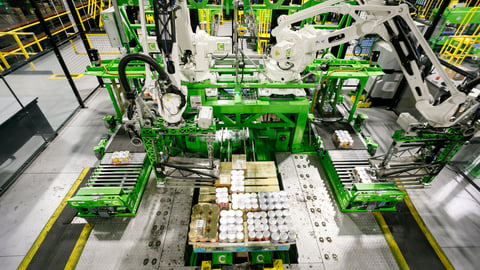
The automation system at Walmart’s regional distribution centers.
Walmart is continuing its efforts to equip its entire network of regional distribution centers with robotic and software automation systems.
In an email to Chain Store Age, Walmart stated that it plans to install high-tech automated equipment provided by AI supply chain technology company Symbiotic LLC at two of its Regional Distribution Centers (RDCs) in Buckeye, Arizona, and Siloam Springs, Arkansas.
The two projects will be completed in phases over several years as part of the larger RDC initiative launched by the discount giant in July 2021 and expanded to include all 42 RDCs in May 2022.
[Read More: Walmart Expands Regional Distribution Automation Strategy]
Walmart says that the new technology doubles the number of cases processed per hour compared to traditional RDCs. By the end of 2025, approximately 65% of stores are expected to receive goods from high-tech distribution centers.
The Buckeye RDC has been in operation for nearly 25 years. In Arizona, Walmart operates three distribution centers, 124 retail stores, and employs over 37,600 employees.
The Siloam Springs RDC has been operational for almost 35 years. In Arkansas, Walmart runs eight distribution centers, 131 retail stores, and employs 55,660 staff members.
How RDC Automation Works
Walmart’s RDC automation plan is part of a broader digital transformation effort in its supply chain aimed at increasing the speed, efficiency, and security of product flow.
Since 2017, Walmart has been collaborating with Symbotic to optimize automated technology solutions for sorting, storing, retrieving, and loading goods onto pallets at its distribution center in Brookswood, Florida.
Under Walmart’s traditional manual system, products arriving at an RDC are either cross-docked or manually stored. When products need to be sent to stores, they are manually loaded into a 53-foot trailer for transportation. Upon arrival at the store, employees manually unload and place items in their proper locations.
With automation provided by Symbotic’s solution, an algorithm determines how to use high-speed mobile robots to store boxes like pieces of a puzzle, reducing inbound processing time and improving storage accuracy for future orders.
The solution combines AI-driven software systems with robotics and automation to sort, store, retrieve, and load goods onto pallets before shipping them to stores. The aim is to speed up product shelf placement.
According to Walmart, the system transforms existing RDCs into high-density automated facilities that offer faster inbound processing, higher inventory accuracy, and a doubling of building capacity. The RDC renovation model reduces unloading time by creating pallets tailored to store and aisle requirements, saving store employees’ time.
Walmart is headquartered in Bentonville, Arkansas, and operates over 10,500 stores and numerous e-commerce sites across 19 countries.
Related Retail News
- Walmart Opens New High-Tech Perishables Distribution Center
Walmart continues to follow its grocery transformation plan.
- Walmart Transforms Grocery Business with Advanced Fulfillment Systems
Walmart is constructing, expanding, and renovating fulfillment centers equipped with next-generation technology capabilities to enhance its grocery supply chain and maintain its leadership in the grocery sector.
Source: Chain Store Age


