Skip to content

Strategy & Planning · Supply Chain · Warehousing · Warehousing & Transport

Reflex Robot 20 Times Cheaper Than Competitors and Masters New Skills in 60 Minutes – The Times HUB

GXO Enhances Productivity and Reduces Costs with Reflex Robotics for Automated Warehouse Operations

Original source: Source information pending

Reflex Robot 20 Times Cheaper Than Competitors and Masters New Skills in 60 Minutes – The Times HUB
📋 本文要点

GXO Enhances Productivity and Reduces Costs with Reflex Robotics for Automated Warehouse Operations

[Technology]

# Reflex Robots Are 20 Times Cheaper Than Competitors and Learn New Skills in 60 Minutes

![Natasha Kumar](https://thetimeshub.in/wp-content/uploads/2024/05/LLAqhZjVS2k-150×150-1.jpg) By Natasha Kumar Sep 26, 2024

![](https://thetimeshub.in/wp-content/uploads/2024/09/robot-reflex-u-20-raziv-deshevshij-za-konkurentiv-i-navchayetsja-novih-navichok-za-60-hvilin-9eacb34.jpg)

## GXO Uses Reflex Robotics to Automate Warehouse Operations, Boost Productivity and Reduce Costs

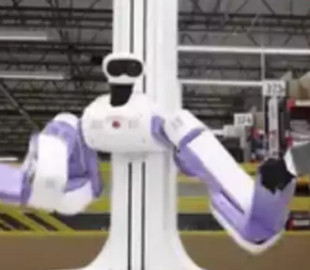
GXO, a leading global logistics solutions provider, has started using robots from Reflex Robotics in its warehouses, significantly accelerating the automation of daily operations.

Reflex Robotics’ robots are designed to perform routine warehouse tasks such as moving goods, picking orders, and restocking inventory. Equipped with machine learning systems, they can quickly adapt to new tasks by observing human actions. Consequently, these robots become fully autonomous within an hour of operation, making them one of the most efficient technologies on the market. Additionally, their cost is only a twentieth of similar humanoid robots, significantly reducing automation expenses.

Reflex Robotics’ robots are used under a “Robotics as a Service” (RaaS) model, allowing companies to subscribe to services rather than purchasing expensive systems. The subscription fees for these robots are half that of labor costs, making them financially viable solutions for large warehouses. Furthermore, the robots can be remotely controlled by operators to efficiently perform more complex tasks.

GXO is actively testing these robots in its “Operations Incubator” program, collaborating with developers to adapt the latest technologies to real-world conditions. In a pilot project, Reflex Robotics’ robots were deployed in a large Fortune 100 retailer’s warehouse and demonstrated the efficiency of automated systems.

Reflex Robotics’ robots are developed by a team of MIT engineers with experience from Tesla, Boston Dynamics, and Amazon, based in New York. Their design focuses on creating affordable universal solutions for automating warehouses and production processes. Unlike most humanoid robots, Reflex robots are significantly cheaper and easier to use, facilitating large-scale implementation.

The collaboration between GXO and Reflex Robotics aims to promote these robots globally to enhance productivity and address labor shortages in the logistics industry. Ritesh Raghavender, CEO of Reflex Robotics, noted that their work has shown significant potential to transform logistics processes and thanked GXO for providing an opportunity to implement projects.

![Natasha Kumar](https://thetimeshub.in/wp-content/uploads/2024/05/LLAqhZjVS2k-150×150-1.jpg)

#### By Natasha Kumar

Natasha Kumar has been a reporter at the news station since 2018. Prior to that, she wrote articles for Styles on adolescence and family dynamics and served as a legal affairs reporter for the Metro desk. Before joining The Times Hub, Natasha Kumar was a contributing writer for Village Voice and a freelance writer for Newsday, The Wall Street Journal, GQ, and Mirabella.

—

Source: The Times HUB

Ask SCI.AI Finished reading? Continue with SCI.AI. Explore the related policy, route, company and historical context. Continue asking
NRF: Early peak shipping season to subside in September
Supply Chain

NRF: Early peak shipping season to subside in September

The National Retail Federation (NRF) and Hackett Associates report that the early peak shipping season is ending, with U.S. port imports expected to decline for the rest of 2026. May was the busiest month at 2.24 million TEU. Tariff changes and supply chain disruptions drove retailers to pull forward orders. Consumer spending remains resilient. Full-year 2026 imports are projected at 25.5 million TEU, up 0.1% from 2025.

China’s exports rise 14%, imports up 22% amid trade war resilience
Supply Chain

China’s exports rise 14%, imports up 22% amid trade war resilience

China’s foreign trade rose 17.3% to ¥30.13 trillion in the first seven months of 2026, with exports up 14% and imports surging 22%. High-tech exports jumped over 50% in July, accounting for nearly 60% of monthly export growth. U.S.-China trade fell 1.6%, while ties with over 180 countries—including ASEAN and the EU—expanded. Green exports like EVs and lithium batteries posted double-digit growth for the 17th straight month. China also applies zero tariffs to imports from 63 countries.

TSMC revenue up 33.7%, ASML ships 86 lithography machines
Manufacturing

TSMC revenue up 33.7%, ASML ships 86 lithography machines

TSMC reported $40.2 billion in Q2 2026 revenue — up 33.7% year-on-year — with 2-nm process contributing 3% of sales. ASML shipped 86 new lithography machines in the same quarter, boosting revenue to €9.32 billion ($10.69 billion). TSMC holds 73% of the global foundry market, while ASML’s EUV tools remain essential for sub-3-nm chip production. Both companies’ five-year net income grew over 90% (ASML) and 251% (TSMC). TSMC’s $100 billion Arizona expansion will support 2-nm manufacturing and advanced packaging.

Welcome Back!

Login to your account below

Create New Account!

Fill the forms below to register

Retrieve your password

Please enter your username or email address to reset your password.

Scan to share via WeChat

Open WeChat and scan the QR code to share

QR Code

Add New Playlist