

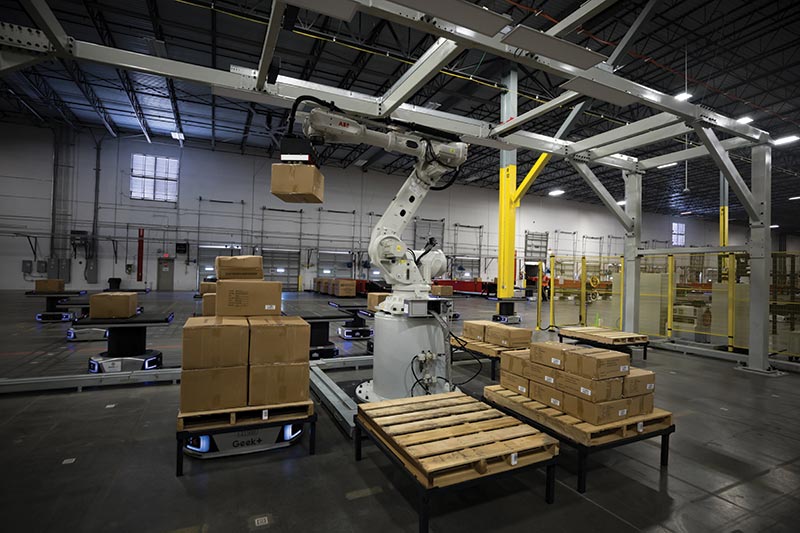
Five Key Robot Systems Collaborate at SHIP8 INC's Automated Distribution Center, Syncing with Small Teams of Staff at Specific Process Stages
# Multiple Robot Systems Flexibly Handle Peak and Fulfillment Processes at SHIP8 Inc.
## At SHIP8 INC.’s Automated Fulfillment Center, Five Key Robotic Systems Collaborate with Small Teams of Staff in Selected Areas.
Author: Roberto Michel October 3, 2024
SHIP8 INC., located in Port Wentworth, Georgia, operates an 11-million-square-foot automated facility that processes over 10,000 unique home textiles SKUs. The workforce ranges from 25 to 35 employees working eight hours a day, five days a week, with additional personnel or extended hours during peak seasons.
SHIP8 INC.’s systems include Autonomous Mobile Robots (AMRs) and smart industrial robotic arms for automated picking and placing tasks. Most goods arrive in floor cartons destined for shipping containers. Incoming cartons are unloaded at one of 13 loading docks equipped with telescopic conveyors. Staff place the items on these conveyors, which automatically move the boxes to mobile sortation AMRs. The boxes then pass through scanning tunnels located near the docks where ground-level mobile robots handle sorting, data collection, and movement.
Once scanned in the tunnel, incoming cartons are directed to one of four industrial robotic workstations. Each articulated robot arm is capable of picking and placing boxes using visual/AI technology. Depending on the fulfillment needs for matching inbound cartons with full-case outbound orders, these robotic units can be allocated for pallet stacking or for selecting full cases for outbound orders to be handed over to mobile sortation AMRs.
For inbound processes requiring robotic pallet stacking, larger AMRs then move the palletized goods to an automatic strapping machine for unitization storage.
The AMRs then transport the strapped pallets to a four-aisle robotic shuttle system that occupies most of the automated facility’s central area. This shuttle system has 27,000 storage locations across four levels. The ground level is an open area used for goods sorting and mobile robot shuttling; this Automated Storage and Retrieval System (AS/RS) allows robots to move vertically or horizontally within the storage infrastructure.
AMRs unload inbound pallets at transfer positions near the four vertical lifts of the shuttle system. Below the shuttle system, goods are sorted in preparation for upcoming pick-and-fulfillment workflows. Some items retrieved from the shuttle system replenish an AMR-based shelf-to-person system, while some palletized goods from the shuttle system are moved by AMRs to one of four robotic arms for automated picking of full-case outbound orders.
The mobile sortation robots then move these specific boxes through a print and label station located in the ground-level mobile robot processing area before transporting them to the correct loading dock for outbound loading and carrier pickup.
Below the shuttle system, some cartons are also broken down and placed onto mobile racks/shelving units for use by nearby shelf-to-person robotic systems. Larger AMRs slide under these shelving units and transport them to one of four illuminated pick stations equipped with tablet screens and scanning devices to guide and verify picking steps and accuracy.
Employees at the workstations barely need to move, placing picked items from shelves onto adjacent rows of mobile, illuminated sort walls. Once a full order or series of orders is completed on a sort wall, the picker presses a button, and an AMR arrives to transport the sort wall to one of 19 manual packing stations, though not all are used even during non-peak times.
After orders are completed at the packing stations, mobile sortation robots retrieve the finished orders through an automated print and label station in the AMR processing area before transporting them to the correct loading dock for outbound loading and carrier pickup. At the docks, telescopic conveyors are used for loading outbound goods and parcels.
These workflows and fulfillment processes are integrated and coordinated via SHIP8’s warehouse management system software with the robotic systems.
## System Suppliers
– Sortation AMRs, larger AMRs, shelf-to-person system, and robotic pallet shuttle AS/RS: Geekplus
– Systems Integration & Design: BlueSkye Automation
– Additional Integration: Oneiro Technologies
– Telescopic Conveyors: Caljan
– Industrial Robotic Arms: ABB Robotics
– AI/3D Vision Software: Mech-Mind
– Automatic Strapping System: Plasticband
– Scanning Tunnel Imager: Cognex
– Print & Labeling: Panther
—
Source Website: Modern Materials Handling


