Skip to content

AI & Automation · Strategy & Planning · Supply Chain · Technology

Integrating Robots and Drones for Food Delivery

We Are Indeed Racing Towards the Future: Serve Robotics Manufactures Sidewalk Delivery Robots

Original source: Source information pending

Integrating Robots and Drones for Food Delivery
📋 本文要点

We Are Indeed Racing Towards the Future: Serve Robotics Manufactures Sidewalk Delivery Robots

# Combining Robots and Drones for Food Delivery

Author: Rain Noe
– October 3rd

Category: [Tech](https://www.core77.com/Tech?utm_source=from_tags) | [Food](https://www.core77.com/Food?utm_source=from_tags)

Ladies and gentlemen, we are rapidly heading towards the future.

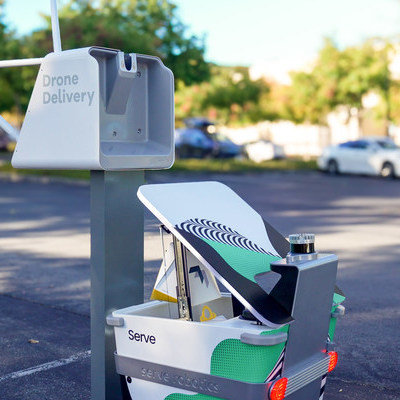
A company called Serve Robotics manufactures these sidewalk delivery robots.

Restaurant staff load items into the robot, which then autonomously delivers them to your building. Although these robots have a delivery range of up to 25 miles, they do not travel fast, with a top speed of only 6 mph, making them most suitable for deliveries within a two-mile radius.

However, this company has now partnered with drone delivery provider Wing Aviation. Under this arrangement, Serve’s robots transport the delivery items to nearby Wing Autoloader stations, where Wing’s drones take over and swiftly fly the orders to your building.

Dr. Ali Kashani, CEO of Serve, states that this means they can offer “city-wide automatic deliveries within 30 minutes.”

Other advantages:

> **- Speed:** Wing’s drones can fly over traffic congestion while Serve’s robots operate solely on sidewalks, thus avoiding street traffic altogether.

> **- Cost-effective:** Drones and robots reduce delivery costs for both operators and consumers, eliminating the need to pay tips.

> **- Environmentally friendly:** Both Wing and Serve are fully electric, reducing vehicle emissions associated with food deliveries while also decreasing traffic volume and congestion.

> **- Safety:** By reducing the number of vehicles on the road, Serve and Wing help lower the incidence of traffic accidents.

> **- Convenience:** Curbside robot package pickup allows businesses to use drone delivery without modifying their facilities or installing new equipment.

The two companies state they will roll out this arrangement in “the coming months,” though no specific locations have been mentioned. (Let me guess: San Francisco.)

—

Source Website: Core77

Ask SCI.AI Finished reading? Continue with SCI.AI. Explore the related policy, route, company and historical context. Continue asking
NRF: Early peak shipping season to subside in September
Supply Chain

NRF: Early peak shipping season to subside in September

The National Retail Federation (NRF) and Hackett Associates report that the early peak shipping season is ending, with U.S. port imports expected to decline for the rest of 2026. May was the busiest month at 2.24 million TEU. Tariff changes and supply chain disruptions drove retailers to pull forward orders. Consumer spending remains resilient. Full-year 2026 imports are projected at 25.5 million TEU, up 0.1% from 2025.

China’s exports rise 14%, imports up 22% amid trade war resilience
Supply Chain

China’s exports rise 14%, imports up 22% amid trade war resilience

China’s foreign trade rose 17.3% to ¥30.13 trillion in the first seven months of 2026, with exports up 14% and imports surging 22%. High-tech exports jumped over 50% in July, accounting for nearly 60% of monthly export growth. U.S.-China trade fell 1.6%, while ties with over 180 countries—including ASEAN and the EU—expanded. Green exports like EVs and lithium batteries posted double-digit growth for the 17th straight month. China also applies zero tariffs to imports from 63 countries.

TSMC revenue up 33.7%, ASML ships 86 lithography machines
Manufacturing

TSMC revenue up 33.7%, ASML ships 86 lithography machines

TSMC reported $40.2 billion in Q2 2026 revenue — up 33.7% year-on-year — with 2-nm process contributing 3% of sales. ASML shipped 86 new lithography machines in the same quarter, boosting revenue to €9.32 billion ($10.69 billion). TSMC holds 73% of the global foundry market, while ASML’s EUV tools remain essential for sub-3-nm chip production. Both companies’ five-year net income grew over 90% (ASML) and 251% (TSMC). TSMC’s $100 billion Arizona expansion will support 2-nm manufacturing and advanced packaging.

Welcome Back!

Login to your account below

Create New Account!

Fill the forms below to register

Retrieve your password

Please enter your username or email address to reset your password.

Scan to share via WeChat

Open WeChat and scan the QR code to share

QR Code

Add New Playlist

