

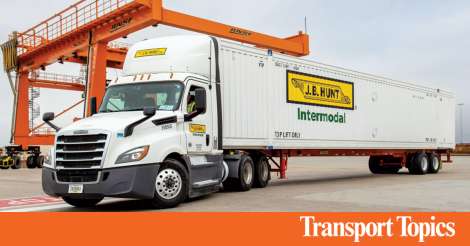
J.B. Hunt Transport Services Sees Profit Decline in Q3 2024 but Beats Analysts' Expectations with Year-over-Year Freight Volume Growth
J.B. Hunt’s Q3 Profits Exceed Expectations, Shares Rise
========================================================
Intermodal Volumes Up 5%, but Simpson Says Market Remains Challenging
J.B. Hunt Transport Services reported a decline in profits for the third quarter of 2024, yet still exceeded analyst expectations due to an increase in intermodal volumes year-over-year.
The Lowell, Arkansas-based transportation company’s data released after market close on October 15 showed that Q3 profits were $152.1 million, with earnings per share (EPS) at $1.49, down from $187.4 million and EPS of $1.80 in the same period last year, representing an 18.8% decline.
On October 16, shares rose by about 5% during the first hour of trading as its earnings surpassed both EPS and revenue expectations.
According to a Zacks Equity Research report, analysts had expected EPS of $1.42 and total revenues of $3.01 billion. The research firm also noted that the company has exceeded revenue estimates in two out of the past four quarters.
In the most recent quarter, total revenues amounted to $3.07 billion, a 3% decrease from $3.16 billion in Q3 2023.
J.B. Hunt attributed the decline in revenues primarily to a decrease of 5% and 6% respectively in gross revenue per load for its intermodal (JBI) and truckload (JBT) segments; a drop of 10% and 6% in loads for its integrated capacity solutions and dedicated contract services (DCS) segment; and a reduction of 6% in the number of stops in last-mile operations.
“We continue to navigate through a challenging freight environment while focusing on costs we can control, delivering exceptional service to our customers, preparing them for their future transportation needs, and always prioritizing safety,” Shelley Simpson, CEO, said during an analyst call after market close on October 15.
“As discussed last quarter, we are seeing a return to a more normal seasonal demand pattern, which has been evident across all our businesses in Q3,” she added.
J.B. Hunt ranks third among North America’s top carriers in the Transport Topics Top 100 list and second in truckload/dedicated contract services while ranking first in intermodal/short-haul market segments. It also ranks third on TT’s Top 100 Logistics Providers list.
The company’s JBI segment reported stable revenues of $1.56 billion for Q3. Year-over-year, volumes grew by 5% to 547,988, up from 521,221 in the same period last year.
“Overall, we saw momentum accelerate into Q3 as our total volume increased by 5%, slightly above normal seasonality,” said Darren Field, president of intermodal, addressing analysts.
“The growth in Q3 was primarily driven by a 7% increase in our cross-country network, with double-digit growth again this quarter out of Southern California and a 3% increase on the East Coast. On a month-to-month basis, our total volume grew by 7% in July, 4% in August, and also 4% in September,” Field said.
“On the East Coast, we continue to compete directly with one-way truckload, but as shown by the overall improvement in volumes this quarter, we are starting to win back some of our customers’ freight due to strong service levels and ability to meet their capacity needs,” he added.
Meanwhile, the company’s DCS segment reported revenues of $846 million for Q3, a 5% decrease from $892.3 million in the same period last year.
By the end of Q3, the fleet within this division had 498 fewer revenue-generating trucks compared to the same time last year and was down by 128 trucks from the end of Q2 2024.
“Despite discussing how customer bankruptcies have pressured our fleet size, we remain disciplined in adhering to our underwriting return thresholds. We believe the market remains stable with significant opportunities for future growth,” said Nicholas Hobbs, COO, during the call.
“In Q3, we sold 258 trucks for new transactions, some of which we expect to sign overflow contracts into Q4 due to timing issues,” Hobbs noted. “Our sales pipeline is still strong, and our teams have worked hard to fill most of the truck losses we experienced this year.”
“Over the past two quarters, we’ve made significant progress in customer sites and new truck startups, which has impacted our margins as mature operations are replaced by newer, less mature ones,” he added.
Regarding the company’s JBT truckload business, revenues for the last three months decreased 12% to $173 million year-over-year.
“Overall volume trends across this division have slightly improved nationwide with some tightness in certain regions typically or should be expected at month and quarter ends,” said Spencer Frazier, executive vice president of sales and marketing, addressing analysts.
“While overall road capacity remains abundant in the market, some customers are beginning to use more bidding to fill out-of-cycle capacity needs,” Frazier noted.
“There is growing interest in increasing cooperative, long-term planning discussions about business strategy. Historically, both types of engagement have indicated a move toward supply-demand balance,” he optimistically pointed out.
—
Source Website: Transport Topics


