

A Swiss Re Corporate Solutions report reveals that while 43% of EU Fortune 500 companies assess physical risk to their own facilities, only 7% extend such assessments to supplier sites—and fewer than 2% evaluate wider infrastructure dependencies. The report, 'Emerging Risks: Hidden Dependencies in Global Supply Chains,' warns that business interruption increasingly stems from third-party vulnerabilities, citing the Middle East conflict as the fourth major global supply shock in six years. Adrian Hall, US CEO of Swiss Re Corporate Solutions, emphasizes that supply chain resilience now hinges on visibility beyond corporate boundaries.
According to www.dcvelocity.com, a Swiss Re Corporate Solutions report warns that supply chain disruption increasingly originates not from a company’s internal operations—but from vulnerable suppliers, infrastructure providers, and third-party logistics partners.
Hidden Dependencies Drive Business Interruption Risk
The Zurich-based insurer’s report, titled “Emerging Risks: Hidden Dependencies in Global Supply Chains,” identifies a critical gap in enterprise risk management. While companies have invested heavily in fortifying their own facilities against climate events, geopolitical shocks, and infrastructure failures, they routinely overlook dependencies outside their direct control. As Adrian Hall, US CEO of Swiss Re Corporate Solutions, stated:
“Businesses have become much better at understanding the risks to their own facilities. The next challenge is understanding the dependencies beyond their own operations that can determine whether they recover quickly or face prolonged disruption.” — Adrian Hall, US CEO, Swiss Re Corporate Solutions
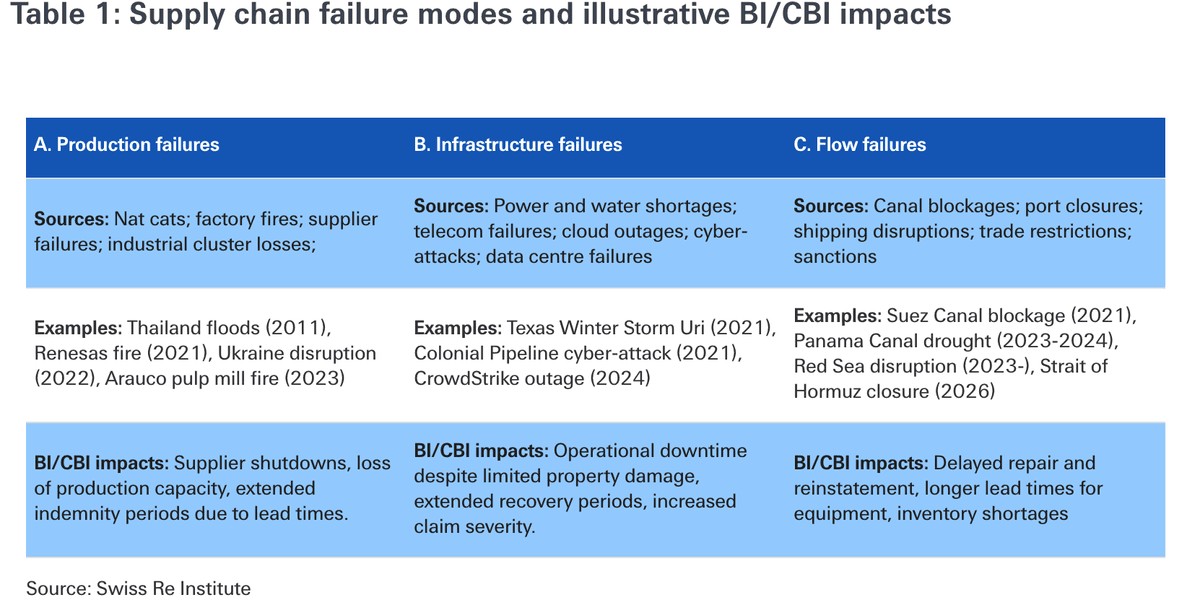
The report underscores how interconnected modern supply chains are: a power outage at a Tier-2 semiconductor supplier in Taiwan, a port closure in the Red Sea, or rail congestion in Eastern Europe can cascade across continents—delaying repairs, halting production lines, and triggering contingent business interruption (CBI) losses far from the original incident site.
Assessment Gap: 43% vs. 7% vs. 2%
Quantitative findings reveal stark disparities in risk assessment scope. According to the report, 43% of Fortune 500 companies headquartered in Europe assess physical risk to their own facilities—but only 7% publicly disclose extending those assessments to supplier facilities. Even more critically, fewer than 2% report evaluating the broader infrastructure they rely on—including electricity grids, transport hubs, and customs clearance systems.
This data gap leaves enterprises exposed: when the Middle East conflict escalated in early 2026, it became the fourth major global supply shock within six years—following the Suez Canal blockage, the Ukraine war’s Black Sea shipping disruptions, and pandemic-era port congestion. Each event triggered cascading delays in equipment replacement, raw material inputs, and finished-goods distribution—amplifying insured business interruption (BI) and CBI losses.
Data Deficiency Undermines Resilience Modeling
Swiss Re notes that advanced tools now exist to model downtime and infrastructure interdependencies at scale—yet their effectiveness hinges entirely on data quality. The report states that many firms still lack foundational visibility into supplier locations, tiered logistics networks, and regional infrastructure vulnerabilities. Without granular data on supplier facilities, power provider reliability, and transport hub capacity, even sophisticated models produce misleading outputs.
For example, a manufacturer may simulate recovery time after a fire at its own plant—but without knowing whether its sole battery-cell supplier relies on a single substation prone to monsoon-related outages, the model fails to capture true contingent risk. Similarly, rerouting shipments via alternative ports becomes operationally futile if customs processing capacity at those ports is already saturated—a condition Swiss Re found unassessed by 98% of surveyed EU Fortune 500 firms.
Practical Implications for Supply Chain Professionals
From a practitioner standpoint, the report signals an urgent shift from siloed risk ownership to network-wide accountability. Supply chain professionals must now treat supplier due diligence—not as procurement compliance—but as core insurance underwriting. This includes mapping Tier-2 and Tier-3 suppliers, validating infrastructure redundancy (e.g., dual-power feeds, backup freight corridors), and embedding contractual clauses requiring real-time incident reporting from logistics partners.
Industry benchmarks suggest progress remains slow: while 2024 saw a 12% rise in supplier risk audits among top-tier shippers, less than 5% integrated infrastructure failure scenarios into their annual continuity planning. Meanwhile, insurers like Swiss Re are beginning to require documented dependency maps before issuing CBI coverage—making transparency a commercial necessity, not just a best practice.
Source: DC Velocity
Compiled from international media by the SCI.AI editorial team.


