

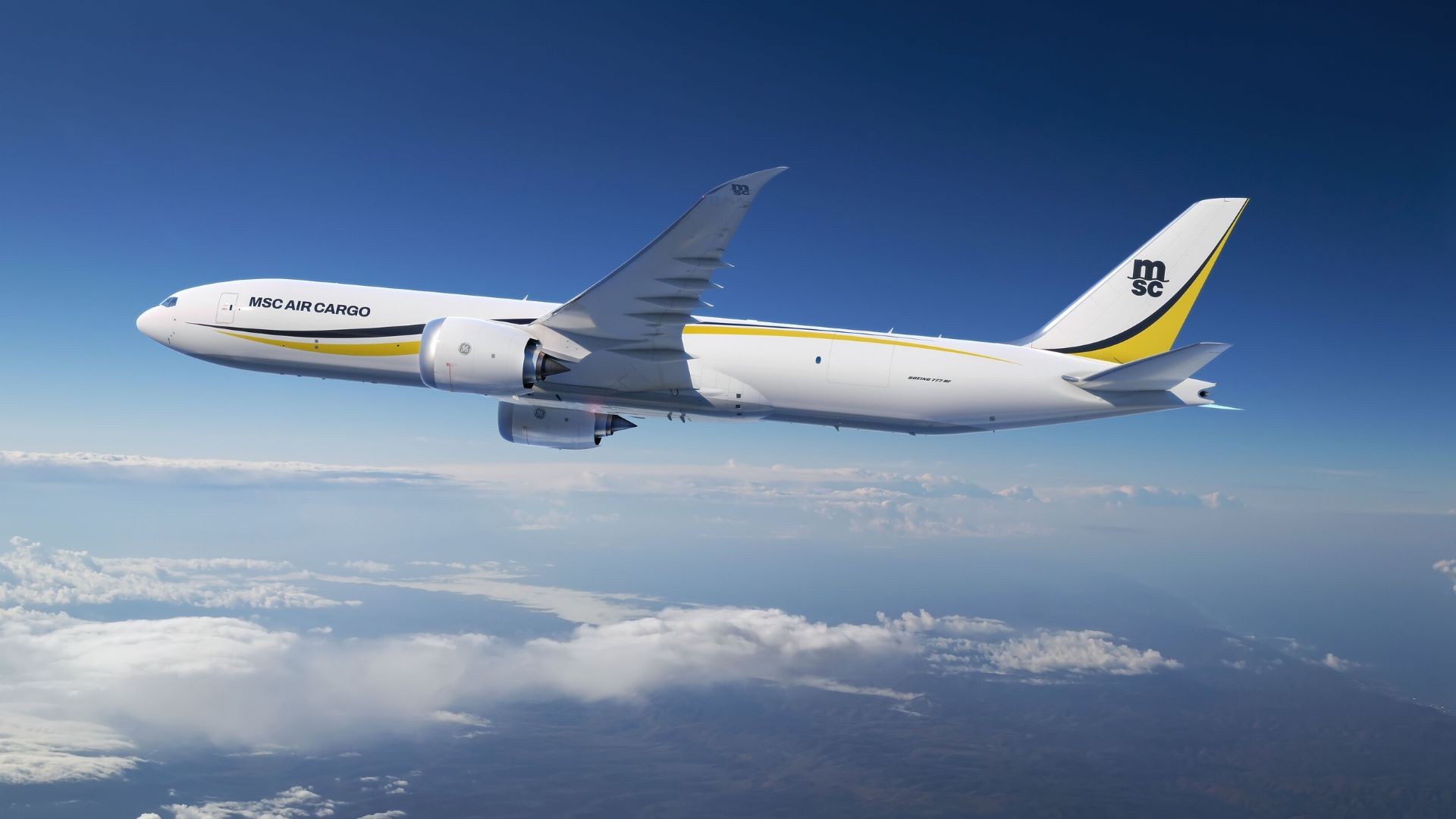
Mediterranean Shipping Co. (MSC) has ordered five Boeing 777-8 freighters, expanding its air cargo fleet to 12 aircraft. The move follows its 2022 launch with Atlas Air and a 2024 acquisition of an Italian cargo airline. Boeing’s 777-8 offers 30% better fuel efficiency than legacy freighters and is slated for first deliveries in 2028. MSC joins China Southern Airlines and two other European operators among the 777-8’s early customers. Separately, Embraer secured a firm order for 20 E190 freighter conversions from lessor Azorra, with options for 10 more.
According to www.freightwaves.com, Mediterranean Shipping Co. (MSC), the world’s largest ocean container line, has placed a firm order for five Boeing 777-8 Freighter aircraft — bringing its total air cargo fleet to 12 aircraft.
MSC Air Cargo’s strategic fleet expansion
The order, announced at the Farnborough International Airshow in England on Monday, July 21, 2026, marks MSC Air Cargo’s first direct purchase of next-generation widebody freighters. The subsidiary launched operations in 2022 in partnership with Atlas Airfour branded Boeing 777-200 freighters globally on its behalf. As of mid-2026, MSC Air Cargo operates seven 777 aircraft — including three flown through a subsidiary established in 2024 after acquiring an Italian cargo airline.
Unlike traditional airlines, MSC Air Cargo functions as an air logistics integrator: it outsources flight operations to certified carriers while retaining end-to-end control over network design, customer service, and commercial strategy. This hybrid model enables rapid scaling without the capital intensity of full airline certification and crew training.
Performance and sustainability advantages
Jannie Davel, CEO of MSC Air Cargo, stated:
“With this order, we are investing in the long-term future of MSC Air Cargo and in the customers we serve. The 777-8 Freighter gives us the efficiency, range and capacity to serve our customers reliably for years to come, while advancing our commitment to more sustainable operations. It is the right aircraft for the next stage of our growth.”
According to Boeing, the 777-8 Freighter carries nearly as much cargo as a Boeing 747-400 but delivers 30% better fuel efficiency, 25% lower operating costs per ton, and reduces ground-level noise footprint by up to 60%. Boeing plans to begin customer deliveries in 2028, following multi-year development delays. MSC Air Cargo is the third Europe-based air cargo operator to order the type, following recent commitments from China Southern Airlines — which ordered five units in late June 2026 — and two other European carriers.
Market context and capacity gap
The order arrives amid tightening intercontinental air cargo capacity. Industry analysts project a decline in available large-freighter tonnage during the second half of the 2020s, driven by the retirement of aging airframes — particularly older 747 and MD-11 freighters — while production and conversion capacity remains constrained by skilled labor shortages, engine reliability issues, and geopolitical supply chain disruptions.
Boeing’s latest 20-year market outlook forecasts demand for 2,930 factory-built and converted freighters through 2045, with new large widebody freighters accounting for 23% of that total. Meanwhile, rival Airbus has secured 103 orders for its upcoming A350 Freighter from 14 customers; first commercial delivery is targeted for late 2027.
Embraer’s E190 freighter push
Also announced at Farnborough was a firm order from lessor Azorra for 20 passenger-to-freighter conversions of the Embraer E190, with options for an additional 10 aircraft. Azorra — which holds a large portfolio of E190s — will use Embraer’s retrofit kit to convert existing airframes. The E190 freighter features a main-deck payload capacity of 23,600 pounds and is positioned between standard Boeing 737-based freighters and large turboprops.
Embraer claims its E-Jet freighters offer 35% greater volume capacity and three times the range of large turboprop freighters, alongside up to 30% lower operating costs than older narrowbody jets. Civil aviation authorities in the U.S., Europe, and Brazil have approved the conversion design. The type entered commercial service in March 2026 with Bridges Air Cargo, a Malta-based operator.
Azorra plans to lease the E190 freighters across Latin America, Southeast Asia, the Middle East, and Africa — targeting e-commerce logistics networks requiring frequent hub-to-secondary-market flights.
Source: FreightWaves
Compiled from international media by the SCI.AI editorial team.


