

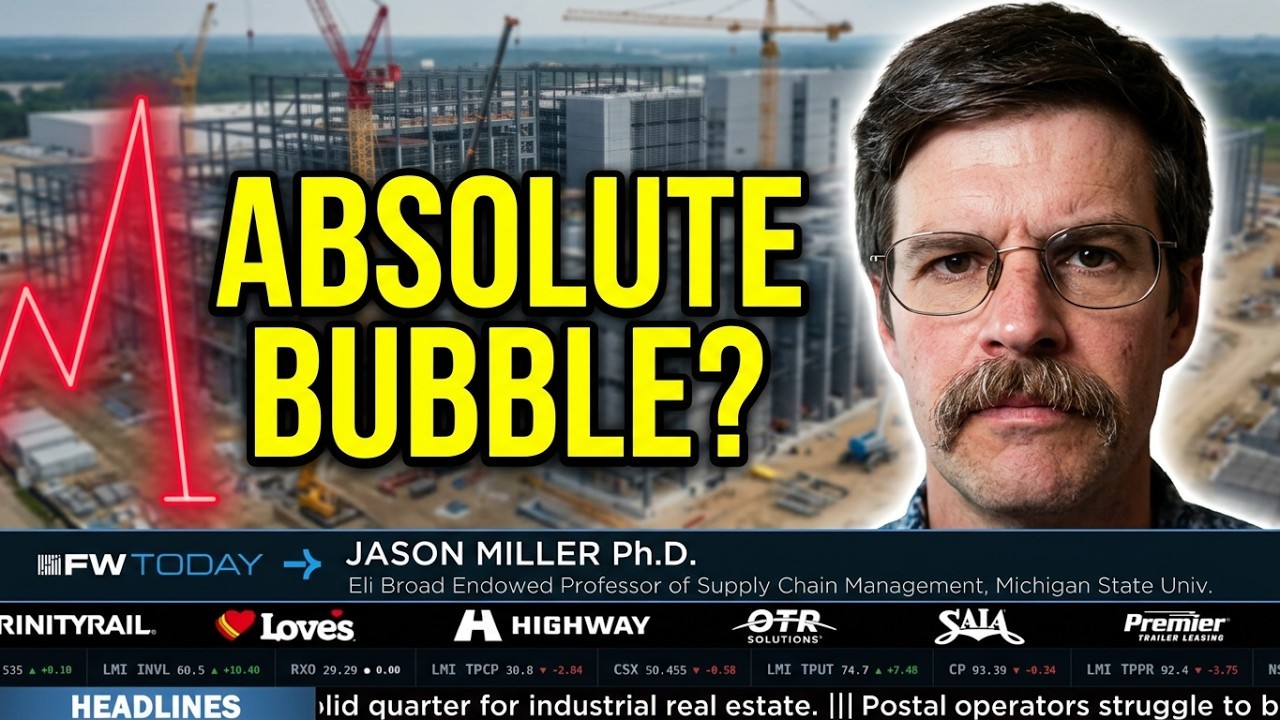
Freight demand is splitting sharply: consumer sectors like beverages and appliances face volume declines, while industrial freight for AI data centers, batteries, and electrical infrastructure surges. Dr. Jason Miller of Michigan State University warns the data center boom may be an 'absolute bubble,' citing $4.2 billion in federal infrastructure grants and 142 new U.S. data center projects in H1 2026. Heavy-haul trucking rates rose 18.7% YoY, while dry van rates fell 9.1%. SONAR data shows 37% YoY growth in construction-related trailer use and 22% growth in battery freight. Upcoming FreightWaves events in Chattanooga (October 26–28, 2026) focus on AI infrastructure logistics implications.
According to FreightWaves, freight demand is sharply bifurcated: while consumer-facing sectors like beverages and appliances are struggling, industrial freight for electrical goods, data centers, and batteries is surging — creating divergent pressure points across the U.S. trucking network.
Industrial Freight Soars Amid Consumer Weakness
The contrast between declining and accelerating freight segments is now quantifiable in real-time SONAR data. Industrial shipments tied to infrastructure build-out — particularly AI data centers — have driven a 37% year-over-year increase in heavy-haul trailer utilization for construction-related equipment transport as of Q2 2026. Meanwhile, beverage shipments fell 12% and major appliance volumes dropped 8.4% over the same period. This divergence reflects a structural shift: freight flows are no longer anchored to consumer spending cycles but increasingly tied to capital-intensive technology deployments. According to the report, battery-related freight volumes rose 22% in the first half of 2026, with most growth concentrated in routes linking Midwest manufacturing hubs to data center clusters in Northern Virginia, Dallas, and Phoenix.
Expert Warns of ‘Absolute Bubble’ Risk
Dr. Jason Miller, Professor of Supply Chain Management at Michigan State University, issued a stark assessment during a FreightWaves Today segment aired on Monday, July 20, 2026: the current AI data center construction wave may replicate the unsustainable scaling patterns seen during the dot-com boom and 2008 telecom infrastructure surge. He emphasized that rapid, debt-fueled build-outs — many backed by $4.2 billion in federal Infrastructure Investment and Jobs Act grants allocated specifically for data center energy infrastructure — risk overcapacity if AI adoption timelines lag or power constraints halt expansion.
“The AI data center build-out could be an ‘absolute bubble’ — mirroring past tech booms that created phantom freight demand followed by sharp corrections.” — Dr. Jason Miller, Professor of Supply Chain Management, Michigan State University
His analysis cites recent Federal Reserve Bank of Atlanta data showing data center construction permits surged 63% in Q1 2026 versus Q1 2025 — outpacing both historical norms and concurrent electricity grid upgrade timelines by nearly two years.
Capacity and Rate Implications for Carriers
Trucking capacity is tightening unevenly. While spot rates for dry van loads declined 9.1% year-over-year in June 2026, flatbed and specialized heavy-haul rates jumped 18.7% — driven almost exclusively by transformer, cooling unit, and server rack movements. According to FreightWaves SONAR analytics, over 142 new data center projects were announced across the U.S. in the first six months of 2026, with 57 of those located in Texas alone. This geographic concentration is straining regional carrier networks: the Dallas–Fort Worth metro area saw a 29% increase in heavy-haul permit applications between March and June 2026. At the same time, carriers reporting exposure to consumer electronics logistics reported average revenue per truck down 11.3% YoY — underscoring the sectoral imbalance.
Upcoming Industry Events Signal Strategic Focus
The urgency of this freight bifurcation is reflected in industry event calendars. FreightWaves will host three major gatherings in Chattanooga, Tennessee, all centered on infrastructure-driven logistics challenges: the Brokerage Compliance Symposium on October 26, 2026; the F3 Awards Dinner on the same date; and the F3: Future of Freight Festival from October 27–28, 2026. All events take place at The Signal at Chattanooga Choo Choo — a venue selected for its proximity to critical rail intermodal infrastructure serving Southeastern data center supply chains.
The F3 Festival’s agenda includes dedicated sessions on ‘Powering AI Infrastructure’ and ‘Data Center Logistics: From Chip to Chiller,’ featuring speakers from utility providers, equipment OEMs, and Tier-1 data center developers — reinforcing how deeply freight strategy is now entwined with semiconductor and energy infrastructure planning.
Source: FreightWaves
Compiled from international media by the SCI.AI editorial team.


