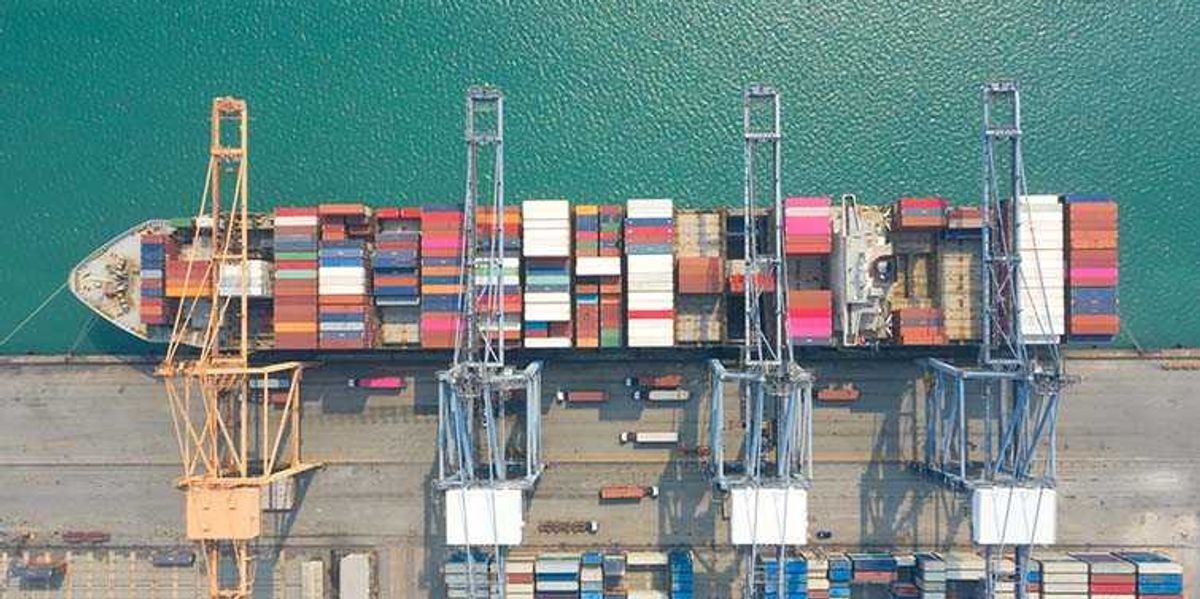
Ocean freight rates surged in June 2026 as shippers frontloaded cargo ahead of fuel surcharges, tariff changes, and July manufacturer price hikes. Transpacific rates to the U.S. West Coast jumped 19% to over $5,700/FEU — exceeding last year’s peak — while transatlantic rates to the U.S. East Coast rose 13% to $7,400/FEU. Freightos and C.H. Robinson attribute the early peak season to Red Sea diversions, port congestion, and shrinking booking windows. Mike Short of C.H. Robinson warned shippers are now competing not just for vessel space but for specific sailings. The trend reflects mounting pressure amid ongoing Strait of Hormuz volatility and broader 2026 logistics uncertainty.
According to DC Velocity, ocean container shipping rates have risen sharply amid an unusually early peak season driven by shipper urgency, tariff shifts, and fuel cost adjustments.
Early peak season compresses booking windows
Freight demand has accelerated well ahead of the traditional July–October peak period, with shippers rushing to move goods before scheduled cost increases take effect. According to Freightos, this frontloading behavior stems from three converging pressures: impending hikes in bunker adjustment factors (BAFs), the expiration of Section 122 tariffs and introduction of new Section 301 tariffs on transpacific trade, and manufacturer price increases set for July 2026.
The result is a compressed timeline for securing space on preferred sailings. As Mike Short, president of global forwarding at C.H. Robinson, stated:
“We’re seeing booking activity pull forward across Trans-Pacific lanes as shippers position inventory earlier and react to expected cost increases. Peak season has effectively started early, and it’s shrinking the window to secure preferred departures. Shippers aren’t just competing for space right now, they’re competing for the right sailing.” — Mike Short, President of Global Forwarding, C.H. Robinson
Rate spikes exceed last year’s peak levels
Transpacific spot rates to the U.S. West Coast climbed 19% to more than $5,700 per FEU — a figure that already surpasses the highest rate recorded during last year’s peak season. Similarly, transatlantic rates to the U.S. East Coast rose 13% to $7,400 per FEU. These increases occurred even as the global container fleet continues to expand, underscoring how acute demand surges and operational constraints can override capacity growth.
According to Freightos analysis, the elevated starting point for fuel-adjusted rates — combined with persistent Red Sea diversions and port congestion — has effectively reduced available vessel capacity. Delays caused by congestion further tighten usable slot availability, pushing spot prices to “very elevated levels”, as noted in Freightos’ market assessment.
Underlying drivers compound supply chain pressure
The timing of this surge coincides with multiple overlapping disruptions. Vessel traffic through the Strait of Hormuz has seen only sporadic progress toward full reopening, contributing to lingering fuel cost volatility. Although stratospheric fuel costs have eased slightly in the week ending June 23, 2026, the relief has not translated into lower freight rates due to intensified demand dynamics.
Freight broker C.H. Robinson confirmed the tightening conditions are occurring faster than anticipated. Its outlook warns that ocean shipping markets will likely deteriorate further for shippers before showing signs of stabilization. The company attributes this worsening trajectory to both structural bottlenecks — including port congestion and diverted routing — and behavioral responses, such as inventory positioning ahead of July 2026 price hikes.
These developments come amid broader industry uncertainty. A separate report cited by DC Velocity notes that logistics players face continued disruption, slack demand, and rising costs throughout 2026. Meanwhile, other maritime developments — including Maersk’s recent expansion of its lithium-ion battery transportation network in North America on June 22, 2026, and forecasts warning of potential Panama Canal restrictions if El Niño triggers drought — underscore the fragility of global maritime infrastructure.
Source: DC Velocity
Compiled from international media by the SCI.AI editorial team.