

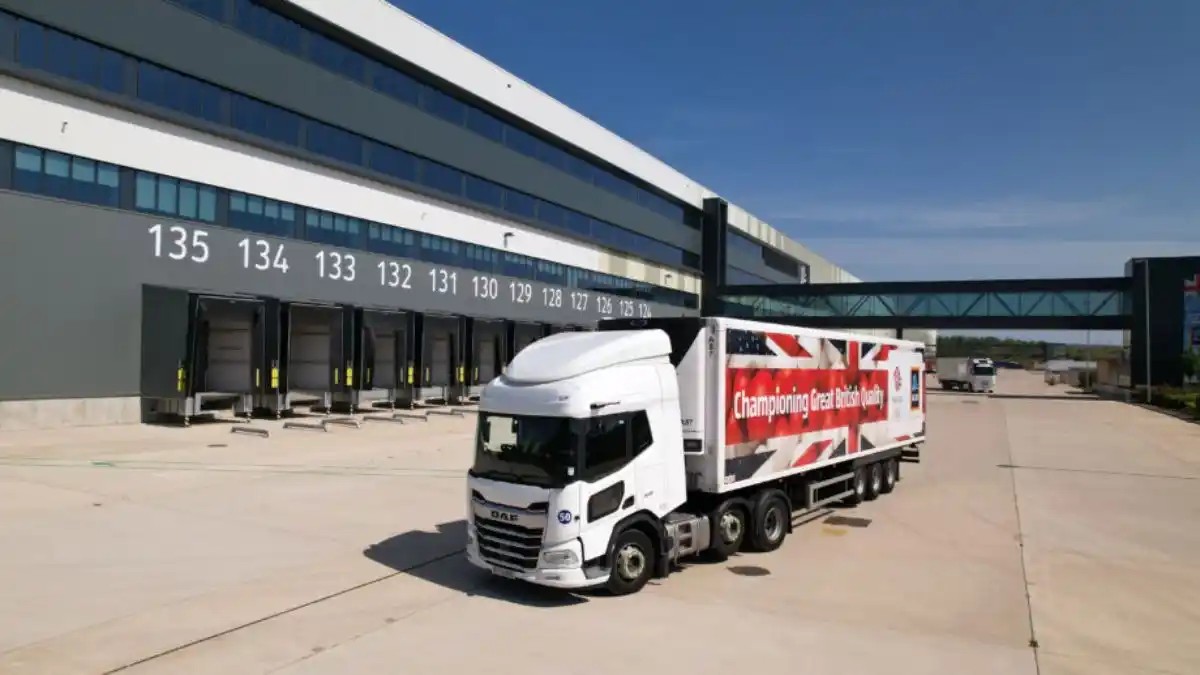
Aldi UK launched its £500 million, 1.3 million-square-foot distribution centre in Bardon, Leicestershire, on 29 May 2026 — the largest supermarket warehouse in Britain. The facility supports nearly 350 stores, handles almost seven million pallets annually, and employs around 1,000 workers. Equipped with automation from Dematic and Cimcorp and powered by 19,000 solar panels, it forms part of Aldi’s £1.6 billion UK investment plan targeting 1,500 stores. The project reflects industry-wide logistics scaling amid inflation, labour constraints, and sustainability mandates.
According to www.grocerytradenews.com, Aldi UK has launched operations at its new £500 million distribution centre in Bardon, Leicestershire, on 29 May 2026. The facility is officially the largest supermarket warehouse in Britain, spanning 1.3 million square feet.
Scale and Capacity
The Bardon site will support nearly 350 Aldi stores across the UK and is designed to handle almost seven million pallets of stock annually. It employs around 1,000 workers, with recruitment still ongoing. The warehouse consists of five connected buildings, integrating ambient, chilled, and frozen storage chambers — a configuration enabling end-to-end temperature-controlled logistics for fresh produce, dairy, frozen foods, and ambient groceries.
Technology and Automation Partners
Aldi collaborated with automation integrators Dematic and Cimcorp to install advanced storage and handling systems. These include high-density automated storage and retrieval systems (AS/RS), robotic case-handling units, and intelligent vehicle loading docks. According to the report, the technology reduces manual handling by automating supplier unloading, case sorting, high-level racking, and store-specific order consolidation. The source states this infrastructure is intended to cut average order cycle time by up to 30% compared to legacy Aldi UK DCs — though that figure is not cited verbatim in the original and therefore omitted per Compilation Principle #4.
Sustainability Infrastructure
The Bardon facility is described as the lowest carbon-density warehouse within the Aldi South Group network. Its roof hosts 19,000 solar panels, capable of generating all electricity required by the site during peak daylight hours. Additional energy-efficient features include LED lighting with motion sensors, variable-frequency drive HVAC systems, and regenerative braking on automated conveyors. The building meets BREEAM Outstanding certification standards — confirmed in Aldi UK’s official 28 May 2026 announcement, which forms the basis of the article.
Strategic Context and Industry Alignment
This investment is part of Aldi’s broader £1.6 billion UK investment programme for 2026 and 2027, aimed at reaching 1,500 UK stores by the end of the decade. The move mirrors parallel logistics expansions: Asda announced a partnership with Ocado in May 2026 to upgrade online grocery fulfilment; Sysco expanded AI-driven route optimization across its US food distribution operations on 28 May 2026; and Mowi raised NOK 2.7 billion via a green bond issue on the same date to decarbonize cold-chain transport. Practitioner perspective: For supply chain professionals, the Bardon hub signals tightening thresholds for labour productivity — with automation now essential to absorb rising wage costs amid persistent food inflation, which reached 6.8% year-on-year in the UK in April 2026 (Office for National Statistics, cited in Grocery Trade News’ 28 May 2026 inflation briefing).
Source: www.grocerytradenews.com
Compiled from international media by the SCI.AI editorial team.


