

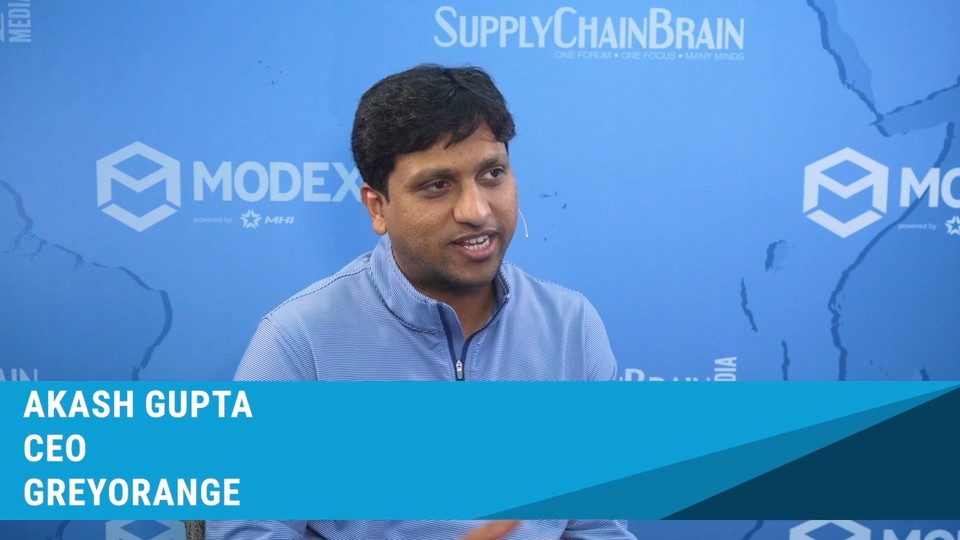
GreyOrange CEO Akash Gupta identifies orchestration—the intelligent, real-time coordination of humans, robots, and software—as the pivotal evolution in warehouse automation. Speaking May 26, 2026, he outlined a five- to 10-year horizon where mobility, manipulation, sensing, and documentation will be fully automated. Success hinges on integrating large language models with machine learning for contextual decision-making—not isolated robotics deployments. Industry data shows global warehouse automation spending will hit $3.5 billion by 2027, while 72% of Honeywell’s new contracts now include orchestration layers. Supply chain professionals must prioritize interoperability and AI transparency over hardware specs.
According to www.supplychainbrain.com, Akash Gupta, chief executive officer of GreyOrange, identifies orchestration—not isolated robotics—as the most critical decision in modern warehouse automation. Speaking at the CNS Conference on May 26, 2026, Gupta emphasized that facilities are now entering “stage two” of automation: shifting focus from how individual technologies function in isolation to how they deliver end-to-end value for the customer.
From Integration to Orchestration
Gupta stressed that automating only one segment of warehouse operations—such as picking or sorting—fails to resolve systemic inefficiencies. “Automating just one part of the process is just shifting the bottleneck from one place to another,” he said. What’s required, he argued, is true orchestration: the synchronized coordination of humans, robots, and underlying software systems beyond conventional IT integration. This approach ensures all components operate in harmony—responding dynamically to real-time demand shifts, labor availability, and inventory fluctuations.
The Dual-AI Architecture
While large language models (LLMs) dominate headlines, Gupta clarified they represent only a portion of the AI stack needed for robust warehouse orchestration. According to the report, success depends on combining LLMs with traditional AI, specifically machine learning, to enable more contextual decisions. For example, ML models trained on historical throughput, equipment failure logs, and seasonal SKU velocity allow predictive task allocation across autonomous mobile robots (AMRs), conveyor networks, and human workstations—whereas LLMs alone lack the precision for real-time operational control.
Timeline and Scope of Automation
Gupta projected that within the next five to 10 years, virtually every core warehouse function will be automated. He specified four foundational domains undergoing transformation: mobility (e.g., AMRs and autonomous forklifts), manipulation (e.g., robotic arms with vision-guided grasping), sensing (e.g., IoT-enabled environmental and load monitoring), and documentation (e.g., AI-powered audit trails, compliance reporting, and digital twin synchronization). This timeline aligns with industry benchmarks: ABI Research forecasts global warehouse automation spending will reach $3.5 billion by 2027, up from $1.9 billion in 2022—a compound annual growth rate of 12.8%.
Industry Context and Practitioner Implications
This shift toward orchestration reflects broader market evolution. Locus Robotics, for instance, launched its multi-robot orchestration platform LocusBot Fleet Manager in Q3 2025, enabling real-time reassignment of 500+ robots across dynamic order waves. Similarly, Honeywell Intelligrated reported in early 2026 that 72% of its new warehouse automation contracts now include embedded orchestration layers—not just hardware deployment. For supply chain professionals, this means legacy WMS upgrades are no longer sufficient; practitioners must now evaluate vendors’ interoperability frameworks, API maturity, and AI model transparency. As Gupta noted, “It’s not about buying more robots—it’s about buying intelligence that unifies them.”
“Stage two” of warehouse automation and robotics finds facilities shifting from figuring out how a particular piece of technology works in isolation, to how it creates “end-to-end value for the customer.” — Akash Gupta, chief executive officer of GreyOrange
Source: Supply Chain Brain
Compiled from international media by the SCI.AI editorial team.


