

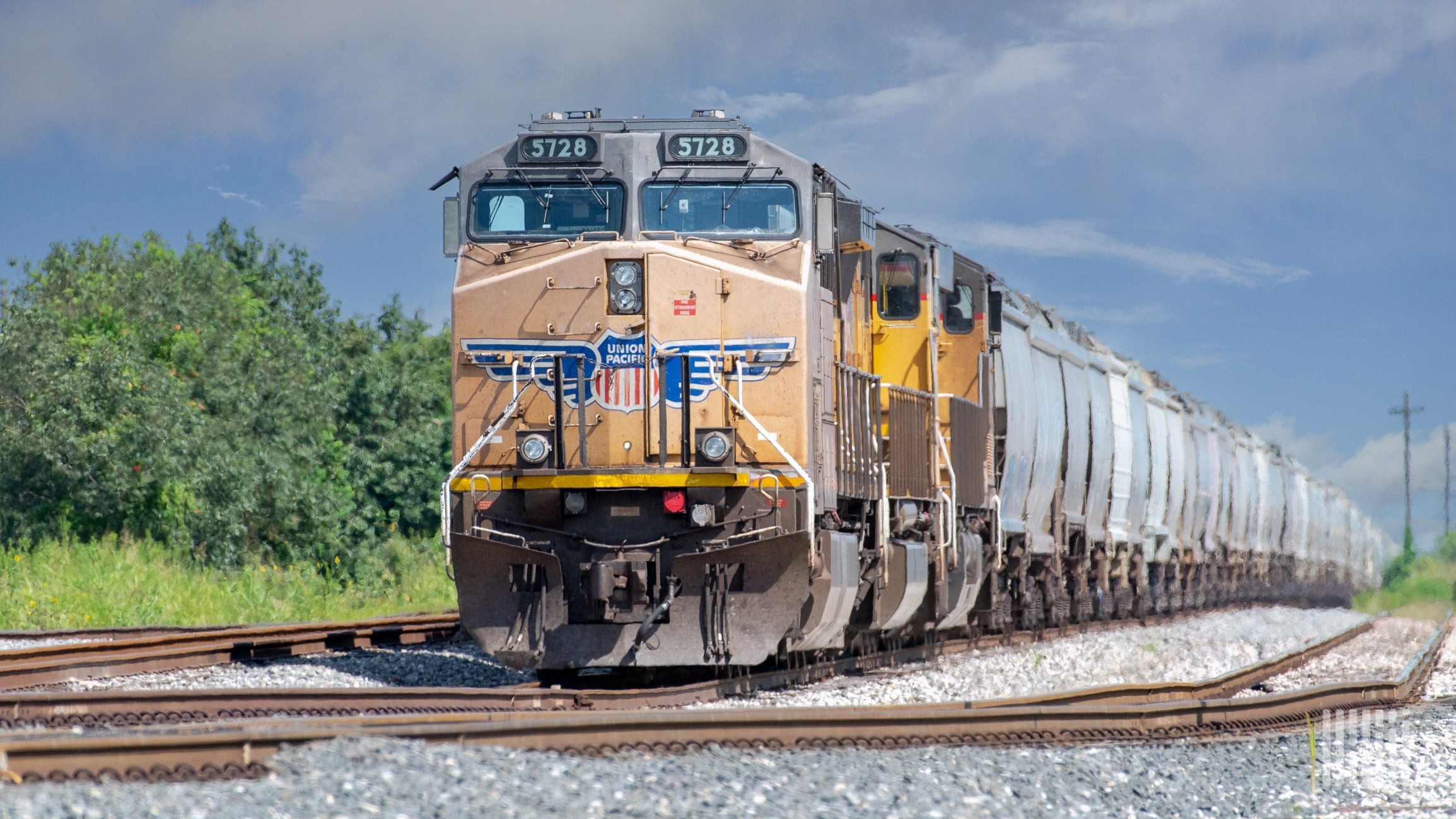
Union Pacific CEO Jim Vena expressed confidence that the revised $85 billion merger application with Norfolk Southern fully addresses the Surface Transportation Board’s concerns following the rejection of the initial filing as incomplete. Key updates include disclosure of the full merger agreement, clarification of a $750 million concession threshold, explicit walk-away triggers—including prohibitions on widespread trackage rights—and safeguards to prevent UP from gaining control of the Terminal Railroad Association of St. Louis. Vena emphasized UP’s willingness to abandon the deal if it fails to benefit shareholders or enhance competitiveness. The STB is expected to rule on application completeness by week’s end.
Union Pacific Chief Executive Jim Vena is confident that the Surface Transportation Board will accept the revised UP-Norfolk Southern merger application because it answers all of the questions regulators had about the initial filing that was deemed incomplete.
Revised Filing Addresses STB’s Key Concerns
Among them: Providing the full merger agreement, including a section that outlines what board-ordered conditions might prompt UP (NYSE: UNP) to walk away from the $85 billion deal to acquire NS (NYSE: NSC).
Initially, UP thought gaining regulatory approval might require $750 million worth of concessions. But when the first application was nearing completion last fall, “we just couldn’t come up to that number anymore, and that’s why we said the concession number is way lower,” Vena told the Wolfe Research Global Transportation and Industrials Conference Thursday in New York.
“Is it zero? No, it’s not,” Vena said. “But it’s not $750 million.”
The merger agreement, however, lists a $750 million threshold that would trigger a review of whether the $85 billion deal would still make sense.
“This deal has to be better for the company, for Union Pacific, has to be able to grow the business, and has to be better for our investors,” Vena said. “If it isn’t, we’re pretty good as a standalone company, and I’m not worried about walking away from it.”
Walk-Away Triggers and Route Divestiture
Under the terms of the merger agreement, UP would abandon the deal if federal regulators order widespread trackage rights or line sales. The only exception: If the combined railroad is required to spin off one of its duplicative main lines between Kansas City and St. Louis. If the merger is approved, UP would have a pair of K.C.-St. Louis routes, including the former Missouri Pacific via Jefferson City, Mo., and NS’ former Wabash via Moberly, Mo.
“We’ll work through the process, and we’re talking to a number of people to be able to get that done,” Vena said of the potential divestiture of a K.C.-St. Louis route. “But those things are complicated. It takes a while to get them done.”
In recent history since the 1990s, shows that the STB has not rejected a merger application twice.
TRRA Control Safeguards
The revised application also addresses how UP would ensure that it does not gain control of the Terminal Railroad Association of St. Louis, which is owned by UP, NS, BNSF (NYSE: BRK-B), Canadian National (NYSE: CNI), and CSX (NASDAQ: CSX).
The other Class I’s have criticized UP for not specifically spelling out how it would divest a portion of its ownership.
BNSF, CSX, and CN all argued that the revised application is incomplete because it does not include an application for control of the TRRA. The UP-NS response is that, unlike the original application, the revised version does not make divestiture of the NS share of the TRRA contingent on the other owners’ willingness to pay fair market value. Instead, the new application asks the board to make divestiture a condition of merger approval, “thereby ensuring the Applicants could not acquire control of TRRA, even temporarily.”
“We will make sure that we will not get to 50% ownership,” Vena said. “So either turn back shares or turn them into nonvoting shares, whatever we need to do.”
Vena says UP called a special TRRA board meeting after the other railroads raised objections to the way the original merger application handled disposition of the UP interest in the switching railroad.
“We actually called the special meeting of the board for the TRRA and asked all the railroads to come in so that we could talk about how we could dispose of our shares or the NS shares when we close on the deal,” he said. “I hate to tell you, nobody showed up even though they were supposed to.”
Vena says the other railroads are simply making “noise” with their objections to the revised application.
“It sort of tells you about our competition,” Vena said.
Public Interest and Competitive Rationale
The other Class I railroads have said that the UP-NS merger cannot meet the STB’s twin merger review hurdles of being in the public interest and enhancing competition.
Vena insists that the deal is in the public interest and will enhance competition by taking trucks off the highway, expanding the single-line service that shippers prefer, and reducing shipping costs through lower single-line rates and faster equipment turn times.
The merger efficiencies and service improvements, he said, will force other railroads to compete on price.
The STB is expected to issue a decision on whether to accept the UP-NS application as complete by the end of next week.
Subscribe to FreightWaves’ Rail e-newsletter and get the latest insights on rail freight right in your inbox.
Related coverage:
- OmniTrax tabs Hoskins to lead transload
- Rail on a roll as ag, metals, chemicals lead traffic
- Formula 1 experiments with freight rail
- Truck dwell holds, rail up at LA-Long Beach
Source: FreightWaves
Compiled from international media by the SCI.AI editorial team.


