Skip to content

AI & Automation · Technology

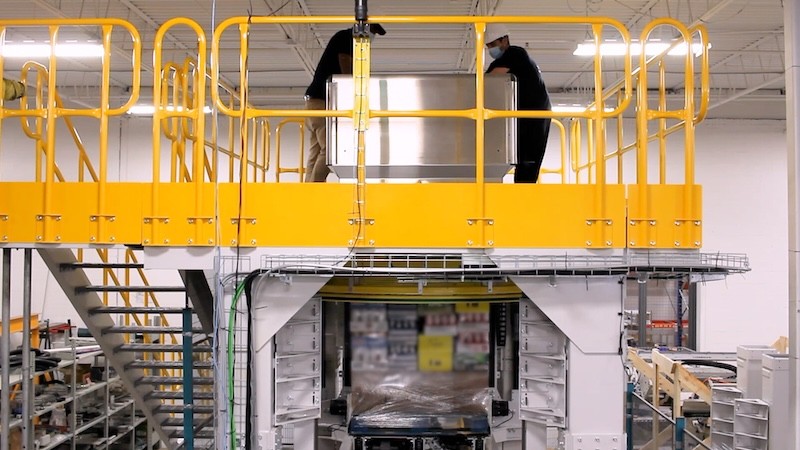
NūMove deploys 22 mixed palletizers across 9 US states

NūMove Robotics & Vision has deployed 22 semi-automatic mixed load palletizers across nine U.S. states, with installations beginning in 2021 and accelerating through 2026. The systems—rated for up to 1,000 products per hour—combine automated pallet handling and ring wrapping with ergonomic operator-assisted layer building. Most deployments occurred in collaboration with integration partner DMW&H. Beverage distributors adopted the solution to address labor shortages and throughput demands, amid industry-wide automation adoption: 68% of large beverage distributors launched warehouse automation initiatives between 2022 and 2025. Each unit costs approximately $385,000 installed.

Original source: roboticsandautomationnews.com

NūMove deploys 22 mixed palletizers across 9 US states

According to roboticsandautomationnews.com, NūMove Robotics & Vision has deployed 22 semi-automatic mixed load palletizers across nine U.S. states, surpassing its previously reported threshold of 20 units. The deployments—completed as of May 22, 2026—target wholesale alcoholic beverage distributors, with the first system installed in 2021. Most installations occurred jointly with integration partner DMW&H as part of large-scale automation projects.

Operational Scale and Throughput Metrics

The systems are fully operational at distribution centers serving the U.S. beverage logistics sector. Facilities in California, Texas, Florida, Ohio, Pennsylvania, Illinois, Georgia, Colorado, and Washington host at least one unit, with several sites installing multiple units to scale throughput. Each Semi-Automatic Mixed Load Palletizer achieves a rated capacity of up to 1,000 products per hour, automating pallet handling and ring wrapping while retaining human operators for mixed-item layer building. The solution’s compact footprint allows deployment in space-constrained facilities common among regional beverage distributors.

Collaborative Deployment Model

NūMove delivers the system either directly to end customers or through its strategic integration partner, DMW&H. According to Robert Lampone, vice president of project delivery at DMW&H, “The palletizer solutions have delivered strong value to our customers by increasing throughput compared to traditional manual palletizing stations while also improving ergonomics for workers.” He added: “These improvements contribute to greater overall productivity and operational efficiency.” Lampone also cited NūMove’s technical responsiveness, noting that issues are addressed quickly to maximize machine uptime—a critical factor given typical distribution center shift schedules operating 24/7.

Engineering and Scalability Features

The system’s modular architecture supports phased expansion: additional units can be installed as production volumes grow. Key hardware components include automated pallet dispensers, ergonomic operator workstations with height-adjustable conveyors, and integrated ring-wrapping systems that improve load stability for transport. Maintenance access is designed for <30-minute service intervals on major subsystems, per NūMove’s published maintenance documentation. The solution complies with ANSI/RIA R15.06–2012 safety standards and integrates with existing warehouse management systems (WMS) via standard OPC UA protocols.

Industry Context and Market Alignment

This deployment wave aligns with broader trends in U.S. beverage logistics: a 2025 MHI Annual Industry Report found that 68% of beverage distributors with >$250M annual revenue had initiated warehouse automation projects since 2022, citing labor shortages and rising same-day delivery expectations. Competitors including Locus Robotics and Honeywell Intelligrated have reported similar adoption curves—Locus deployed 142 autonomous mobile robots across 12 beverage DCs in 2025, while Honeywell launched its SmartPalletizer Pro system in Q4 2025 targeting mixed-SKU environments. Unlike fully autonomous robotic palletizers requiring $1.2–$2.4 million per cell (per ARC Advisory Group 2025 data), NūMove’s semi-automatic model carries an average installed cost of $385,000 per unit, making it accessible to mid-tier distributors with 150–400 employees.

Source: Robotics & Automation News

Compiled from international media by the SCI.AI editorial team.

Ask SCI.AI Finished reading? Continue with SCI.AI. Explore the related policy, route, company and historical context. Continue asking
BlueGrace acquires Idaho 3PL Truk TMS to expand Pacific Northwest LTL
AI & Automation

BlueGrace acquires Idaho 3PL Truk TMS to expand Pacific Northwest LTL

BlueGrace Logistics has acquired Idaho-based third-party logistics provider Truk TMS to strengthen its presence in the Pacific Northwest. The deal brings Truk TMS—previously a BlueGrace partner—fully into the company’s ecosystem, granting its customers access to BlueGrace’s Managed Logistics platform and BlueShip technology. Financial terms remain undisclosed. BlueGrace, headquartered in Tampa, Florida, serves over 10,000 customers from nine offices across the U.S. and Mexico and operates a carrier network exceeding 250,000. As a Warburg Pincus portfolio company, BlueGrace previously acquired STB Freight Group and FreightCenter in 2025. Truk TMS CEO Mark Barnes emphasized continuity of service backed by expanded capabilities.

project44 launches LSP44 AI unit, splits operations
Digital Platforms

project44 launches LSP44 AI unit, splits operations

Chicago-based project44 has split into two independent businesses as of July 14, 2026: the original project44 serving enterprise shippers, and LSP44—a new AI-dedicated platform for logistics service providers. LSP44 processes 2.3 million shipment events per hour, reduced manual tendering time by 68% in pilots, and launches commercially in Q3 2026. The move reflects accelerating AI adoption among LSPs, which grew 41% year-over-year in 2026 per the 37th State of Logistics Report. Early deployments are underway in Chicago, Dallas, and Rotterdam.

Brisbane Warehouse Boom Raises Efficiency Standards
Robotics

Brisbane Warehouse Boom Raises Efficiency Standards

Brisbane’s industrial sector saw record investment in 2025, with 155,000 sq m of warehouse space delivered early in 2026 and leased immediately. Australia’s NABERS Energy ratings now benchmark warehouse efficiency, while equipment rental models — like those offered by All Lift Forklifts — cut emissions by one-third through shared utilization. Space heating consumes 39% of warehouse energy; lighting accounts for 15%. Adelaide and Perth more than doubled investment volumes in 2025. To meet national targets, resource productivity must rise 30% by 2030.

Welcome Back!

Login to your account below

Create New Account!

Fill the forms below to register

Retrieve your password

Please enter your username or email address to reset your password.

Scan to share via WeChat

Open WeChat and scan the QR code to share

QR Code

Add New Playlist

