

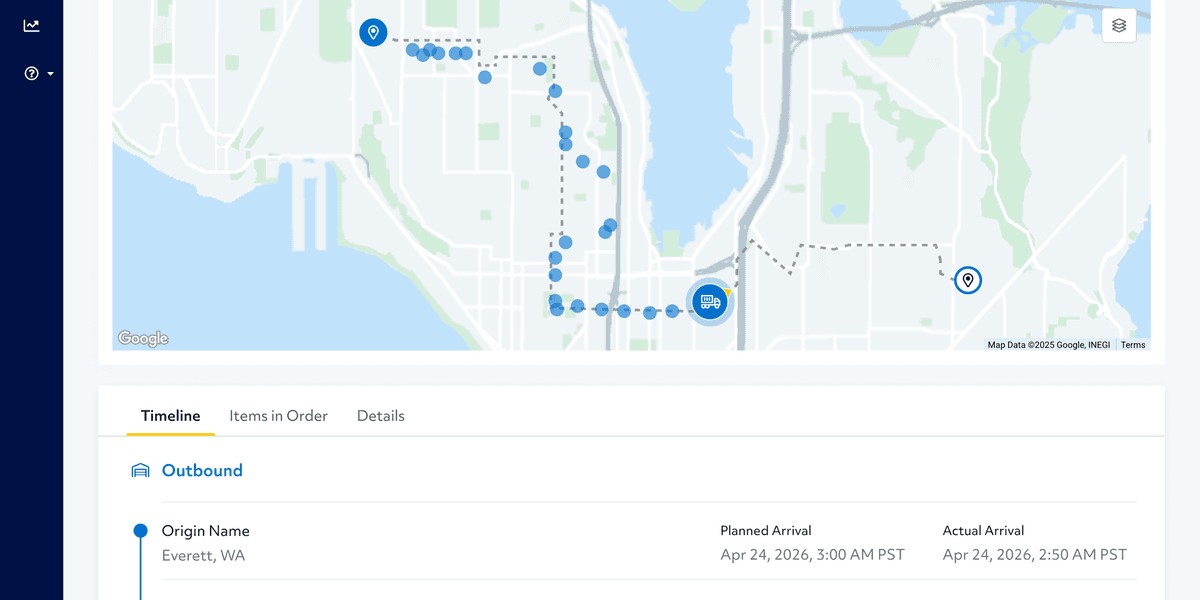
Penske Logistics launched its Supply Chain Insight platform on May 4, 2026—a cloud-based solution delivering real-time, unified visibility across transportation and warehousing networks. The system integrates internal and external data sources, displays live loads (blue/red circles) and warehouses (gray icons) on an interactive map, and provides access to ~100 KPIs—including on-time delivery and planned vs. actual miles. It includes an AI assistant for natural-language queries and supports custom metrics. According to Vishwa Ram, VP of Data Science and Analytics, the platform solves 'fragmentation,' not visibility. Penske plans continued AI-driven enhancements.
According to www.thescxchange.com, third-party logistics provider Penske Logistics launched its new cloud-based technology platform, Supply Chain Insight, on May 4, 2026. The platform delivers real-time, end-to-end visibility across customers’ transportation and warehousing networks by unifying data from internal systems and external partners—including carriers, external warehouses, and third-party service providers.
Unified Data Layer Solves Fragmentation
Vishwa Ram, Penske Logistics’s vice president of Data Science and Analytics, stated:
“Most supply chains today don’t have a visibility problem. They have a fragmentation problem. So, if you are within a single system, you have perfect visibility. But when a shipment moves from one mode to another, or transitions from one system to another, or from one partner to another, that visibility breaks down.”
Supply Chain Insight addresses this by creating a “unified data layer” that integrates siloed inputs. Upon login, users see an interactive map displaying all current transportation routes and warehouse activity—rendering loads as blue circles (red if late or delayed) and warehouses as gray icons.
Real-Time Operational Dashboard & Document Access
The platform’s homepage features a left-side navigation pane linking to dedicated pages for loads, orders, warehouse inventory, and key performance indicators. Users can click any icon to view timelines of activity or drill into specifics—for example, the number of inbound and outbound loads, their current locations, and how many are delayed, late, or on a watchlist. Crucially, Supply Chain Insight also hosts critical documents—including proof of delivery and bills of lading—within the same interface, eliminating cross-system document retrieval.
Metrics, Customization, and Embedded AI Assistant
Supply Chain Insight offers around 100 metrics, including total orders delivered, on-time delivery rate, and planned versus actual miles. Customers may also build customized metrics tailored to their operational benchmarks. An embedded AI assistant supports natural-language queries—for instance, “Where is load #PEN-8842?” or “What was our on-time performance last week?” According to Ram, the long-term vision is for the assistant to evolve into a “personal analyst” capable of anticipating risk and recommending actions.
Practitioner Impact and Industry Context
For supply chain professionals, Supply Chain Insight enables rapid root-cause resolution: if a shipment is short, users can instantly verify stock availability at alternate warehouses and dispatch express replenishment. This reduces time-to-decision from hours to minutes. Industry-wide, such integration reflects a broader shift—Descartes’ April 2026 report noted that 73% of U.S. port stakeholders cited data fragmentation as a top-three barrier to resilience. Similarly, Amazon’s April 2026 launch of its own 3PL business signals intensified competition in tech-enabled logistics services. Penske’s move follows its $1.2 billion investment in digital infrastructure announced in Q3 2025, per public SEC filings referenced in industry coverage.
Source: www.thescxchange.com
Compiled from international media by the SCI.AI editorial team.


