

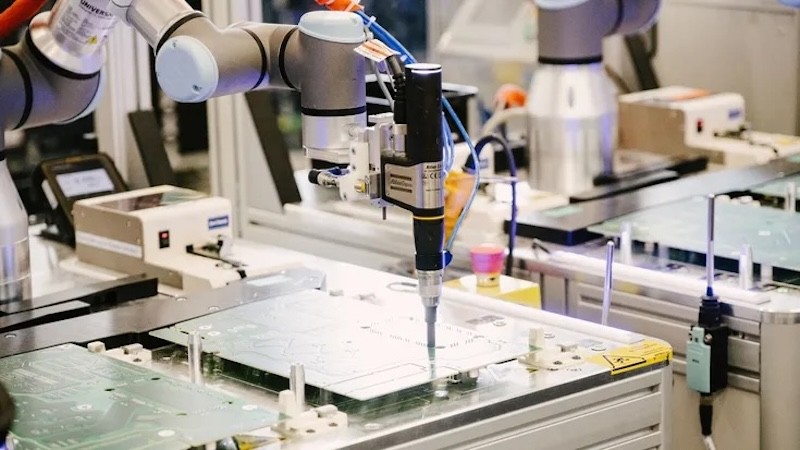
Flex and Teradyne Robotics are expanding their long-standing partnership — rooted in over 20 years of semiconductor equipment collaboration — to scale intelligent automation globally. Flex now both deploys Teradyne’s Universal Robots cobots and MiR AMRs in its own factories and manufactures key robotics components for Teradyne’s customers. According to the report, this dual-role model enables continuous operational feedback and faster replication of validated automation workflows. Leadership highlights Flex’s global footprint, resilient supply chain, and manufacturing expertise as central to accelerating physical AI-driven robotics adoption in complex electronics, industrial equipment, and data center infrastructure production.
According to roboticsandautomationnews.com, Flex — one of the world’s largest contract manufacturers — and Teradyne Robotics have expanded their partnership to scale intelligent automation across global manufacturing operations.
Dual-Role Collaboration Model
Under the expanded relationship, Flex serves a dual function: it deploys Teradyne Robotics solutions — including Universal Robots (UR) cobots and Mobile Industrial Robots (MiR) autonomous mobile robots (AMRs) — within its own production facilities, while simultaneously manufacturing key robotics components for Teradyne Robotics. This integrated model enables real-world validation of automation technologies at scale and accelerates replication of proven workflows.
Strategic Continuity and Industry Context
The collaboration builds on more than 20 years of prior partnership between Flex and Teradyne in delivering semiconductor test equipment globally. Flex has long supported Teradyne with advanced manufacturing, systems integration, and global supply chain execution for semiconductor test platforms used across electronics and semiconductor production environments. The extension into robotics and intelligent automation reflects a natural evolution, leveraging shared expertise to address rising complexity, scale requirements, and the need for greater flexibility in modern production.
This move aligns with broader industry trends: major electronics contract manufacturers like Foxconn and Jabil have increasingly invested in internal automation capabilities and robotics partnerships to enhance responsiveness and reduce labor dependency. Similarly, semiconductor equipment suppliers such as Applied Materials and ASML have deepened co-development ties with manufacturing partners to accelerate deployment of AI-integrated tools in fab environments. For supply chain professionals, the Flex–Teradyne model demonstrates how vertically aligned hardware development, component manufacturing, and operational deployment can compress time-to-value for automation investments — especially in high-mix, low-volume electronics and industrial equipment segments where flexibility is critical.
Leadership Perspectives
“For more than 20 years, Flex and Teradyne have partnered to deliver semiconductor equipment at global scale. Expanding our relationship into robotics and intelligent automation builds on a strong foundation, combining Teradyne Robotics’ industry-leading technologies with Flex’s advanced manufacturing capabilities, global footprint and execution expertise.” — Dennis Kirkpatrick, president of lifestyle, consumer devices, and core industrial, Flex
“Flex’s experience in manufacturing complex products across industries, combined with its global scale and resilient supply chain, makes it an ideal partner for advancing intelligent automation. Together, we’re accelerating the adoption of robotics technologies that improve productivity, flexibility and operational resilience across manufacturing environments worldwide.” — Jean-Pierre Hathout, president of the Teradyne Robotics Group
The partnership emphasizes next-generation intelligent automation incorporating physical AI technologies, designed to enable more adaptive and flexible responses to dynamic production needs. By combining Teradyne’s evolving cobot and AMR capabilities with Flex’s real-world deployment environments and manufacturing scale, the two companies aim to improve consistency, throughput, and efficiency across applications and global facilities.
Source: Robotics & Automation News
Compiled from international media by the SCI.AI editorial team.


