

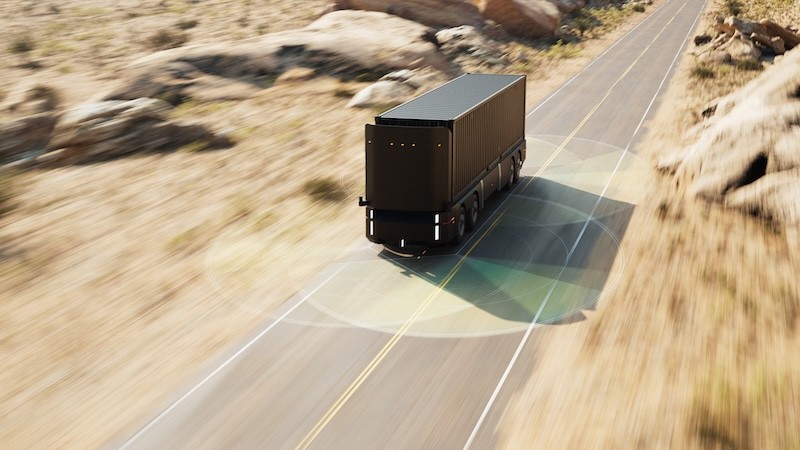
According to roboticsandautomationnews.com, Humble Robotics has emerged from stealth with a fully autonomous, cabless, electric hauler designed for freight logistics — the Humble Hauler. The company announced it has raised $24 million in seed funding, led by Eclipse, with additional participation from Energy Impact Partners and others.
A Ground-Up Redesign for Freight Automation
The Humble Hauler is described as an entirely new vehicle platform — not a retrofit — engineered specifically for autonomy and electrification. By removing the cab, it achieves significantly lower weight than a traditional Class 8 tractor-trailer combination. This design enables 360° sensor coverage via camera, LiDAR, and radar, supporting true dock-to-dock operation across warehouses, railyards, and seaports. Its first configuration is built to move shipping containers.
Physical AI and Vision-Language-Action Capabilities
The hauler is powered by cutting-edge vision-language-action (VLA) models, allowing it to reason about dynamic environments and execute appropriate actions — even in previously unseen scenarios. According to the report, this capability dramatically improves safety and accelerates time to market. The electric powertrain insulates operations from volatile fuel costs and reduces maintenance burdens, enabling freight movement without human intervention while advancing sustainability goals.
Market Context and Industry Challenge
In the US alone, truck-based freight represents a $906 billion industry, yet autonomous trucking has yet to achieve meaningful commercial deployment — hindered by persistent driver shortages and supply chain fragmentation. Humble positions its solution as the first Class 8 autonomous vehicle capable of unloading directly at the dock, removing key obstacles to affordable, efficient AV freight movement.
Leadership and Technical Foundation
Eyal Cohen, Humble’s founder and CEO — a two-time entrepreneur with prior experience at Apple, Uber, and Waabi — stated:
“I have dedicated my career to building electric and autonomous vehicle technology. For the first time, freight can be fully automated all the way to the loading dock. We are making freight sustainable, safe and efficient in a way no one thought was possible. And we’re doing it with an exceptional team of industry veterans and AV experts – our first vehicle was completed in just six months.”
The founding team includes talent from Tesla, Waymo, Cruise, and other leaders in physical AI.
Deployment Roadmap and Safety Architecture
With its first prototype completed in under six months, Humble is now partnering with market-leading logistics and supply chain organizations to begin autonomous testing and commercialization pilots. The seed funding will support next-generation vehicle development, expansion of its autonomy stack, initial pilot deployments, and early manufacturing efforts toward public-road deployment. Jiten Behl, partner at Eclipse and Humble board member, emphasized the integrated approach:
“Humble is operating at an unprecedented pace. They understand that autonomous trucking isn’t just a software problem – it requires a full-stack rethink across hardware, AI, and electrification. That integration is what unlocks speed to scale and a step-change reduction in the cost of moving freight.”
Multiple safety fallbacks and proprietary guardrails are embedded in the system to manage risk in dynamic commercial environments.
Source: Robotics & Automation News
Compiled from international media by the SCI.AI editorial team.


