

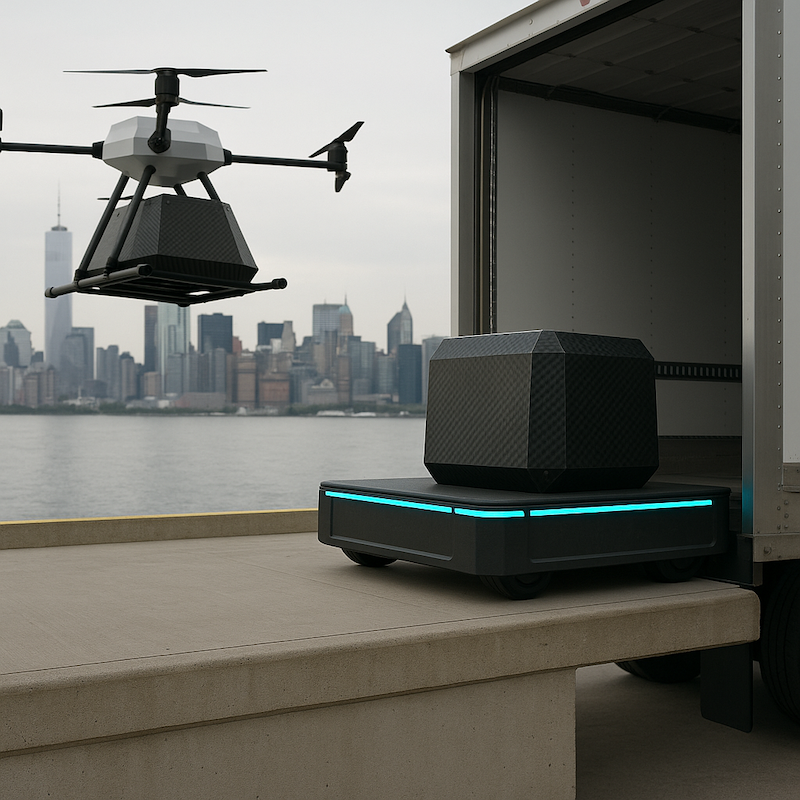
Unmanned aerial vehicles (UAVs) are emerging as a pragmatic solution to urban last-mile delivery bottlenecks. As cities grapple with rising e-commerce demand and congestion, drones offer more than speed—they promise a fundamental reimagining of urban logistics. This article explores how drones bypass terrestrial congestion, the strategic advantages of aerial mobility, the critical infrastructure needed for integration, public-private partnerships driving adoption, and the challenges of noise, privacy, and equity that must be addressed for sustainable implementation.
In the heart of Manhattan, where delivery vans idle in gridlock for an average of 47 minutes per shift and curb space is traded like real estate, a quiet revolution is taking flight—literally. Unmanned aerial vehicles (UAVs) are no longer futuristic prototypes confined to military or recreational use; they are emerging as a pragmatic, scalable solution to one of urbanism’s most persistent failures: the last-mile delivery bottleneck. As cities worldwide grapple with rising e-commerce demand, decarbonization mandates, and shrinking public space, drones offer more than speed—they promise a fundamental reimagining of how goods move through dense human ecosystems.
This transformation extends far beyond convenience. It challenges foundational assumptions about infrastructure, regulation, equity, and environmental impact—raising urgent questions not just about how drones fly, but where, for whom, and at what cost.
The Congestion Crisis: A Ground-Level Breakdown
Urban logistics consumes an estimated 23% of city road space yet accounts for only 8% of freight tonnage—a staggering inefficiency rooted in vehicle idling, double-parking, and circuitous routing. In London, delivery vehicles contribute to 30% of all urban CO₂ emissions from transport; in Tokyo, over 60% of commercial vehicle trips cover less than 3 kilometers. The “last mile”—the final leg between distribution hubs and end consumers—represents up to 28% of total delivery costs and 53% of emissions in urban supply chains (McKinsey, 2025).
Crucially, congestion isn’t merely a traffic problem—it’s a spatial justice issue. Curb access is increasingly contested: food trucks, ride-hail pickups, waste collection, emergency services, and micro-mobility docking all compete for the same finite linear meters. In New York City alone, over 14,000 curb zones are now designated for time-limited, app-managed loading—but enforcement remains patchy, and small businesses lack the digital integration to participate effectively. This fragmentation erodes reliability, inflates labor costs, and disproportionately burdens low-income neighborhoods where infrastructure investment lags.
Drones bypass this terrestrial tangle entirely—not by eliminating ground logistics, but by decongesting it. By shifting lightweight, high-velocity parcels (under 5 kg, representing ~68% of e-commerce shipments) into three-dimensional airspace, UAVs relieve pressure on curbs, reduce vehicle-kilometers traveled (VKT), and lower noise and particulate emissions at street level.
Beyond Speed: The Strategic Advantages of Aerial Mobility
The value proposition of drone delivery transcends simple time savings. Its true innovation lies in topographic arbitrage—the ability to traverse natural and built barriers that ground vehicles cannot cross efficiently.
Consider the East River in New York. A package traveling from Brooklyn Navy Yard to Roosevelt Island via road requires a 12-minute detour through the Queensboro Bridge or subway tunnels—plus tolls, traffic lights, and potential bridge closures. A VTOL (vertical takeoff and landing) drone covers the same 2.3 km in under 90 seconds, flying directly across the waterway at 120 meters altitude. Similarly, in Lisbon’s steep, narrow alleys or Seoul’s high-density apartment complexes with limited ground access, drones enable point-to-point service where traditional fleets stall—or never deploy.
Real-world deployments confirm operational viability. Walmart’s expanded drone delivery network—now active in 27 U.S. metro areas including Dallas-Fort Worth, Phoenix, and Nashville—achieves median delivery times of 14.2 minutes from order to doorstep, with 99.3% on-time performance and <0.02% incident rate (Walmart Logistics Annual Report, Q4 2025). Critically, Walmart’s model integrates drones into existing fulfillment architecture: local stores serve as “drone hubs,” using rooftop launch pads and AI-powered weather-adaptive dispatch systems. This avoids costly greenfield infrastructure while leveraging underutilized retail assets.
Even more transformative is New York City’s pioneering conversion of the historic East 34th Street Heliport into the nation’s first municipal UAV cargo terminal—a project slated for full operational launch in Q3 2026. Designed in collaboration with the Port Authority of NY/NJ and NASA’s UTM (Unmanned Traffic Management) program, the terminal features automated battery-swapping stations, encrypted parcel lockers accessible via biometric verification, and real-time deconfliction with air ambulance and news helicopter routes. Crucially, it allocates 40% of daily capacity to community-based cooperatives and minority-owned logistics firms—embedding equity into infrastructure design from day one.
Infrastructure, Not Just Aircraft: The Hidden Layer of Integration
Technology alone does not scale. What distinguishes viable drone logistics from experimental novelty is standardized, interoperable infrastructure. Unlike autonomous ground vehicles—which require lane markings, V2X sensors, and municipal traffic signal upgrades—UAV systems depend on three critical, often overlooked layers:
- Digital Sky Infrastructure: Real-time, high-fidelity 3D airspace maps integrated with building information modeling (BIM), weather APIs, and dynamic no-fly zone databases. The FAA’s updated UAS Service Supplier (USS) framework, rolled out nationwide in January 2026, now mandates open-data sharing among certified USS providers—enabling seamless handoffs between Walmart’s proprietary system and municipal traffic management platforms.
- Physical Access Nodes: Rooftop vertiports, modular delivery pods, and “drone-friendly” building façades with embedded charging and secure drop zones. Singapore’s Lendlease Tampines One development—completed in late 2025—features façade-integrated drone docks on every 8th floor, serving 1,200 residential units without adding ground-level loading bays.
- Regulatory & Governance Architecture: Harmonized certification standards (e.g., ASTM F3411-23a for remote ID), noise thresholds (<45 dB(A) at 10 m), and privacy safeguards (mandatory geofenced camera disablement over private residences). The EU’s new Urban Air Mobility Regulation (UAMR-2026), effective April 2026, sets binding limits on night operations and establishes “community consent thresholds” requiring neighborhood approval for permanent vertiport installations.
Without coordinated investment across these domains, drone networks risk becoming fragmented silos—efficient within corporate boundaries but incapable of forming resilient, citywide multimodal supply chains.
Public-Private Synergy: From Pilots to Policy
Sustained integration demands more than venture capital—it requires institutional alignment. The most promising models treat drones not as standalone solutions, but as connective tissue between legacy systems. In Rotterdam, the Port Authority partnered with DHL and the Municipality to embed drone relays into its “Smart Corridor” initiative: maritime containers are unloaded at Maasvlakte, sorted at inland terminals, and then dispatched via drone “micro-feeder” routes to regional distribution centers—cutting inter-terminal truck movements by 37% and enabling 24/7 off-peak deliveries.
Similarly, the Los Angeles Cleantech Incubator’s “Drone Equity Pilot” (2024–2026) provided subsidized UAV access, training, and insurance to 42 small-scale grocers and pharmacies in South LA and Boyle Heights. Participating businesses reported 22% higher same-day order fulfillment, 18% reduction in fuel-related overhead, and—unexpectedly—a 31% increase in repeat customers citing “reliability and reduced wait times.” These outcomes have directly informed LA’s 2026 Urban Freight Strategy, which earmarks $84 million for drone-ready infrastructure in historically underserved corridors.
Such initiatives underscore a vital truth: drones do not replace workers—they reassign labor value. Dispatch coordinators become airspace compliance officers; drivers transition to maintenance technicians and community liaison roles; warehouse staff gain cross-training in UAV payload integrity and thermal imaging diagnostics. According to a Brookings Institution analysis (2025), cities investing in inclusive drone workforce pipelines see net job growth in logistics—countering automation-driven displacement fears.
Navigating the Headwinds: Noise, Privacy, and Equity
No technology is neutral—and drones carry legitimate concerns. Community surveys in Austin and Portland revealed consistent top-tier objections: nighttime noise intrusion, perceived surveillance risks, and fears of “sky privatization” by corporate fleets. These are not technical hurdles; they are design imperatives.
Leading operators now embed mitigation into core engineering. Zipline’s next-gen ZipCore drone (launched Q1 2026) uses bio-inspired rotor shrouds and distributed electric propulsion to achieve near-silent operation at 30 meters altitude. Meanwhile, Wing’s “PrivacyFirst” firmware automatically disables cameras during non-emergency flights and encrypts all telemetry data with zero-knowledge architecture—verified annually by independent auditors.
Equity remains the most complex challenge. Without deliberate intervention, drone benefits could concentrate in affluent ZIP codes with flat rooftops, strong Wi-Fi, and responsive property managers—exacerbating existing divides. That’s why NYC’s heliport conversion includes mandatory “equity anchors”: priority dispatch for SNAP-eligible deliveries, multilingual customer support, and subsidized subscription tiers for low-income households. Likewise, the UK’s Department for Transport now ties national drone corridor funding to demonstrable inclusion metrics—including minimum delivery density per square kilometer in deprived areas.
Toward a Three-Dimensional Supply Chain
Drones will not eliminate trucks, nor should they. The future lies in orchestrated modality: heavy freight moves by rail and electric freighter; medium loads travel via autonomous electric vans on dedicated lanes; lightweight, time-sensitive parcels ascend into managed low-altitude airspace. This layered approach reduces systemic fragility—when a storm floods streets, drones maintain medical supply lines; when a port strike halts ships, aerial micro-fulfillment absorbs local demand spikes.
What makes 2026 pivotal is not technological readiness—but institutional maturation. Regulatory sandboxes have evolved into rulebooks; pilot projects have yielded replicable blueprints; and public skepticism has given way to conditional trust, contingent on transparency, accountability, and shared benefit.
As we reimagine urban logistics, the question is no longer whether drones belong in our skies—but how wisely, equitably, and sustainably we choose to govern them. The congestion crisis did not emerge overnight. Neither will its resolution. But for the first time, we hold tools not just to ease traffic—but to redesign the very logic of movement in the city. And that, perhaps, is the most grounded innovation of all.
Source: Robotics & Automation News
Compiled from international media by the SCI.AI editorial team.


