

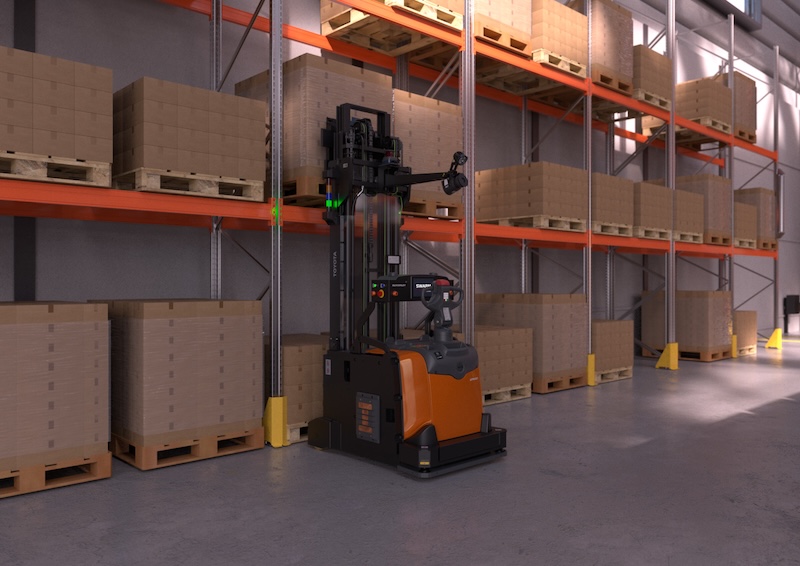
Toyota Material Handling Europe has launched Swarm Automation Transport — an integrated AGV system combining the SAI125CB automated counterbalance stacker with T-ONE control software. Designed for mixed fleets and diverse pallet types (euro and bottom-deck), it supports pallet transport, stacking, and replenishment across logistics, manufacturing, retail, and e-commerce settings. The system enables vertical storage up to 5 meters independently (12 meters with complementary systems), features lithium-ion auto-charging, and a 360-degree safety suite. José Maria Gener, VP Sales & Marketing, calls it "a major step" toward accessible warehouse automation.
According to roboticsandautomationnews.com, Toyota Material Handling Europe has introduced the Swarm Automation Transport system — a new automated guided vehicle (AGV) platform designed for flexible, scalable warehouse logistics operations.
Integrated Hardware and Software Platform
The system combines Toyota’s SAI125CB automated counterbalance stacker with its proprietary T-ONE control software platform, enabling real-time coordination across both fully automated and mixed fleets of manual and automated equipment. Unlike siloed automation solutions, Swarm is engineered to support concurrent workflows — including pallet transport, stacking, and replenishment — while maintaining interoperability with legacy infrastructure and human-operated forklifts.
Versatile Pallet Handling and Operational Flexibility
- Supports multiple pallet formats: euro pallets and bottom-deck pallets
- Enables both standard and turned pallet loading at low to mid-lift heights
- Deployable across diverse environments: logistics warehouses, manufacturing facilities, retail distribution centers, and e-commerce operations
- Operates as either a fully automated solution or in hybrid configurations alongside manual trucks — facilitating phased automation adoption
System Integration and Vertical Capability
Swarm Automation Transport is designed to interoperate with other Toyota automated equipment, including automated reach trucks. This integration allows for independent pallet storage up to 5 meters, and up to 12 meters when deployed in combination with complementary systems. The platform targets high-frequency, repetitive tasks such as buffer zone handling, line-side replenishment, and cross-dock transport — all critical nodes in modern warehouse flow optimization.
Scalability, Safety, and Energy Efficiency
The system uses lithium-ion batteries with automatic charging, which Toyota states reduces energy consumption and extends operational uptime. A 360-degree safety system — incorporating sensors, laser scanners, and physical bumpers — is embedded to mitigate collision risks in dynamic, shared workspaces. These features align with industry-wide priorities: OSHA data shows that forklift-related incidents account for roughly 7% of all workplace fatalities in US warehousing, while the International Federation of Robotics reports global warehouse automation adoption grew 12.4% year-on-year in 2023, driven by labor shortages and throughput demands.
“Swarm Automation Transport marks a major step in our mission to make automation accessible to every warehouse,” says José Maria Gener, vice president sales and marketing at Toyota Material Handling Europe.
This launch follows Toyota’s broader automation roadmap, including its 2022 rollout of automated reach trucks in Germany and its 2023 partnership with Swiss logistics provider Kuehne + Nagel to pilot mixed-fleet orchestration in Zurich. It also reflects a sector-wide trend: DHL launched its own modular AMR fleet management platform, SynQ, in early 2024; Amazon continues expanding its custom-built Proteus and Sparrow robots across fulfillment centers; and Walmart announced a $2.7 billion investment in automation upgrades across 25 distribution centers in 2023. For supply chain professionals, Swarm offers a pragmatic entry point — especially for mid-sized facilities where full-scale robotic depots remain cost-prohibitive. Its plug-and-play compatibility with existing WMS and MES systems lowers integration risk, while its support for varied pallet types avoids costly re-engineering of inbound packaging standards.
Source: Robotics & Automation News
Compiled from international media by the SCI.AI editorial team.


