South Korea’s supply chains face acute strain as force majeure events—including the Iran war and a fire at Anjeon Industry—trigger refinery cuts, auto production halts, and airline route cancellations. GS Caltex reduced crude processing by 125,000 bpd to 675,000 bpd; Donghee Auto suspended Ray and Morning assembly for 11 days; and carriers like VietJet Air and Aero K scaled back regional air freight capacity. With Anjeon supplying >50% of Hyundai/Kia’s engine valves and government export controls tightening, petrochemical feedstock shortages and extended vehicle lead times (7–8 months) are now entrenched. Industry leaders warn prolonged Middle East conflict could undermine long-term competitiveness.
According to en.sedaily.com, escalating force majeure events—including the Iran war and a major fire at Anjeon Industry in Daejeon—are triggering cascading production halts across South Korea’s industrial supply chains. Refiners have reduced crude processing volumes, automakers have suspended vehicle assembly, and airlines are canceling routes amid fuel shortages and procurement constraints.
Refining Sector Slows Amid Crude Procurement Pressures
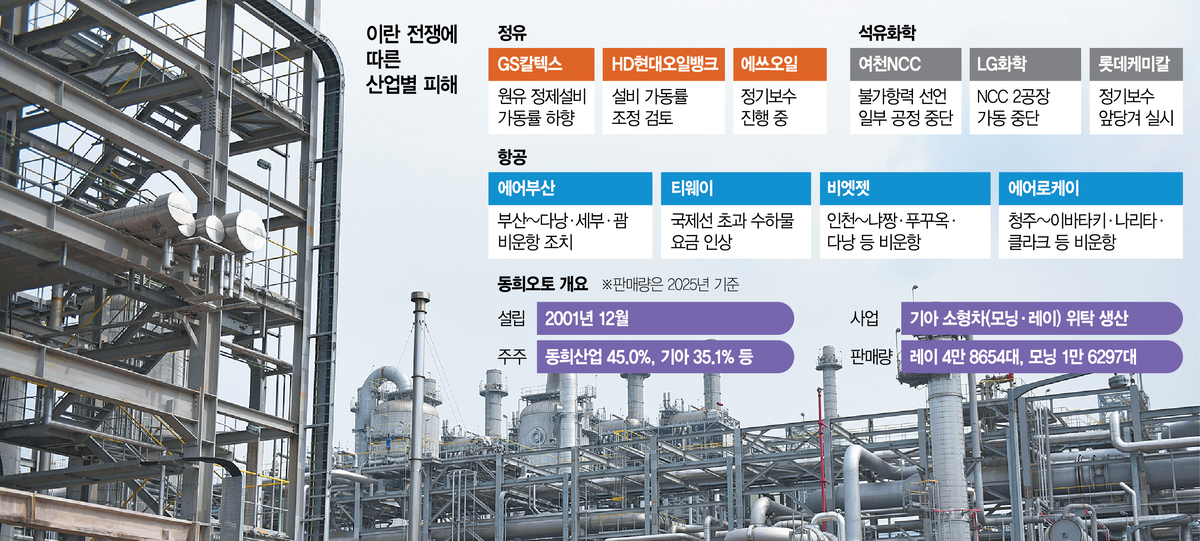
GS Caltex recently cut its daily crude oil refining volume from 800,000 barrels to 675,000 barrels—a reduction of 125,000 barrels per day. The company is also reviewing further cuts to its refining facility utilization rate. Other major refiners are responding similarly: S-Oil entered scheduled maintenance this month and shut down one of three refining units at its Onsan plant; SK Energy and HD Hyundai Oilbank have advanced their planned maintenance timelines. HD Hyundai Oilbank and remaining refiners are actively monitoring crude oil supply conditions and assessing additional utilization adjustments.
This contraction follows the South Korean government’s implementation of a price ceiling and export controls on the 13th—measures that have intensified profitability pressure on refiners already strained by geopolitical volatility in the Middle East.
Cascading Impact on Petrochemicals and Auto Production
The decline in refining volumes directly threatens petrochemical operations, as naphtha and other base feedstocks—produced during refining—are essential raw inputs. Reduced output will inevitably squeeze petrochemical plant utilization rates further.
Meanwhile, the fire at Anjeon Industry—a key automotive engine valve supplier based in Daejeon—has triggered a critical bottleneck. Anjeon supplies more than half of the engine valves used by Hyundai Motor and Kia. As a result, Donghee Auto—which exclusively contract-manufactures Kia’s Morning and Ray models—halted operations at its Seosan plant from the afternoon of April 1 through April 11. The Ray, a steady seller with 48,654 units sold last year, already faces delivery delays of seven months for the conventional model and eight months for the Ray EV; the shutdown is expected to extend those lead times.
Donghee Auto receives engines from Hyundai Wia, which has reportedly curtailed supply volumes following the fire.
Airline Route Cuts Reflect Jet Fuel Shortages
Airlines are responding to jet fuel scarcity with widespread route adjustments. China Southern Airlines canceled select flights on the Incheon–Changchun route from April 1–10. VietJet Air implemented an emergency suspension of the Incheon–Phu Quoc route for all of April and reduced frequency on the Busan–Nha Trang route from seven flights per week to four. Aero K plans partial suspension of four international routes—Cheongju–Ibaraki, Cheongju–Narita, Cheongju–Clark, and Cheongju–Ulaanbaatar—from next month through June 23. T’way Air (091810.KS) announced it will raise excess baggage fees on most international routes starting April 30.
Broader Industry Concerns
Korean industry stakeholders warn that persistent disruptions from geopolitical crises and industrial accidents could erode mid- to long-term competitiveness. The refining and petrochemical sectors—already impacted by fallout from the Iran war—face inevitable profitability deterioration if Middle East instability endures.
Source: en.sedaily.com
Compiled from international media by the SCI.AI editorial team.