Skip to content

Supply Chain · Warehousing & Transport

DHL & Locus Robotics Hit 1 Billion Warehouse Picks

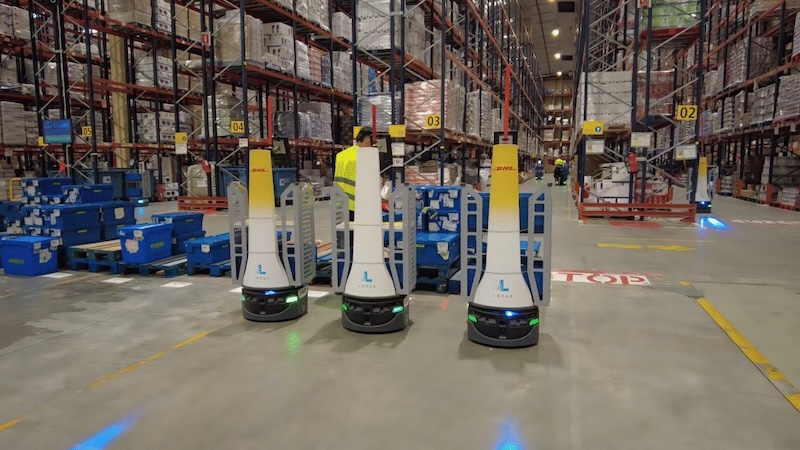
DHL Supply Chain and Locus Robotics have completed their one billionth warehouse pick using autonomous mobile robots (AMRs), achieved across more than 40 global facilities. Since their 2017 partnership, deployments have delivered 30–180% gains in units picked per hour and an 80% reduction in staff training time. The milestone reflects a broader industry shift toward automation as core infrastructure — prioritizing consistent throughput over speed alone. DHL’s expanded agreement targets 5,000 AMRs globally, reinforcing scalability as central to modern fulfillment strategy.

Original source: Source information pending

DHL & Locus Robotics Hit 1 Billion Warehouse Picks

According to roboticsandautomationnews.com, DHL Supply Chain and Locus Robotics have completed their one billionth warehouse pick using autonomous mobile robots (AMRs) — a landmark achievement in large-scale warehouse automation deployment.

Global Deployment Across 40+ Facilities

The milestone pick occurred inside a DHL-managed facility and was executed by a single Locus AMR operating within DHL’s global network of automated fulfillment centers. Though the item was a modest pink beanie, the event underscores the operational scale now routine in modern logistics infrastructure.

DHL first partnered with Locus Robotics in 2017, responding to intensifying e-commerce demand and the need for higher warehouse productivity. Since then, the collaboration has expanded to more than 40 DHL-managed facilities worldwide, spanning e-commerce, retail, and healthcare logistics sectors.

Thousands of Locus AMRs operate under coordination from Locus Robotics’ warehouse execution platform — a system designed to integrate robotic fleets with human workers for goods movement and order picking.

Measurable Operational Gains

DHL reports consistent performance improvements since deployment began:

  • 30–180% increase in units picked per hour
  • 80% reduction in training time for warehouse staff

These metrics reflect real-world adoption beyond pilot phases — a shift from experimental use to embedded infrastructure.

A Decade of Scaling Automation

The one billion pick follows steady growth: in 2020, the global Locus customer network — anchored by DHL — surpassed 100 million picks, also at a DHL facility. This progression highlights how rapidly AMR-based fulfillment has scaled amid evolving demand patterns.

In line with this growth, DHL and Locus announced an expanded agreement targeting deployment of 5,000 AMRs across DHL’s global network. At the time, DHL Supply Chain CEO Oscar de Bok emphasized scalability as foundational to successful automation:

“An idea is only a good idea if it can scale.” — Oscar de Bok, CEO, DHL Supply Chain

From Speed to Consistency

The milestone signals a strategic pivot in logistics operations. While speed once defined competitive advantage, operators increasingly prioritize consistent throughput and reliability — especially amid unpredictable e-commerce demand driven by viral trends, flash promotions, and rapid behavioral shifts.

Automation systems that sustain stable output across fluctuating volumes are now viewed as mission-critical infrastructure — not just efficiency tools.

Infrastructure Behind the Expected Experience

For end consumers, the billionth pick is invisible. What they experience instead is the outcome: orders arriving on schedule, regardless of complexity or volume. Behind that reliability lies an increasingly automated, coordinated, and data-informed physical layer — one that supports the precise orchestration required across global supply chains.

Source: Robotics & Automation News

Compiled from international media by the SCI.AI editorial team.

Ask SCI.AI Finished reading? Continue with SCI.AI. Explore the related policy, route, company and historical context. Continue asking
NRF: Early peak shipping season to subside in September
Supply Chain

NRF: Early peak shipping season to subside in September

The National Retail Federation (NRF) and Hackett Associates report that the early peak shipping season is ending, with U.S. port imports expected to decline for the rest of 2026. May was the busiest month at 2.24 million TEU. Tariff changes and supply chain disruptions drove retailers to pull forward orders. Consumer spending remains resilient. Full-year 2026 imports are projected at 25.5 million TEU, up 0.1% from 2025.

China’s exports rise 14%, imports up 22% amid trade war resilience
Supply Chain

China’s exports rise 14%, imports up 22% amid trade war resilience

China’s foreign trade rose 17.3% to ¥30.13 trillion in the first seven months of 2026, with exports up 14% and imports surging 22%. High-tech exports jumped over 50% in July, accounting for nearly 60% of monthly export growth. U.S.-China trade fell 1.6%, while ties with over 180 countries—including ASEAN and the EU—expanded. Green exports like EVs and lithium batteries posted double-digit growth for the 17th straight month. China also applies zero tariffs to imports from 63 countries.

TSMC revenue up 33.7%, ASML ships 86 lithography machines
Manufacturing

TSMC revenue up 33.7%, ASML ships 86 lithography machines

TSMC reported $40.2 billion in Q2 2026 revenue — up 33.7% year-on-year — with 2-nm process contributing 3% of sales. ASML shipped 86 new lithography machines in the same quarter, boosting revenue to €9.32 billion ($10.69 billion). TSMC holds 73% of the global foundry market, while ASML’s EUV tools remain essential for sub-3-nm chip production. Both companies’ five-year net income grew over 90% (ASML) and 251% (TSMC). TSMC’s $100 billion Arizona expansion will support 2-nm manufacturing and advanced packaging.

Welcome Back!

Login to your account below

Create New Account!

Fill the forms below to register

Retrieve your password

Please enter your username or email address to reset your password.

Scan to share via WeChat

Open WeChat and scan the QR code to share

QR Code

Add New Playlist

