

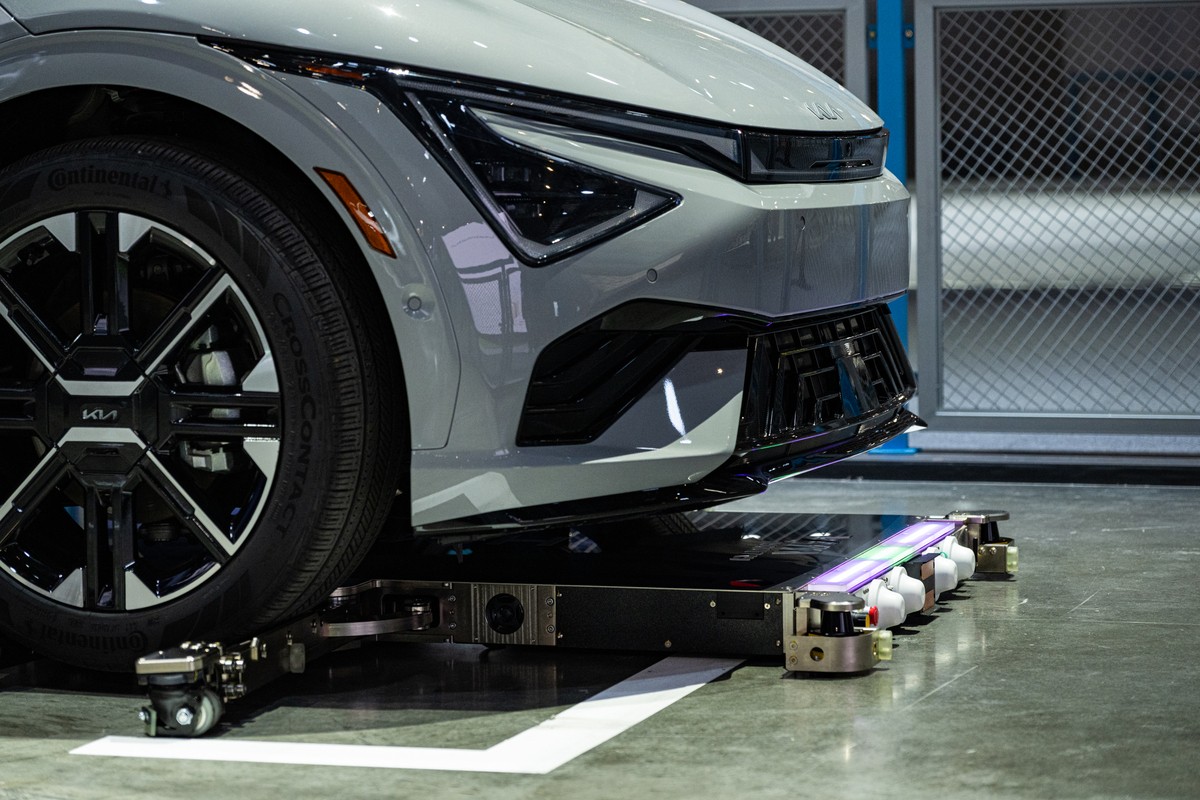
Hyundai Wia will invest 400 billion won in robotics — 1.6 times its 250 billion won robot sales in 2025 — targeting 400 billion won in robotics revenue by 2028. The company is deploying 94 logistics robots across Hyundai Motor Group sites in Singapore, Georgia, Ulsan, Gwangju, and Hwaseong, while building production capacity at its Changwon plant. Strategic investments in AI and software startups aim to secure technology for driverless forklifts and mobile picking robots. The effort supports Hyundai Motor Group’s Atlas-based unmanned manufacturing vision and seeks to raise external robotics sales to 50% by 2030.
According to en.sedaily.com, Hyundai Wia plans to invest 400 billion won in its robotics business over the medium to long term — an amount equivalent to 1.6 times its 250 billion won in robot-related sales last year.
Strategic investment and technology acquisition
The investment is separate from Hyundai Motor Group’s recently announced Yeongnam-region initiative and will be funded partly through the planned sale of Hyundai Wia’s defense business. The company is actively reviewing strategic equity investments in artificial intelligence (AI) and software startups to secure next-generation automation technologies early in the development cycle.
Hyundai Wia aims to expand its portfolio of industrial robots for manufacturing and logistics applications. Key development projects include the mobile picking robot (MPR), an autonomous, AI-driven logistics robot designed to navigate warehouses and factories independently to locate and retrieve specific goods, and driverless forklifts. The company also plans to build dedicated robot production facilities, including at its Changwon plant.
Global deployment and infrastructure synergy
Hyundai Wia has already deployed 94 logistics robots across multiple Hyundai Motor Group sites: the Hyundai Motor Group Innovation Center in Singapore (HMGICS), Hyundai Motor Group Metaplant America (HMGMA) in Georgia, Hyundai Motor’s Ulsan plant, Kia’s Gwangju plant, and Kia’s Hwaseong plant. These deployments support automated material handling, internal transport, and warehouse operations.
The robotics expansion is explicitly aligned with Hyundai Motor Group’s broader AI and automation strategy — particularly its focus on the Atlas humanoid robot developed by Boston Dynamics. Hyundai Motor Group is designing unmanned manufacturing facilities where Boston Dynamics handles Atlas mass production while Hyundai Wia constructs and integrates the surrounding automation infrastructure, including control systems and physical AI environments.
Growth targets and structural transformation
Hyundai Wia views robotics as a core growth engine beyond its traditional group-affiliated business. It has set a target to grow robotics-related external sales to 50% of total robotics revenue by 2030. To achieve this, the company plans to scale its robot-related sales from 250 billion won in 2025 to 400 billion won by 2028.
A Hyundai Wia official stated:
“Ultimately, we aim to realize an ‘AX (AI transformation) factory’ that unmans the entire manufacturing and logistics process based on robots and AI.”
The official added:
“By 2028, we plan to build a fully automated system at the Changwon plant to secure safety and technological capabilities, and to proceed with a structural improvement that reduces dependence on group affiliates.”
This includes developing integrated control systems and robot operation platforms tailored for high-demand zones such as Saemangeum and the Yeongnam region, where Hyundai Motor Group is making new large-scale investments.
Source: en.sedaily.com
Compiled from international media by the SCI.AI editorial team.


