

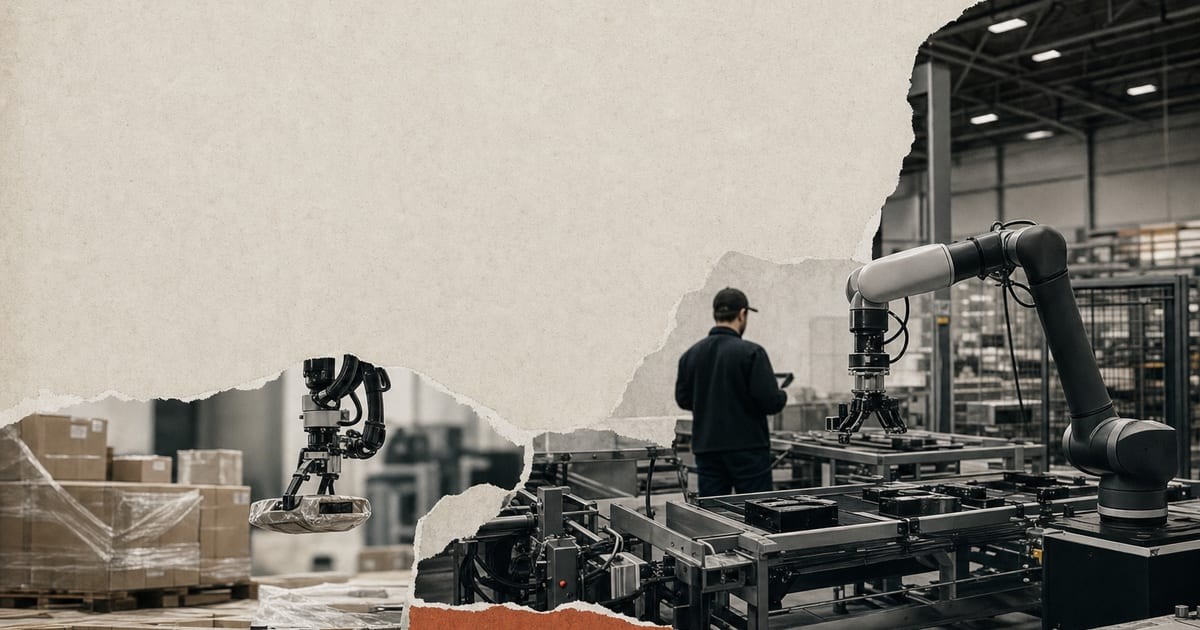
Industrial robotics is shifting toward integrated physical AI systems, no-code cobots for hazardous and precision tasks, and sim-to-real validation. Ambi Robotics and Pickle Robot launched the first revenue-generating autonomous truck unloading system in late June 2026. Hirebotics introduced an explosion-proof no-code painter; Productive Robotics debuted its 7-axis OB7 cobot for gear machining at IMTS. X Square Robot reached a $2.8 billion valuation backed by China’s top four internet firms. A German survey found 82% support humanoid robot adoption, while Jane Heffner assumed IFR presidency in early July 2026.
According to www.marketscale.com, a $2.8 billion funding round for physical AI underscores surging capital allocation toward embodied intelligence in industrial robotics — alongside commercially deployed no-code collaborative robots now tackling explosion-proof spray-finishing and abrasive gear machining.
Integrated physical AI delivers first revenue-generating truck unloading
Ambi Robotics and Pickle Robot jointly announced in late June 2026 the first commercial integration of a physical AI system that fully automates truck unloading and palletizing without human intervention. The deployment marks a shift from conceptual pitch decks to operational reality — with revenue generation confirmed by both companies. Unlike multipurpose standalone robots, this architecture links two specialized systems — Ambi’s perception and decision stack with Pickle’s manipulation hardware — into a coordinated workflow governed by shared AI. This modular, interoperable design is becoming the dominant pattern in logistics automation, prompting distribution center operators to evaluate vendor integration capabilities rather than individual robot SKUs.
Techman Robot reinforced this systems-first approach at Automate 2026 in June, positioning its AI automation platform around rapid deployment and standardized quality control — particularly for manufacturers relocating production to the United States. The company explicitly warned against the “Hidden Cost Trap” of traditional automation: extended commissioning cycles and persistent programming expenses that erode return on investment.
No-code cobots expand into high-risk, high-precision applications
Hirebotics launched a no-code cobot painting solution in late June 2026, built on FANUC’s CRX-10iA/L Paint hardware and Hirebotics’ Beacon Platform. Certified as explosion-proof, the system eliminates the need for dedicated paint cells or complex safety infrastructure — targeting manufacturers who previously deferred spray-finishing automation due to cost and regulatory barriers. Meanwhile, Productive Robotics demonstrated its 7-axis OB7 cobot at IMTS, applying it to abrasive machining, sawing, and gear finishing. Its seven degrees of freedom enable access to workpiece orientations inaccessible to standard 6-axis cobots — all configured via zero-programming plug-and-play setup.
Both developments respond directly to an enterprise constraint repeatedly cited across industry surveys: the bottleneck is not robot hardware availability, but the acute shortage of certified robotic programmers and integrators. No-code platforms transfer configuration responsibility from specialists to frontline operators — reducing deployment timelines and sustaining operational continuity.
Capital flows toward physical AI foundation models
X Square Robot closed four consecutive financing rounds, achieving a valuation exceeding $2.8 billion, according to RoboticsTomorrow. The company is developing embodied AI foundation models — the robotics equivalent of large language models — trained to generalize across diverse physical tasks rather than being hard-coded for single-use applications. Notably, all four major Chinese internet technology leaders are listed as investors, signaling strategic alignment beyond financial return. In contrast, WIRobotics adopted an open-ecosystem strategy, releasing its ALLEX simulation model in late June 2026 as the first component of a physical AI development platform. High-fidelity sim-to-real validation — testing robot behaviors in digital twin environments before hardware deployment — is now a mandatory procurement criterion for engineering teams evaluating robotic systems.
Industry context: Europe accelerates humanoid adoption, IFR leadership shifts
A late-June 2026 survey of German economic stakeholders, reported by RoboticsTomorrow, found that 82% consider humanoid robots critical drivers of future innovation — with strong calls for accelerated adoption across automotive and precision manufacturing sectors. As Germany remains a leading indicator for Western automation cycles, this sentiment directly informs five-year capital planning for procurement teams. Concurrently, Jane Heffner was named president of the International Federation of Robotics (IFR) in early July 2026, with Adrien Brouillard appointed vice president. The IFR’s annual World Robotics report serves as the global benchmark for robot installation data — and leadership transitions often precede shifts in measurement frameworks used for internal business cases.
Operations teams should audit inbound logistics workflows against the Ambi-Pickle model: if truck unloading and palletizing remain manual, a proven commercial alternative now exists. When evaluating cobots for painting or machining, vendors must be asked about post-deployment programming requirements — not just initial setup. And organizations relying on IFR data for forecasting should confirm which metrics the new leadership prioritizes before finalizing 2027 projections.
Source: marketscale.com
Compiled from international media by the SCI.AI editorial team.


