Skip to content

Japan & Korea Supply Chain

CMA CGM acquires FedEx Supply Chain for $1.4B to triple North American logistics

CMA CGM has agreed to acquire FedEx Supply Chain for $1.4 billion, nearly tripling CEVA Logistics’ North American contract logistics operations. The deal, announced July 1, 2026, adds ~150 warehouses and 20,000 employees to CEVA’s existing 1,000-warehouse global network, which handled 15 million shipments in 2025. It also establishes CMA CGM as FedEx’s preferred ocean carrier and triggers multi-year air and ocean freight agreements phased in through 2028. The acquisition supports CMA CGM’s $20 billion U.S. investment pledge made in 2025 and advances its shift toward integrated end-to-end logistics.

Original source: maritime-executive.com

CMA CGM acquires FedEx Supply Chain for $1.4B to triple North American logistics

According to maritime-executive.com, CMA CGM has agreed to acquire FedEx Supply Chain for an enterprise value of $1.4 billion, a move designed to nearly triple the size of its North American contract logistics operations through subsidiary CEVA Logistics.

Strategic Expansion in North America

The acquisition, announced on July 1, 2026, marks a major step in CMA CGM’s multi-year transformation from a container shipping carrier into an integrated end-to-end logistics provider. By integrating FedEx Supply Chain — a U.S.-based subsidiary of FedEx Corp. — CEVA Logistics will expand its North American footprint to approximately 150 warehouses and a combined workforce of 20,000 people. This significantly augments CEVA’s existing global scale: as of 2025, it operated 1,000 warehouses worldwide and handled 15 million shipments that year.

Integration and Commercial Alignment

Under the terms of the deal, CMA CGM will become a preferred ocean carrier for FedEx, while both companies will enter into multi-year commercial agreements covering air and ocean freight services. These agreements are expected to be phased in between now and 2028. The sale aligns with FedEx’s strategic pivot to focus on high-value verticals and follows the recent spin-off of FedEx Freight, completed last month. FedEx stated it is streamlining its portfolio “to better position the business” — a rationale confirmed by the company’s public statements.

Leadership Vision and U.S. Investment Commitment

Rodolphe Saade, Chairman and Chief Executive of the CMA CGM Group, emphasized the dual strategic intent behind the acquisition: strengthening integrated supply chain offerings and reinforcing long-term commitment to the U.S. market.

“We are strengthening our ability to provide customers with integrated supply chain solutions. These deals also reinforce our long-term commitment to investing in the United States and supporting the resilience and efficiency of its supply chain.” — Rodolphe Saade, Chairman and Chief Executive of the CMA CGM Group

This commitment includes a pledge Saade made to former President Donald Trump during an Oval Office meeting in 2025 to invest $20 billion in the United States over a four-year period.

Timeline and Regulatory Context

The transaction is expected to close in 2026, subject to customary regulatory approvals and closing conditions. CMA CGM has been systematically expanding its logistics and terminals businesses since acquiring CEVA Logistics in 2019. That acquisition itself was part of a broader consolidation strategy, with CEVA assembled through multiple prior acquisitions. The FedEx Supply Chain purchase represents the largest single addition to CEVA’s North American infrastructure to date and positions it among the top-tier contract logistics providers in the region.

Source: maritime-executive.com

Compiled from international media by the SCI.AI editorial team.
Ask SCI.AI Finished reading? Continue with SCI.AI. Explore the related policy, route, company and historical context. Continue asking
South Korea, Brazil Ink Deal to Restart Mercosur FTA Talks
Japan & Korea Supply Chain

South Korea, Brazil Ink Deal to Restart Mercosur FTA Talks

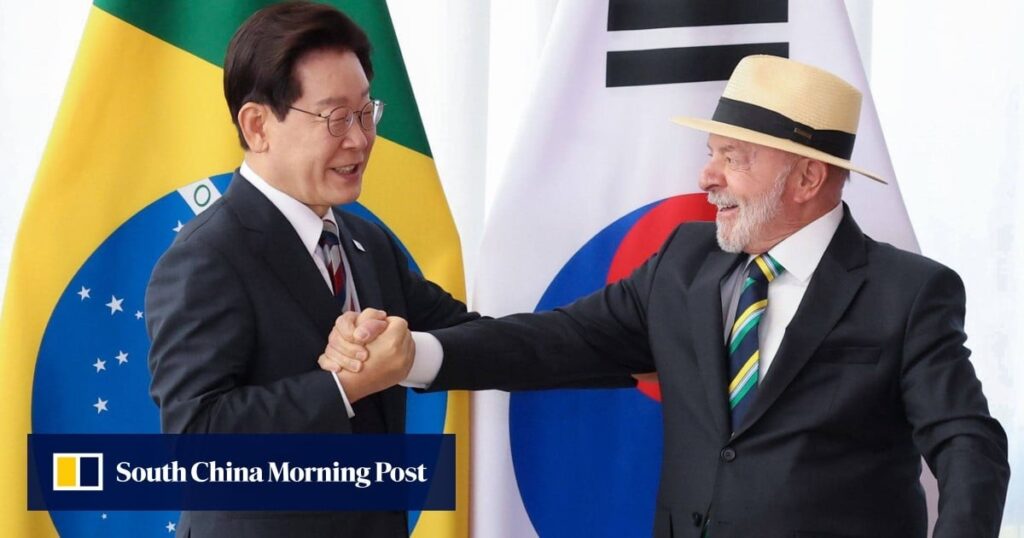
South Korean President Lee Jae Myung and Brazilian President Luiz Inacio Lula da Silva agreed on 29 July 2026 to restart free-trade negotiations with Mercosur — the South American bloc of Argentina, Brazil, Paraguay, Uruguay, and Bolivia. A joint working group will prepare a formal declaration for the Mercosur summit in December 2026. Talks, launched in 2018, stalled in late 2021 amid manufacturing-sector concerns. Analysts say Seoul must back diplomacy with real investment and technology transfer. Mercosur’s $3.5 trillion GDP and 270 million consumers make it a high-stakes opportunity for Korean exporters and supply chain planners.

Nissan to export US-built Murano to Japan in early 2027
Japan & Korea Supply Chain

Nissan to export US-built Murano to Japan in early 2027

Nissan will begin exporting the U.S.-built Murano SUV from its Smyrna, Tennessee plant to Japan in early 2027 — enabled by a September 2025 U.S.-Japan trade agreement that lowered U.S. tariffs on Japanese vehicles from 25% to 15% and allowed U.S. safety certification to satisfy Japanese regulatory requirements. The move follows similar announcements by Toyota and Honda to export U.S.-assembled models to Japan. Nissan sold 42,747 Muranos in the U.S. in 2025 (+121% YoY), while U.S. imports from Japan fell 17.4% to 113,094 units.

Japan pulls rare earths from Pacific seabed; yttrium at 1,000 ppm
Japan & Korea Supply Chain

Japan pulls rare earths from Pacific seabed; yttrium at 1,000 ppm

Japan has extracted yttrium (at 1,000 ppm) and dysprosium from deep-sea mud near Minamitorishima Island in the Pacific Ocean. The seabed deposit lies 2,000 meters below the surface and forms part of Japan’s strategy to cut reliance on China, which supplies over 90% of global refined rare earths. Despite promising assays, commercialization remains distant due to high extraction costs, with no large-scale pilot expected before the late 2030s. Japan has committed ¥15 billion to seabed R&D and is pursuing alternatives including domestic smelting (Shin-Etsu, 2027), recycling (Toyota Tsusho), and international partnerships (France, Greenland). Rare-earth costs for Japanese firms rose over 20% in early 2026.

Welcome Back!

Login to your account below

Create New Account!

Fill the forms below to register

Retrieve your password

Please enter your username or email address to reset your password.

Scan to share via WeChat

Open WeChat and scan the QR code to share

QR Code

Add New Playlist