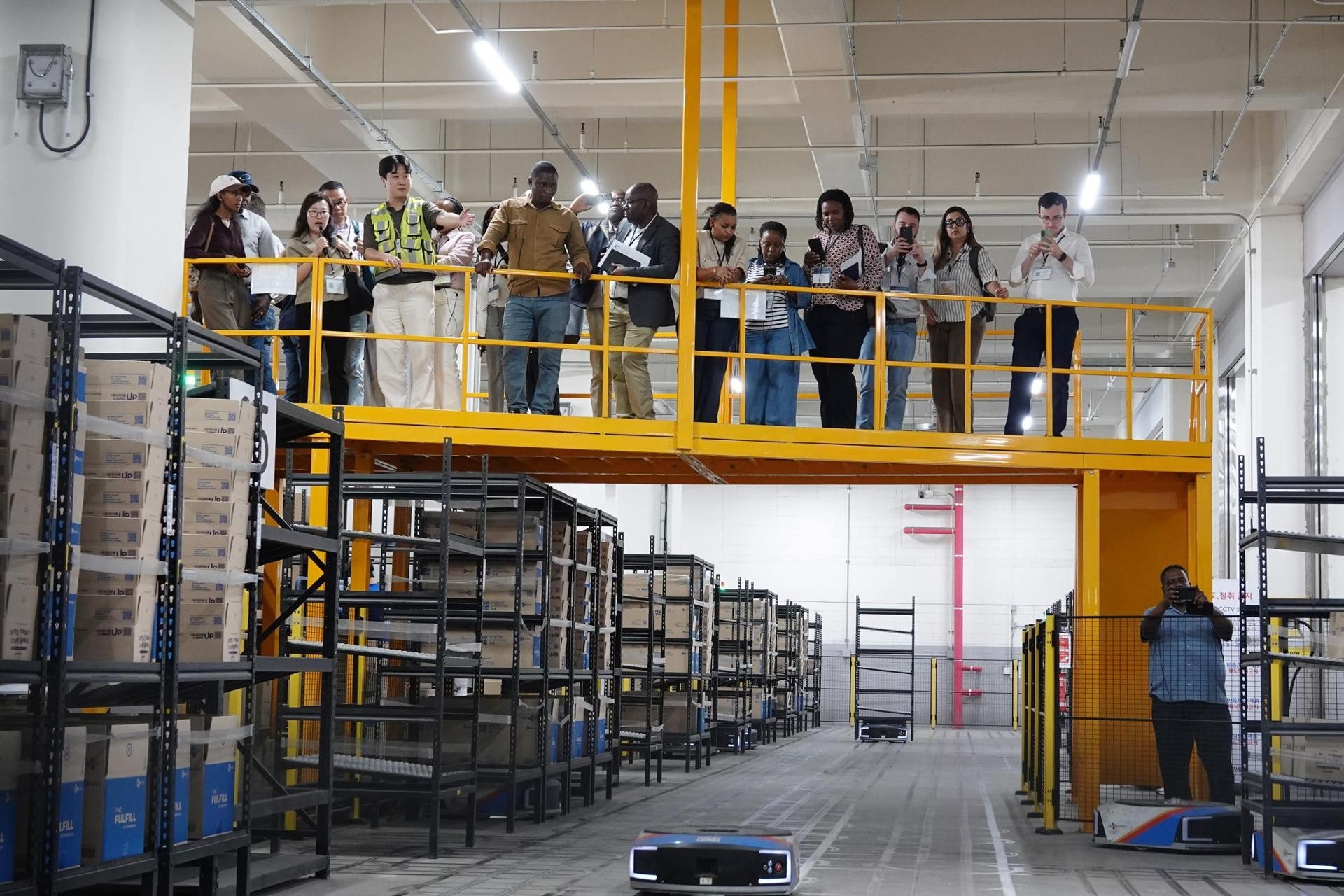
The World Bank Group brought over 100 transport and logistics officials from 10+ countries to CJ Logistics’ Gunpo and Incheon facilities between June 16–25, 2026. Delegates observed 126 AGVs at Gunpo and 140 AI-powered picking robots at Incheon — both serving as models for scalable, resilient logistics infrastructure in developing economies. Nicolas Peltier-Thiberge, World Bank’s Global Director for Transport, called the visit a demonstration of integrated infrastructure and operations, signaling intent to expand cooperation on supply chain diagnostics, hub design, and warehouse operations.
According to www.koreatimes.co.kr, the World Bank Group hosted more than 100 transport and logistics officials from over 10 countries across Asia, Africa, the Pacific, and Latin America at CJ Logistics facilities in Korea between June 16–25, 2026.
Capacity-building program with Korean partners
The visits formed part of the World Bank Group Academy on Advancing Connectivity and Logistics Solutions — a joint capacity-building initiative run with the Korea Transport Institute, a government-funded research body, and the KDI School of Public Policy and Management, a graduate institution affiliated with the Korea Development Institute. The academy supports the World Bank Group’s broader objective of building economic corridors: integrated road, rail, port, and logistics networks designed to strengthen cross-border connectivity within regions.
The four-session program included site tours at two key CJ Logistics facilities: the Gunpo Smart Fulfillment Center in Gyeonggi Province and the Incheon Global Distribution Center. Both sites serve as operational benchmarks for scalable, technology-driven logistics infrastructure in developing economies.
Automated systems on display
At the Gunpo center, delegation members observed an automated fulfillment system deploying 126 automated guided vehicles (AGVs) for goods movement and packaging, alongside real-time monitoring dashboards and fully automated inspection and packing lines. These systems enable high-throughput, error-reduced order processing under variable demand conditions.
The Incheon facility showcased 140 picking robots that deliver items to human workers on demand, plus mobile robotic palletizers using artificial intelligence vision technology to sort and stack outbound shipments by destination country. The center also handles customs clearance, final packaging, and outbound processing for orders across the Asia-Pacific region — underscoring its role as a regional logistics hub.
High-level engagement and cooperation roadmap
On Friday, June 25, 2026, Nicolas Peltier-Thiberge, Global Director for Transport at the World Bank, visited CJ Logistics’ headquarters in Jongno District, Seoul, for strategic talks on collaboration in supply chain consulting, food security, and logistics infrastructure development in developing countries.
Peltier-Thiberge emphasized integration as a cornerstone of modern logistics resilience.
“The visit demonstrated how logistics infrastructure and operating systems can be integrated to improve both efficiency and resilience,” — Nicolas Peltier-Thiberge, Global Director for Transport, World Bank
He expressed hope for broad cooperation spanning supply chain diagnostics, hub design, transport system development, and warehouse operations — areas where CJ Logistics has deployed proven, scalable solutions in domestic and emerging-market contexts.
CJ Logistics’ investment in automation reflects wider industry trends: according to the International Federation of Robotics, global warehouse robot installations rose 22% year-on-year in 2025, with Asia-Pacific accounting for 48% of new deployments. The company’s Gunpo and Incheon facilities represent replicable models for public-sector stakeholders seeking to modernize national logistics ecosystems without requiring greenfield infrastructure.
Source: koreatimes.co.kr
Compiled from international media by the SCI.AI editorial team.