Skip to content

Japan & Korea Supply Chain

Samsung Strike Blocked Amid $30B Bonus Dispute

A South Korean court has blocked a planned 18-day strike by over 45,000 Samsung Electronics workers, averting a potential $67 billion disruption. The dispute centers on union demands for 15% of Samsung’s projected $200 billion 2026 operating profit as a bonus—up to $30 billion. The company has already scaled back chip production, citing AI-driven demand and supply chain risks. The ruling pushes the standoff back to negotiations after an emergency arbitration. The conflict highlights growing labor tensions amid record profits and concentrated semiconductor supply chains.

Original source: kedglobal.com

Samsung Strike Blocked Amid $30B Bonus Dispute
📋 本文要点

A South Korean court has blocked a planned 18-day strike by over 45,000 Samsung Electronics workers, averting a potential $67 billion disruption. The dispute centers on union demands for 15% of Samsung’s projected $200 billion 2026 operating profit as a bonus—up to $30 billion. The company has already scaled back chip production, citing AI-driven demand and supply chain risks. The ruling pushes the standoff back to negotiations after an emergency arbitration. The conflict highlights growing labor tensions amid record profits and concentrated semiconductor supply chains.

South Korean Court Blocks 18-Day Samsung Strike

According to KED Global, a South Korean court has blocked a planned 18-day strike by more than 45,000 unionized workers at Samsung Electronics, effectively halting the labor action days before it was set to begin. The ruling comes amid escalating tensions over a proposed 15% share of 2026 operating profits as a performance bonus, which could amount to 45 trillion won ($30 billion), according to industry analysts.

Production Cuts and Supply Chain Concerns

Samsung Electronics has already begun scaling back semiconductor production in anticipation of the strike, taking emergency measures to mitigate potential disruptions. The company, the world’s largest memory chipmaker, faces the risk of over $67 billion in economic damage if the strike proceeds, industry officials have warned. The move affects critical components such as DRAM and NAND flash memory, which are essential for artificial intelligence (AI) systems and global data infrastructure.

“A walkout at the world’s largest memory chipmaker would be unimaginable for national economic stability,” said Kim Jung-kwan, South Korea’s minister of trade, industry and energy, during a February 2026 cabinet meeting.

Union Demands and Profit Disparity

Unionized workers at Samsung’s Pyeongtaek plant, where around 40,000 employees rallied on April 23, 2026, are demanding the removal of a performance bonus cap and a 15% allocation of the company’s projected $200 billion in 2026 operating profit. The dispute has intensified since Samsung reported its strongest quarterly performance in South Korean corporate history, driven by surging demand for memory chips due to the AI boom.

The company’s Q1 2026 earnings were higher than its full 2025 annual profit, underscoring the financial stakes in the labor negotiations. The labor dispute has also exposed a rift between semiconductor workers and those in non-chip divisions, with some non-chip union members leaving the labor union due to concerns over widening performance bonus disparities.

Emergency Arbitration and Negotiation Deadlock

The court injunction was granted following an emergency arbitration request filed by Samsung. The ruling pushes the dispute back to formal negotiations, suspending the strike until a resolution is reached. The company has rejected previous offers to enter talks, citing the need to maintain stable supply chain operations, particularly for high-bandwidth memory (HBM) chips used in AI accelerators.

Industry experts note that the semiconductor supply chain remains highly concentrated, with Samsung, TSMC, and SK Hynix dominating the global DRAM and NAND markets. Any prolonged disruption at Samsung could ripple through global tech manufacturing, affecting major clients like NVIDIA, Apple, and Microsoft.

Source: www.kedglobal.com

Compiled from international media by the SCI.AI editorial team.
Ask SCI.AI Finished reading? Continue with SCI.AI. Explore the related policy, route, company and historical context. Continue asking
South Korea, Brazil Ink Deal to Restart Mercosur FTA Talks
Japan & Korea Supply Chain

South Korea, Brazil Ink Deal to Restart Mercosur FTA Talks

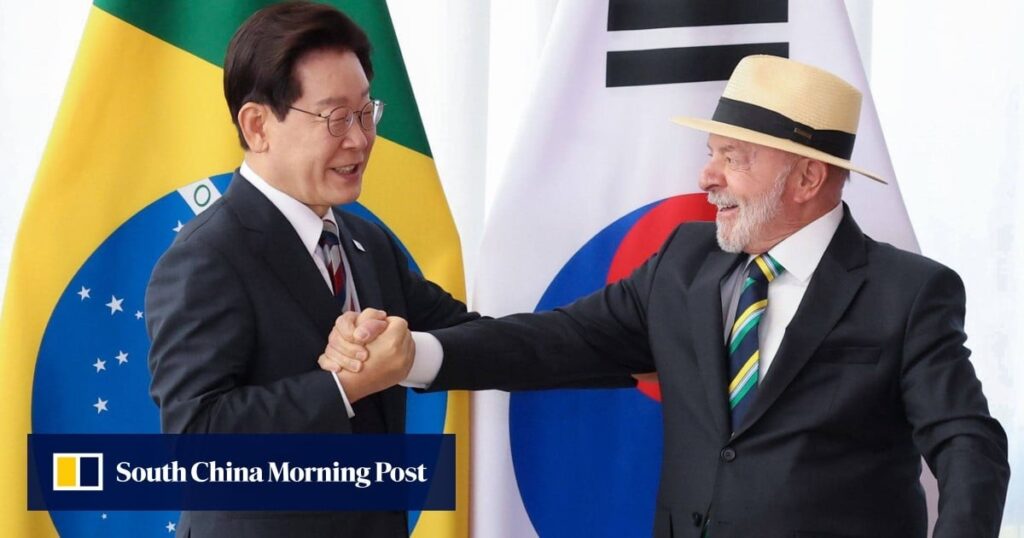
South Korean President Lee Jae Myung and Brazilian President Luiz Inacio Lula da Silva agreed on 29 July 2026 to restart free-trade negotiations with Mercosur — the South American bloc of Argentina, Brazil, Paraguay, Uruguay, and Bolivia. A joint working group will prepare a formal declaration for the Mercosur summit in December 2026. Talks, launched in 2018, stalled in late 2021 amid manufacturing-sector concerns. Analysts say Seoul must back diplomacy with real investment and technology transfer. Mercosur’s $3.5 trillion GDP and 270 million consumers make it a high-stakes opportunity for Korean exporters and supply chain planners.

Nissan to export US-built Murano to Japan in early 2027
Japan & Korea Supply Chain

Nissan to export US-built Murano to Japan in early 2027

Nissan will begin exporting the U.S.-built Murano SUV from its Smyrna, Tennessee plant to Japan in early 2027 — enabled by a September 2025 U.S.-Japan trade agreement that lowered U.S. tariffs on Japanese vehicles from 25% to 15% and allowed U.S. safety certification to satisfy Japanese regulatory requirements. The move follows similar announcements by Toyota and Honda to export U.S.-assembled models to Japan. Nissan sold 42,747 Muranos in the U.S. in 2025 (+121% YoY), while U.S. imports from Japan fell 17.4% to 113,094 units.

Japan pulls rare earths from Pacific seabed; yttrium at 1,000 ppm
Japan & Korea Supply Chain

Japan pulls rare earths from Pacific seabed; yttrium at 1,000 ppm

Japan has extracted yttrium (at 1,000 ppm) and dysprosium from deep-sea mud near Minamitorishima Island in the Pacific Ocean. The seabed deposit lies 2,000 meters below the surface and forms part of Japan’s strategy to cut reliance on China, which supplies over 90% of global refined rare earths. Despite promising assays, commercialization remains distant due to high extraction costs, with no large-scale pilot expected before the late 2030s. Japan has committed ¥15 billion to seabed R&D and is pursuing alternatives including domestic smelting (Shin-Etsu, 2027), recycling (Toyota Tsusho), and international partnerships (France, Greenland). Rare-earth costs for Japanese firms rose over 20% in early 2026.

Welcome Back!

Login to your account below

Create New Account!

Fill the forms below to register

Retrieve your password

Please enter your username or email address to reset your password.

Scan to share via WeChat

Open WeChat and scan the QR code to share

QR Code

Add New Playlist