Skip to content

North America Supply Chain

Mexico Customs Revenue Falls 13% Amid Tariff-Driven Trade Shifts — www.freightwaves.com

Mexico’s customs revenue fell 13% YoY in Jan–Feb 2026 to $11.49B amid tariff-driven shifts, while Canada’s imports surged 8.4% to $72.1B and the U.S. trade deficit with Mexico widened by $4.1B to $16.8B. Data shows companies are restructuring—not halting—cross-border trade: reclassifying goods, adjusting declared values, and rerouting freight. Arvato launched a 270,000-sq-ft logistics hub in Denton, TX to support AI infrastructure growth.

Original source: freightwaves.com

Mexico Customs Revenue Falls 13% Amid Tariff-Driven Trade Shifts — www.freightwaves.com
📋 本文要点

Mexico’s customs revenue fell 13% YoY in Jan–Feb 2026 to $11.49B amid tariff-driven shifts, while Canada’s imports surged 8.4% to $72.1B and the U.S. trade deficit with Mexico widened by $4.1B to $16.8B. Data shows companies are restructuring—not halting—cross-border trade: reclassifying goods, adjusting declared values, and rerouting freight. Arvato launched a 270,000-sq-ft logistics hub in Denton, TX to support AI infrastructure growth.

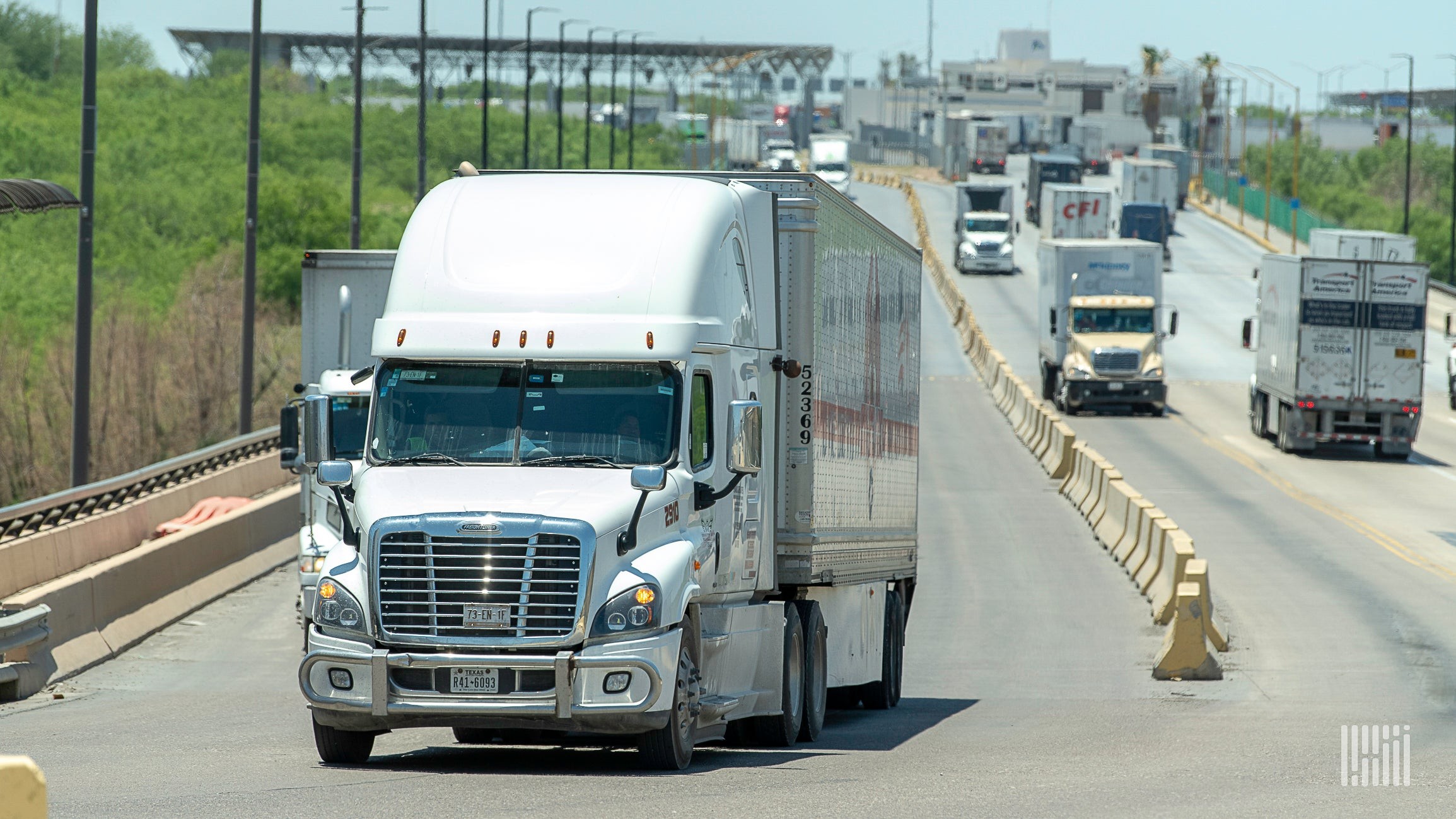
According to www.freightwaves.com, Mexico’s customs revenue fell 13% year over year in real terms for January–February 2026, totaling $11.49 billion, even as trade volumes remained relatively stable — signaling tariff and currency pressures are reshaping, not halting, North American freight flows.

Mexico’s Border Customs Under Pressure

Mexico’s National Customs Agency (ANAM) reported that VAT collected on imports dropped 22.6%, while import duty revenue declined 7%. Land border customs revenue fell 18.2%, and the declared value of goods handled at border crossings dropped 8.1% year over year. Border customs declarations also fell 6.1%, reflecting softer activity at key gateways including Nuevo Laredo, Tijuana, and Ciudad Juárez. The Mexican peso strengthened 15.7% year over year in February, reducing the peso-denominated tax base for duties and VAT.

Canada’s Import Surge and Widening Deficit

Canada’s February 2026 imports surged 8.4% to $72.1 billion, while exports rose 6.4%, widening the trade deficit to $5.7 billion — the largest since August, according to Statistics Canada. Imports from the U.S. jumped 13.6%, driven by gold and motor vehicles; imports of metals, vehicles, and industrial goods reached record highs — consistent with tariff-anticipatory sourcing behavior.

U.S. Trade Deficit Widens Across Key Partners

The U.S. goods and services trade deficit widened to $57.3 billion in February, per the U.S. Bureau of Economic Analysis. Imports rose $15.2 billion, while exports increased $12.6 billion. The U.S. trade deficit with Mexico alone grew by $4.1 billion to $16.8 billion, as imports from Mexico increased and U.S. exports to Mexico declined.

Supply Chain Restructuring, Not Retreat

  • Mexico’s falling customs revenue despite stable freight volumes indicates companies are reclassifying goods, shifting sourcing, or rerouting shipments to reduce tariff exposure.
  • Canada’s record import surge — especially in metals and autos — aligns with documented patterns of front-loading and transshipment during trade policy uncertainty.
  • The U.S. deficit expansion with Mexico reflects ongoing nearshoring momentum: total U.S. imports from Mexico hit $42.3 billion in February, up 9.2% year over year (BEA data cited in FreightWaves follow-up reporting).

Arvato Expands Texas Logistics Infrastructure

Supply chain provider Arvato opened a new logistics hub in Denton, Texas, featuring 270,000 square feet of space — with 150,000 square feet initially operational. Located in the Dallas–Fort Worth metroplex, the facility has direct access to Interstate 35 and is 30 minutes from Dallas/Fort Worth International Airport. It supports AI and data center hardware logistics, including high-security warehousing and white-glove deliveries to active and under-construction facilities.

Source: FreightWaves

Compiled from international media by the SCI.AI editorial team.

Ask SCI.AI Finished reading? Continue with SCI.AI. Explore the related policy, route, company and historical context. Continue asking
Dachser acquires 10% stake in Synergie Canada to expand airfreight
North America Supply Chain

Dachser acquires 10% stake in Synergie Canada to expand airfreight

German logistics firm Dachser has acquired a 10% minority stake in Synergie Canada, a Montreal-based air and sea freight forwarder founded in 2008. The investment strengthens Dachser’s North American presence and supports expansion beyond Europe. Synergie Canada generated €60 million in revenue in 2025 and employs around 100 people. CEO Tobias Burger called Canada 'a highly attractive market' due to its economic links across the Americas and Europe. President Marc-André Guindon noted the partnership will improve customer access to European markets. The deal follows similar moves by Atlas Air Worldwide and Air Charter Service in 2026.

Toyota opens $100M Indiana forklift plant, targets 80% electric by 2035
North America Supply Chain

Toyota opens $100M Indiana forklift plant, targets 80% electric by 2035

Toyota Material Handling North America (TMHNA) opened a $100 million electric forklift plant in Columbus, Indiana, on August 6, 2026. The 295,000-square-foot facility will produce Class 1 stand-up counterbalanced forklifts for Toyota and Raymond brands, enabling its Greene, N.Y., factory to pivot to reach trucks and automation. Production starts at eight units daily, scaling to 24 by September. TMHNA reports 70% of North American lift truck sales are now electric — projected to hit 80% by 2035. Seventy-five percent of output is custom-built, with 14 seat options available. Sixty percent of parts are sourced in North America, while Japan supplies key components; a new foreign trade zone helps bypass customs bottlenecks.

US lifts Mexico cattle ban Aug. 24 to curb beef prices
North America Supply Chain

US lifts Mexico cattle ban Aug. 24 to curb beef prices

The U.S. Department of Agriculture will lift its ban on Mexican cattle imports starting Aug. 24, 2026 — a restriction in place since November 2024 — to help curb record-high beef prices. The phased reopening affects three southern border ports and responds to a 22.7% year-over-year retail beef price surge. The move follows White House pressure on grocers and an antitrust probe into top beef processors ahead of the November 2026 elections. U.S. cattle inventories have fallen 12.3% since 2022, intensifying reliance on Mexican feeder cattle, which could supply up to 8% of domestic needs within a year.

Welcome Back!

Login to your account below

Create New Account!

Fill the forms below to register

Retrieve your password

Please enter your username or email address to reset your password.

Scan to share via WeChat

Open WeChat and scan the QR code to share

QR Code

Add New Playlist