Skip to content

Japan & Korea Supply Chain

Tata Electronics: 75,000 Workers, Top Apple Contract Maker in India

Tata Electronics now employs 75,000 workers in India — surpassing Foxconn’s local headcount and becoming Apple’s largest contract manufacturing partner in the country by workforce size, according to Moneycontrol.com. This surge stems from rapid scaling at its 500-acre Hosur facility and integration of acquired Pegatron and Wistron operations. The growth aligns with Apple’s India diversification strategy and India’s Production-Linked Incentive (PLI) scheme. Though Tata currently leads in headcount, Foxconn is expected to reclaim the top spot once its Devanahalli facility ramps up later this year.

Original source: moneycontrol.com

Tata Electronics: 75,000 Workers, Top Apple Contract Maker in India
📋 本文要点

Tata Electronics now employs 75,000 workers in India — surpassing Foxconn’s local headcount and becoming Apple’s largest contract manufacturing partner in the country by workforce size, according to Moneycontrol.com. This surge stems from rapid scaling at its 500-acre Hosur facility and integration of acquired Pegatron and Wistron operations. The growth aligns with Apple’s India diversification strategy and India’s Production-Linked Incentive (PLI) scheme. Though Tata currently leads in headcount, Foxconn is expected to reclaim the top spot once its Devanahalli facility ramps up later this year.

According to www.moneycontrol.com, Tata Electronics now employs 75,000 people in India — surpassing Foxconn’s local headcount and becoming Apple’s largest contract manufacturing partner in the country by workforce size.

Rapid Scaling Driven by Hosur Hub and Acquisitions

The expansion represents a dramatic increase from approximately 15,000 employees in 2023, as reported by The Economic Times and cited by Moneycontrol. This growth has been primarily fueled by Tata Electronics’ 500-acre facility in Hosur, Tamil Nadu, which serves as the operational core for Apple iPhone production in India. The workforce figure also includes personnel across recently acquired facilities formerly operated by Pegatron and Wistron.

Strategic Context: PLI Scheme and China Diversification

Apple’s expanding manufacturing footprint in India is underpinned by the Indian government’s Production-Linked Incentive (PLI) scheme and its broader strategy to reduce dependence on China. As global supply chain professionals know, India has emerged as a critical node in Apple’s multi-regional sourcing architecture — with Tata Electronics now at the center of that shift. While Tata Electronics holds the top position in India by headcount, the source states: “While Tata Electronics has temporarily overtaken Foxconn in India in terms of headcount, Foxconn is expected to regain the top position once its Devanahalli facility ramps up later this year.”

Operational Benchmarking and Industry Implications

Supply chain professionals should note that Tata Electronics’ scale-up was not only about hiring volume but also about meeting exacting performance standards. According to one source quoted in The Economic Times:

“Tata Electronics has been expanding at a whirlwind pace… They have managed to satisfy Apple’s stringent metrics, met surging demand and have laid out a blueprint for other homegrown firms to emulate.” — Source quoted in The Economic Times

This milestone reflects more than corporate growth — it signals an inflection point in regional manufacturing capacity. For practitioners managing tier-1 supplier relationships, logistics planning, or labor-intensive assembly networks in South Asia, the 75,000-strong workforce underscores the viability of large-scale, vertically integrated domestic manufacturing ecosystems. It also highlights intensified competition among contract manufacturers in India, where both capital investment and workforce development are now tightly coupled with global OEM requirements. Notably, Tata Electronics and Apple have not issued official statements on the development.

Source: www.moneycontrol.com

Compiled from international media by the SCI.AI editorial team.
Ask SCI.AI Finished reading? Continue with SCI.AI. Explore the related policy, route, company and historical context. Continue asking
South Korea, Brazil Ink Deal to Restart Mercosur FTA Talks
Japan & Korea Supply Chain

South Korea, Brazil Ink Deal to Restart Mercosur FTA Talks

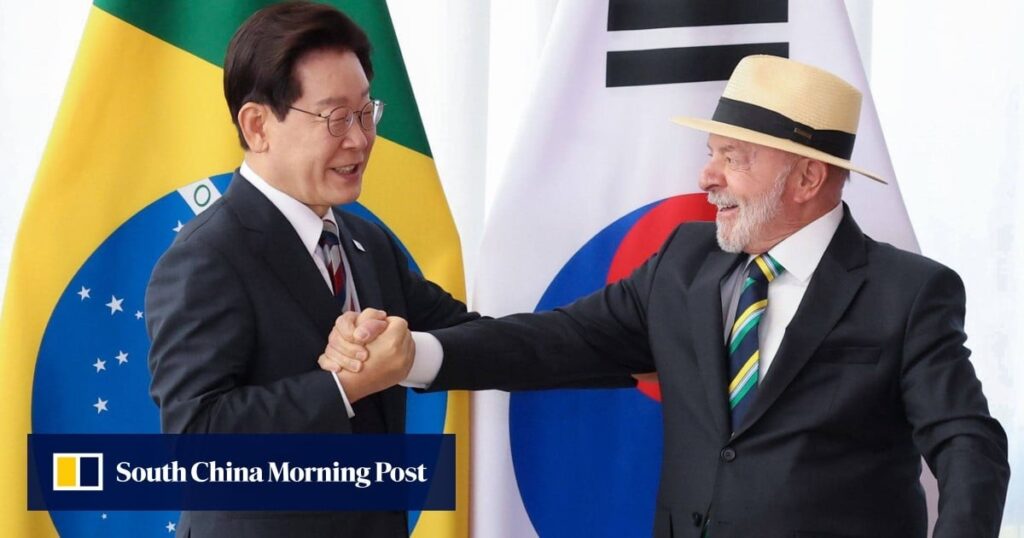
South Korean President Lee Jae Myung and Brazilian President Luiz Inacio Lula da Silva agreed on 29 July 2026 to restart free-trade negotiations with Mercosur — the South American bloc of Argentina, Brazil, Paraguay, Uruguay, and Bolivia. A joint working group will prepare a formal declaration for the Mercosur summit in December 2026. Talks, launched in 2018, stalled in late 2021 amid manufacturing-sector concerns. Analysts say Seoul must back diplomacy with real investment and technology transfer. Mercosur’s $3.5 trillion GDP and 270 million consumers make it a high-stakes opportunity for Korean exporters and supply chain planners.

Nissan to export US-built Murano to Japan in early 2027
Japan & Korea Supply Chain

Nissan to export US-built Murano to Japan in early 2027

Nissan will begin exporting the U.S.-built Murano SUV from its Smyrna, Tennessee plant to Japan in early 2027 — enabled by a September 2025 U.S.-Japan trade agreement that lowered U.S. tariffs on Japanese vehicles from 25% to 15% and allowed U.S. safety certification to satisfy Japanese regulatory requirements. The move follows similar announcements by Toyota and Honda to export U.S.-assembled models to Japan. Nissan sold 42,747 Muranos in the U.S. in 2025 (+121% YoY), while U.S. imports from Japan fell 17.4% to 113,094 units.

Japan pulls rare earths from Pacific seabed; yttrium at 1,000 ppm
Japan & Korea Supply Chain

Japan pulls rare earths from Pacific seabed; yttrium at 1,000 ppm

Japan has extracted yttrium (at 1,000 ppm) and dysprosium from deep-sea mud near Minamitorishima Island in the Pacific Ocean. The seabed deposit lies 2,000 meters below the surface and forms part of Japan’s strategy to cut reliance on China, which supplies over 90% of global refined rare earths. Despite promising assays, commercialization remains distant due to high extraction costs, with no large-scale pilot expected before the late 2030s. Japan has committed ¥15 billion to seabed R&D and is pursuing alternatives including domestic smelting (Shin-Etsu, 2027), recycling (Toyota Tsusho), and international partnerships (France, Greenland). Rare-earth costs for Japanese firms rose over 20% in early 2026.

Welcome Back!

Login to your account below

Create New Account!

Fill the forms below to register

Retrieve your password

Please enter your username or email address to reset your password.

Scan to share via WeChat

Open WeChat and scan the QR code to share

QR Code

Add New Playlist