

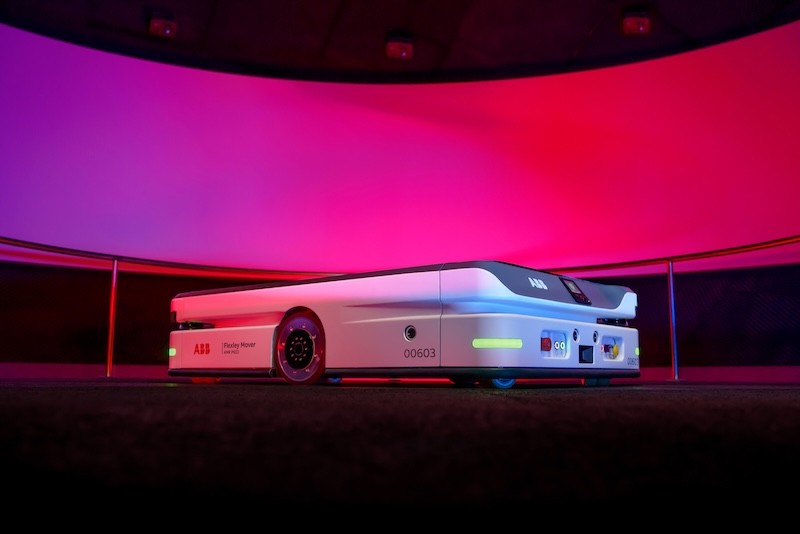
ABB Robotics’ Flexley Mover P603 AMR has won the iF Design Award 2026 for intralogistics innovation. According to the report, its Visual SLAM navigation speeds commissioning by up to 20% versus other systems, supports loads up to 1500 kg, and operates in space-constrained environments. Launched in 2025, the AMR reduces infrastructure requirements and enables rapid adaptation to changing production needs. Alfonso González, global AMR product line manager of ABB Robotics, emphasized its role in lowering automation barriers through autonomous, versatile robotics.
According to roboticsandautomationnews.com, ABB Robotics’ Flexley Mover P603 autonomous mobile robot (AMR) has won the iF Design Award 2026 in the Industry, Tools and Machinery Product Design category — recognizing its innovation in intralogistics automation.
Design and Performance Highlights
The award underscores the P603’s integration of compact physical design, intelligent navigation, and autonomous functionality. Its AI-powered Visual SLAM technology enables precise movement without fixed infrastructure — accelerating commissioning by up to 20 percent compared to other navigation systems and reducing implementation complexity. The unit’s compact footprint supports operation in space-constrained facilities, while integrated load sensing ensures safe handling of loads up to 1500 kg.
Strategic Context for Supply Chain Professionals
Launched in 2025, the Flexley Mover P603 is engineered to boost output, improve material flow, reduce setup time, and lower infrastructure dependencies. Its quick installation and adaptability to dynamic environments make it especially relevant for manufacturers modernizing operations with minimal production disruption. In an industry where labor shortages, facility retrofit constraints, and demand volatility are intensifying, such versatile AMRs support rapid reconfiguration of internal logistics — a critical capability for lean, responsive supply chains.
This development aligns with broader industry trends: major logistics and manufacturing firms globally are scaling AMR deployments to address rising labor costs and operational inflexibility. For example, Amazon has deployed over 750,000 robotic drive units across its fulfillment network; DHL has rolled out AMRs in more than 50 warehouses worldwide; and Walmart has expanded autonomous floor-scrubbing and goods-movement robots across distribution centers. Unlike legacy AGVs requiring magnetic tape or laser-guided infrastructure, AMRs like the P603 use software-defined navigation — enabling faster ROI, easier scalability, and integration with warehouse management systems (WMS) and manufacturing execution systems (MES).
Executive Perspective
“The Flexley Mover P603 is the latest step in ABB Robotics’ approach to autonomous, software-driven intralogistics automation, where machines can operate independently while working seamlessly alongside people and other systems. This award recognizes not only the strength of the design, but also how we’re lowering the barriers to automation through more autonomous and versatile robotics (AVRTM) that can do more things, in more places, and do it faster, safer and smarter.” — Alfonso González, global AMR product line manager of ABB Robotics
For supply chain professionals, the P603 reflects a maturing class of AMRs where hardware sophistication is matched by deployment pragmatism — supporting incremental automation, mixed-human–robot workflows, and future-ready scalability without wholesale facility redesign.
Source: Robotics & Automation News
Compiled from international media by the SCI.AI editorial team.


