Skip to content

North America Supply Chain

US Supply Chain Shift After Tariffs: 5 Charts

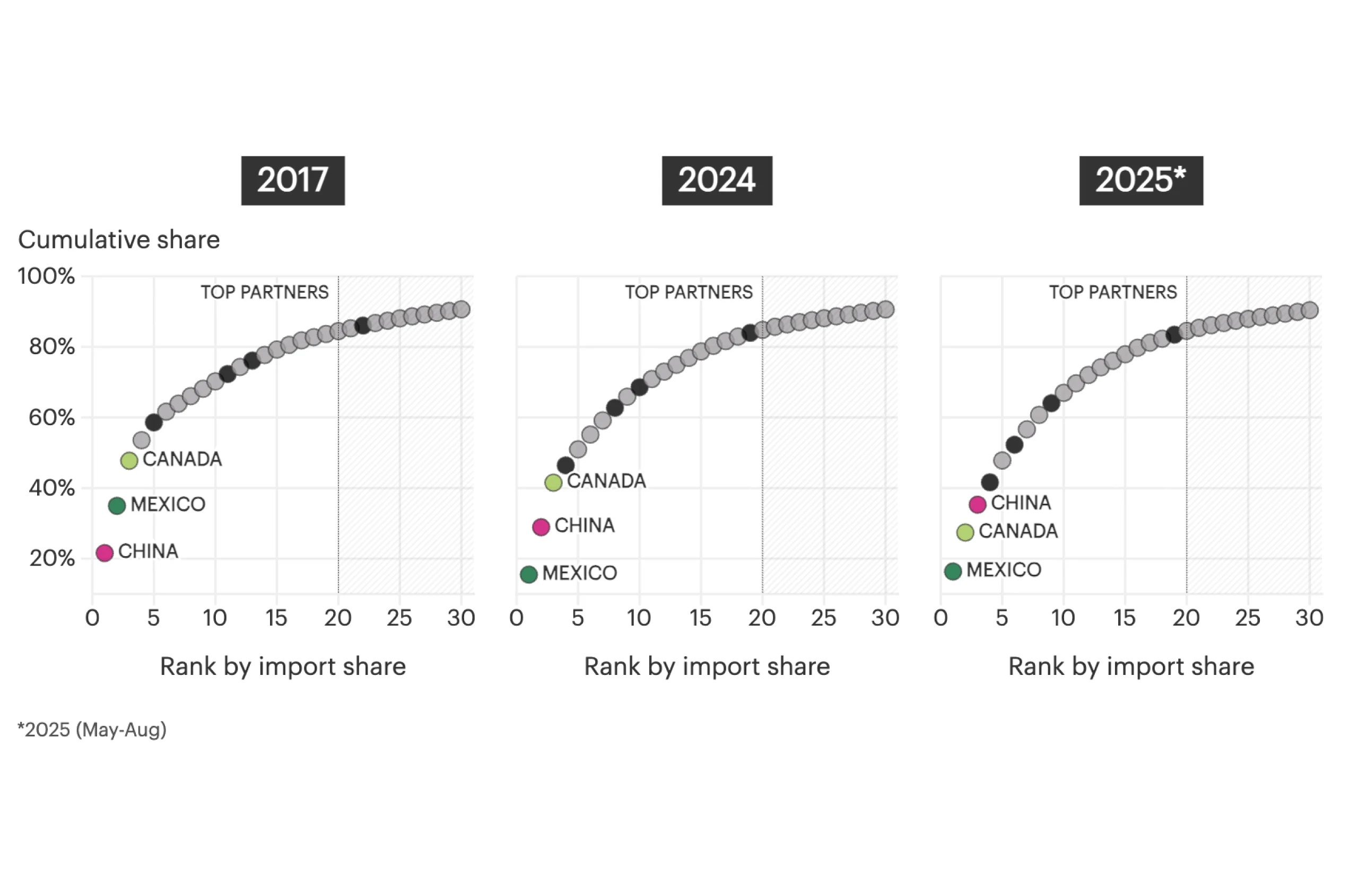
According to www.library.hbs.edu, US imports from China have fallen to near-2001 levels following tariff implementation, accelerating a pre-existing shift toward Mexico and other partners. Research by Laura Alfaro and Davin Chor — using US Census Bureau data across over 5,300 product categories — documents this 'great reallocation' in their November 2025 NBER working paper. The April 2, 2025 'Liberation Day' tariffs acted as a catalyst, not a cause, as firms were already positioned to adapt. Supply chain professionals must now contend with structural geographic reorientation, increased nearshoring complexity, and long-term sourcing diversification.

Original source: library.hbs.edu

US Supply Chain Shift After Tariffs: 5 Charts

According to www.library.hbs.edu, US imports from China have declined to near-2001 levels — the year China joined the World Trade Organization — as a result of tariff-driven supply chain recalibration accelerating a pre-existing trend toward Mexico and other trade partners.

The Great Reallocation in Action

Research by Harvard Business School’s Laura Alfaro, the Warren Alpert Professor of Business Administration, and Davin Chor, professor at Dartmouth’s Tuck School of Business, documents what they term the “great reallocation” in US supply chain trade. Their November 2025 working paper, “An Anatomy of the Great Reallocation in US Supply Chain Trade,” published by the National Bureau of Economic Research (NBER), analyzes US Census Bureau trade data across over 5,300 product categories.

Tariff Timing and Preparedness

The Trump administration’s major tariff announcement on April 2, 2025, branded “Liberation Day,” did not trigger but rather accelerated shifts already underway. According to the report, companies were already positioned to adjust to the new levies — indicating strategic foresight and operational readiness among many importers and manufacturers.

Geographic Reorientation

The source states that US import flows have shifted away from China and toward Mexico and other top partners. This diversification has reshaped sourcing geography across multiple sectors, with implications for logistics planning, customs compliance, and supplier risk assessment.

Methodology and Scope

The analysis draws exclusively on official US trade statistics, enabling granular tracking of changes by product category. As noted in the source, the five charts accompanying the article visualize key dimensions of this reallocation — including volume trends, partner-level share shifts, and sectoral concentration changes — though the specific chart data points are not described in the text.

Practitioner Implications

For global supply chain professionals, this reallocation underscores the growing operational importance of Mexico as a nearshoring hub, especially for time-sensitive or tariff-sensitive goods. It also signals heightened need for agile customs documentation systems, dual-sourcing strategies, and deeper due diligence on second- and third-tier suppliers in newly prioritized regions. The return of Chinese import volumes to 2001 levels suggests long-term structural change — not cyclical fluctuation — requiring sustained network redesign rather than short-term tactical responses.

Source: www.library.hbs.edu

Compiled from international media by the SCI.AI editorial team.

Ask SCI.AI Finished reading? Continue with SCI.AI. Explore the related policy, route, company and historical context. Continue asking
Dachser acquires 10% stake in Synergie Canada to expand airfreight
North America Supply Chain

Dachser acquires 10% stake in Synergie Canada to expand airfreight

German logistics firm Dachser has acquired a 10% minority stake in Synergie Canada, a Montreal-based air and sea freight forwarder founded in 2008. The investment strengthens Dachser’s North American presence and supports expansion beyond Europe. Synergie Canada generated €60 million in revenue in 2025 and employs around 100 people. CEO Tobias Burger called Canada 'a highly attractive market' due to its economic links across the Americas and Europe. President Marc-André Guindon noted the partnership will improve customer access to European markets. The deal follows similar moves by Atlas Air Worldwide and Air Charter Service in 2026.

Toyota opens $100M Indiana forklift plant, targets 80% electric by 2035
North America Supply Chain

Toyota opens $100M Indiana forklift plant, targets 80% electric by 2035

Toyota Material Handling North America (TMHNA) opened a $100 million electric forklift plant in Columbus, Indiana, on August 6, 2026. The 295,000-square-foot facility will produce Class 1 stand-up counterbalanced forklifts for Toyota and Raymond brands, enabling its Greene, N.Y., factory to pivot to reach trucks and automation. Production starts at eight units daily, scaling to 24 by September. TMHNA reports 70% of North American lift truck sales are now electric — projected to hit 80% by 2035. Seventy-five percent of output is custom-built, with 14 seat options available. Sixty percent of parts are sourced in North America, while Japan supplies key components; a new foreign trade zone helps bypass customs bottlenecks.

US lifts Mexico cattle ban Aug. 24 to curb beef prices
North America Supply Chain

US lifts Mexico cattle ban Aug. 24 to curb beef prices

The U.S. Department of Agriculture will lift its ban on Mexican cattle imports starting Aug. 24, 2026 — a restriction in place since November 2024 — to help curb record-high beef prices. The phased reopening affects three southern border ports and responds to a 22.7% year-over-year retail beef price surge. The move follows White House pressure on grocers and an antitrust probe into top beef processors ahead of the November 2026 elections. U.S. cattle inventories have fallen 12.3% since 2022, intensifying reliance on Mexican feeder cattle, which could supply up to 8% of domestic needs within a year.

Welcome Back!

Login to your account below

Create New Account!

Fill the forms below to register

Retrieve your password

Please enter your username or email address to reset your password.

Scan to share via WeChat

Open WeChat and scan the QR code to share

QR Code

Add New Playlist