Skip to content

Procurement · Strategic Sourcing

48-Hour Buyer-Owned GSM Baseline for Toilet Tissue Parent Rolls

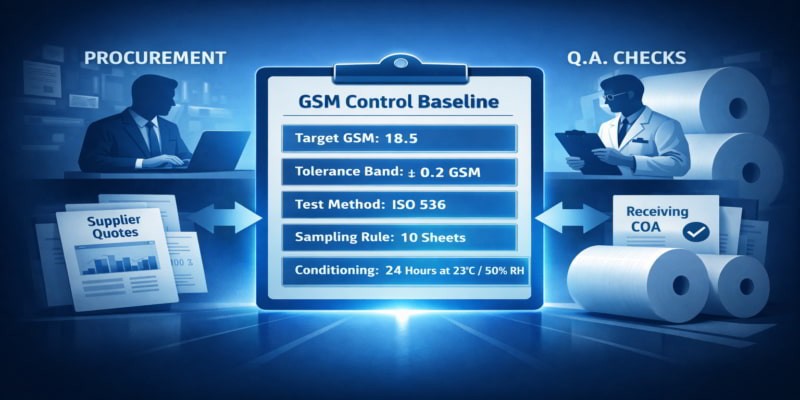
According to www.paperindex.com, toilet tissue converters must establish a buyer-owned GSM baseline within 48 hours to prevent line stoppages and specification drift. A quoted '18.5 GSM' is operationally meaningless without defined tolerance, ISO 536 test method, controlled conditioning (23°C/50% RH), and sampling rules. Discrepancies in moisture stabilization alone can shift results by nearly 1 GSM point. Procurement and QA must jointly own one unified document—no exceptions. Incomplete RFQs lacking test methods must be returned, not evaluated.

Original source: paperindex.com

48-Hour Buyer-Owned GSM Baseline for Toilet Tissue Parent Rolls
📋 本文要点

According to www.paperindex.com, toilet tissue converters must establish a buyer-owned GSM baseline within 48 hours to prevent line stoppages and specification drift. A quoted '18.5 GSM' is operationally meaningless without defined tolerance, ISO 536 test method, controlled conditioning (23°C/50% RH), and sampling rules. Discrepancies in moisture stabilization alone can shift results by nearly 1 GSM point. Procurement and QA must jointly own one unified document—no exceptions. Incomplete RFQs lacking test methods must be returned, not evaluated.

According to www.paperindex.com, establishing a buyer-owned grammage (GSM) accuracy baseline for toilet tissue parent rolls is a critical first step for procurement and quality assurance teams—requiring decisive action within the first 48 hours of specification development.

Why GSM Baseline Control Is Non-Negotiable

A supplier quoting “18.5 GSM” conveys no operational meaning unless paired with explicit tolerance, test method, sampling rules, and conditioning protocols. As the source states: “Numbers Without Ranges Fail: A target GSM is useless without a tolerance band; your converting line needs a defined acceptable range to work with.” Without such parameters, converters face line stoppages, inconsistent unwind performance, and downstream yield loss—even when supplier-certified results appear identical.

The Operational Cost of Ambiguity

Two suppliers may both report 18.5 GSM, yet produce rolls with divergent mechanical behavior—one testing per ISO 536 after conditioning at 23°C and 50% relative humidity, the other testing immediately post-production before moisture stabilizes. The source notes this discrepancy can shift results by nearly a full GSM point on the same material. Such misalignment directly fuels specification misalignment costs, receiving instability, and retailer rejections—especially in private-label operations where tolerances are often omitted.

The 48-Hour Action Framework

  • Hour 0–12: Audit all existing GSM references—including contracts, supplier spec sheets, Certificates of Analysis from the last three shipments, incoming inspection notes, complaint logs, and production downtime records tied to roll performance. Identify gaps where: (1) no tolerance band is named; (2) no test method is specified; or (3) no sampling or conditioning rules govern result comparison.
  • Hour 12–24: Convert one nominal GSM figure into an actionable control protocol—defining separate baselines per grade family (e.g., standard, premium, private-label), stating the target GSM in plain language, and assigning a tolerance band (e.g., ±0.3 GSM).

Alignment Between Procurement and QA

The source stresses that “Procurement and QA Need One Document: Both teams must agree on the exact same baseline—same target, same tolerance, same method—before sending anything to suppliers.” Incomplete quotes lacking named test methods must be returned for clarification—not compared against incomplete specs. As stated: “One buyer-owned baseline beats a thousand supplier assumptions.”

Source: www.paperindex.com

Compiled from international media by the SCI.AI editorial team.

Ask SCI.AI Finished reading? Continue with SCI.AI. Explore the related policy, route, company and historical context. Continue asking
BlueGrace acquires Idaho 3PL Truk TMS to expand Pacific Northwest LTL
AI & Automation

BlueGrace acquires Idaho 3PL Truk TMS to expand Pacific Northwest LTL

BlueGrace Logistics has acquired Idaho-based third-party logistics provider Truk TMS to strengthen its presence in the Pacific Northwest. The deal brings Truk TMS—previously a BlueGrace partner—fully into the company’s ecosystem, granting its customers access to BlueGrace’s Managed Logistics platform and BlueShip technology. Financial terms remain undisclosed. BlueGrace, headquartered in Tampa, Florida, serves over 10,000 customers from nine offices across the U.S. and Mexico and operates a carrier network exceeding 250,000. As a Warburg Pincus portfolio company, BlueGrace previously acquired STB Freight Group and FreightCenter in 2025. Truk TMS CEO Mark Barnes emphasized continuity of service backed by expanded capabilities.

BMW cuts 8,000 jobs by 2027 amid EU supply chain retooling
Procurement

BMW cuts 8,000 jobs by 2027 amid EU supply chain retooling

BMW plans to cut ~8,000 global positions by 2027 — primarily in administration and development — as shrinking margins (down to 2.3% in automotive) and collapsing China deliveries (−30.2% Q2) force structural change. Simultaneously, EU industrial policy pushes for regionalized, policy-aligned auto sourcing. New CEO Milan Nedeljkovic is revisiting 'untouchable' processes across procurement, production, and development — highlighting how lean operations now collide with geopolitical supply chain constraints.

U.S. CEOs Would Pay 17% Premium for Supply Chain Resilience
Procurement

U.S. CEOs Would Pay 17% Premium for Supply Chain Resilience

A Proxima survey of over 500 global CEOs reveals that more than 80% of U.S. executives estimate up to 20% of revenue would be at risk from a two-week disruption among their top three suppliers. The 104 U.S.-based respondents said they would accept an average 17% increase in third-party supplier costs to ensure resilience—70% would accept 11% or more. Geopolitical tensions (30%) topped threat concerns, while 47% reported experiencing a cyber-related supply chain disruption in the past 24 months. Only 39% had conducted a full cyber resilience stress-test in the last year.

Welcome Back!

Login to your account below

Create New Account!

Fill the forms below to register

Retrieve your password

Please enter your username or email address to reset your password.

Scan to share via WeChat

Open WeChat and scan the QR code to share

QR Code

Add New Playlist

