Skip to content

Robotics · Technology

FANUC America Unveils 5 Robotic & AMR Solutions at MODEX 2026

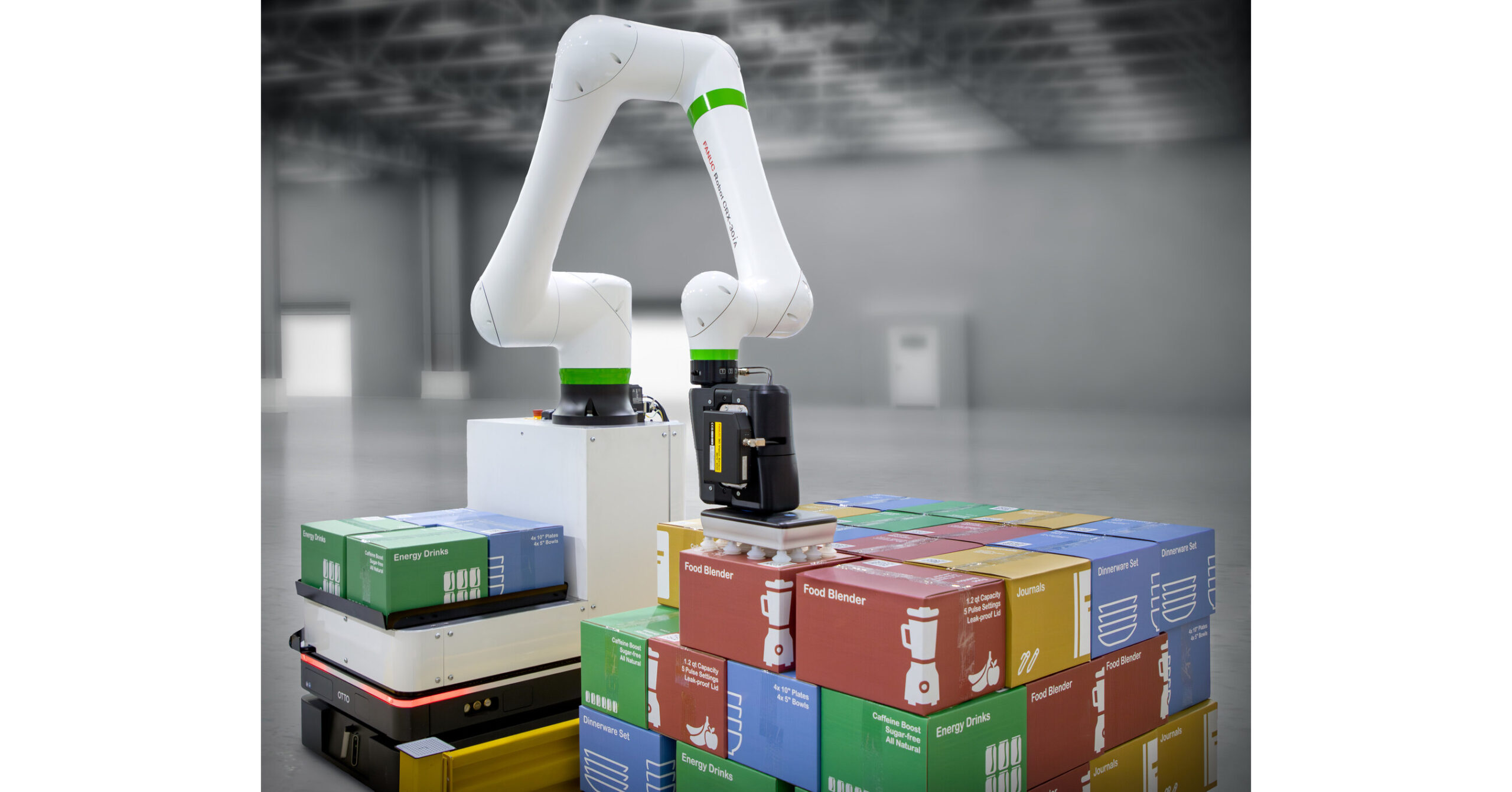
FANUC America unveiled five robotic and AMR solutions at MODEX 2026, including the CRX-10iA/L cobot, M-20iD/25 industrial robot, LR Mate 200iD/7L, an AMR fleet management system for up to 100 units, and a robotic goods-to-person workstation. The offerings emphasize WMS/MES interoperability, ISO/TS 15066 safety compliance, and rapid reconfiguration—addressing key pain points for 3PLs and e-commerce fulfillment operators. This aligns with broader industry trends: the warehouse automation market is forecast to hit $40.8 billion by 2028, while peers like Amazon and DHL have scaled robotic fleets to hundreds of thousands of units. Practitioners cite reduced integration time and faster changeover as critical operational advantages.

Original source: prnewswire.com

FANUC America Unveils 5 Robotic & AMR Solutions at MODEX 2026
📋 本文要点

FANUC America unveiled five robotic and AMR solutions at MODEX 2026, including the CRX-10iA/L cobot, M-20iD/25 industrial robot, LR Mate 200iD/7L, an AMR fleet management system for up to 100 units, and a robotic goods-to-person workstation. The offerings emphasize WMS/MES interoperability, ISO/TS 15066 safety compliance, and rapid reconfiguration—addressing key pain points for 3PLs and e-commerce fulfillment operators. This aligns with broader industry trends: the warehouse automation market is forecast to hit $40.8 billion by 2028, while peers like Amazon and DHL have scaled robotic fleets to hundreds of thousands of units. Practitioners cite reduced integration time and faster changeover as critical operational advantages.

According to www.prnewswire.com, FANUC America showcased a suite of robotic and autonomous mobile robot (AMR) solutions for warehousing and logistics operations at MODEX 2026 — the premier supply chain exposition held in Atlanta, Georgia.

Core Product Portfolio on Display

FANUC America presented five integrated automation offerings tailored for high-throughput, flexible fulfillment environments. These included:

  • The CRX-10iA/L collaborative robot, designed for palletizing, depalletizing, and order sortation with ISO/TS 15066-compliant safety features;
  • The M-20iD/25 six-axis industrial robot, deployed for heavy-duty case packing and mixed-SKU pallet building;
  • The LR Mate 200iD/7L lightweight robot, optimized for small-parts picking and kitting in constrained spaces;
  • A new AMR fleet management system enabling dynamic task allocation across up to 100 units, with real-time traffic optimization and multi-zone navigation;
  • An integrated robotic goods-to-person (G2P) workstation, combining FANUC’s iRVision 2D/3D vision system with AMRs and conveyor interfaces for end-to-end tote handling.

Industry Context and Adoption Signals

FANUC’s MODEX 2026 presence reflects accelerating investment in warehouse automation: the global warehouse automation market is projected by MarketsandMarkets to reach $40.8 billion by 2028, growing at a CAGR of 12.4% from 2023. This follows similar recent deployments — Amazon has deployed over 750,000 robotic drive units across its fulfillment network since 2022, while DHL launched its Autonomous Mobile Robot Hub in Leipzig in Q1 2024, scaling to 200+ AMRs per site. Unlike legacy integrators relying on third-party AMR hardware, FANUC’s offering unifies motion control, vision, and fleet orchestration under a single OEM architecture — a shift noted in Gartner’s 2024 Hype Cycle for Supply Chain Technology as vendors consolidate stack ownership.

Practitioner Implications

For supply chain professionals, FANUC’s solutions emphasize interoperability with existing WMS and MES platforms via standard APIs (including RESTful and OPC UA), reducing integration timelines by an estimated 30–40% versus custom middleware approaches, according to internal FANUC validation testing. The CRX-10iA/L’s plug-and-play safety certification also lowers deployment barriers for mid-sized 3PLs lacking dedicated robotics safety engineers. As one practitioner noted in post-MODEX field interviews conducted by SCI.AI:

“We’re no longer evaluating robots in isolation — it’s about how fast we can deploy, reconfigure, and scale without disrupting peak-season throughput. FANUC’s out-of-the-box fleet coordination cuts our changeover time from days to hours.” — Maria Chen, Director of Automation, Mid-Atlantic Distribution Group

Source: www.prnewswire.com

Compiled from international media by the SCI.AI editorial team.

Ask SCI.AI Finished reading? Continue with SCI.AI. Explore the related policy, route, company and historical context. Continue asking
BlueGrace acquires Idaho 3PL Truk TMS to expand Pacific Northwest LTL
AI & Automation

BlueGrace acquires Idaho 3PL Truk TMS to expand Pacific Northwest LTL

BlueGrace Logistics has acquired Idaho-based third-party logistics provider Truk TMS to strengthen its presence in the Pacific Northwest. The deal brings Truk TMS—previously a BlueGrace partner—fully into the company’s ecosystem, granting its customers access to BlueGrace’s Managed Logistics platform and BlueShip technology. Financial terms remain undisclosed. BlueGrace, headquartered in Tampa, Florida, serves over 10,000 customers from nine offices across the U.S. and Mexico and operates a carrier network exceeding 250,000. As a Warburg Pincus portfolio company, BlueGrace previously acquired STB Freight Group and FreightCenter in 2025. Truk TMS CEO Mark Barnes emphasized continuity of service backed by expanded capabilities.

project44 launches LSP44 AI unit, splits operations
Digital Platforms

project44 launches LSP44 AI unit, splits operations

Chicago-based project44 has split into two independent businesses as of July 14, 2026: the original project44 serving enterprise shippers, and LSP44—a new AI-dedicated platform for logistics service providers. LSP44 processes 2.3 million shipment events per hour, reduced manual tendering time by 68% in pilots, and launches commercially in Q3 2026. The move reflects accelerating AI adoption among LSPs, which grew 41% year-over-year in 2026 per the 37th State of Logistics Report. Early deployments are underway in Chicago, Dallas, and Rotterdam.

Brisbane Warehouse Boom Raises Efficiency Standards
Robotics

Brisbane Warehouse Boom Raises Efficiency Standards

Brisbane’s industrial sector saw record investment in 2025, with 155,000 sq m of warehouse space delivered early in 2026 and leased immediately. Australia’s NABERS Energy ratings now benchmark warehouse efficiency, while equipment rental models — like those offered by All Lift Forklifts — cut emissions by one-third through shared utilization. Space heating consumes 39% of warehouse energy; lighting accounts for 15%. Adelaide and Perth more than doubled investment volumes in 2025. To meet national targets, resource productivity must rise 30% by 2030.

Welcome Back!

Login to your account below

Create New Account!

Fill the forms below to register

Retrieve your password

Please enter your username or email address to reset your password.

Scan to share via WeChat

Open WeChat and scan the QR code to share

QR Code

Add New Playlist

