

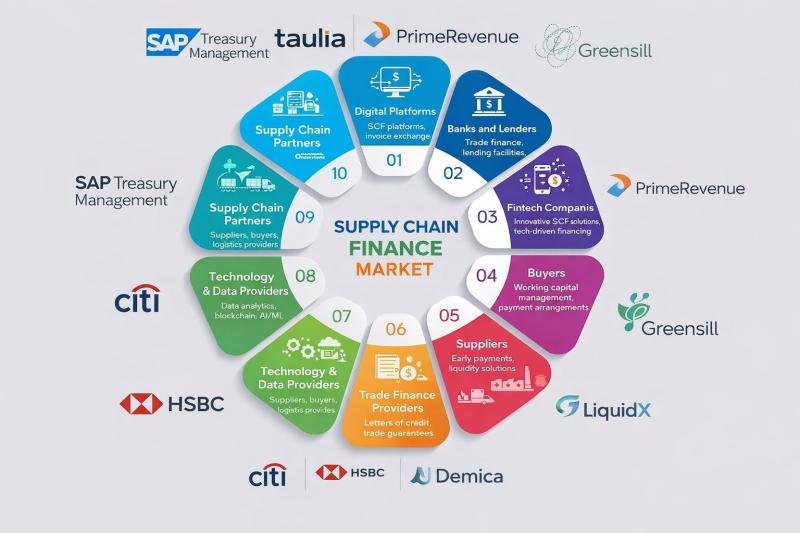
The Global Supply Chain Finance Market hit $1.5 billion in 2022 and is forecast to reach $4.0 billion by 2031, growing at a 13.0% CAGR (2024–2031). Key drivers include AI-powered credit scoring, blockchain-enabled transparency, and virtual card-based financing. Recent moves by Visa (Feb 2026), SAP (Jan 2026), Taulia–Mastercard (Nov 2025), Citi (Oct 2025), and PrimeRevenue (Sep 2025) underscore rapid digitization. Major players include Citibank, J.P. Morgan Chase, HSBC, and Taulia. For practitioners, success hinges on integrating finance tools with ERP systems and proactively onboarding SME suppliers into digital platforms.
According to www.openpr.com, the Global Supply Chain Finance Market reached USD 1.5 billion in 2022 and is projected to grow to USD 4.0 billion by 2031, expanding at a CAGR of 13.0% during the forecast period 2024–2031.
Market Drivers and Strategic Role
Supply chain finance encompasses financial solutions designed to optimize cash flow and mitigate risk across buyer–supplier relationships. As highlighted in the DataM Intelligence report, it bridges liquidity gaps, enhances operational efficiency, and supports global trade by improving working capital management and reducing payment risks. Technology integration—including AI, blockchain, and automation—is accelerating adoption, particularly among enterprises seeking resilience amid tightening credit conditions and fragmented supplier ecosystems.
Recent Industry Developments (2025–2026)
- In February 2026, Visa Inc. launched a digital platform for SME invoice financing, leveraging real-time payment data to improve credit access across global supplier networks.
- In January 2026, SAP SE enhanced its ERP suite with an AI-driven supply chain finance module using predictive analytics to reduce payment delays and optimize working capital.
- In November 2025, Taulia Inc. partnered with Mastercard Incorporated to introduce a virtual card-based supplier financing solution enabling instant payments while extending buyer payment terms.
- In October 2025, Citigroup Inc. deployed a blockchain-enabled platform to increase transaction transparency, reduce fraud, and accelerate settlement cycles—targeting multinational corporations with complex supply chains.
- In September 2025, PrimeRevenue Inc. secured strategic investment from private equity firms to scale global operations and expand digital financing accessibility for suppliers worldwide.
Key Market Participants
The report identifies leading players including Citibank, J.P. Morgan Chase, HSBC, Standard Chartered, Wells Fargo, Banco Santander, BNP Paribas, Deutsche Bank, Oracle, and Taulia. These institutions reflect the convergence of traditional banking infrastructure and fintech innovation—particularly as banks increasingly embed supply chain finance capabilities directly into ERP and procurement platforms.
Practitioner Implications
For supply chain professionals, these developments signal a shift toward embedded, automated financing tools that require closer cross-functional alignment between procurement, finance, and IT teams. Real-time data integration—especially from ERP and procurement systems—is now foundational for qualifying suppliers for dynamic discounting or early-payment programs. The rise of virtual cards and blockchain settlements also demands updated controls for auditability and reconciliation. Notably, SMEs stand to benefit most from improved credit scoring via AI and expanded platform access—but only if buyers actively onboard them into digital finance ecosystems. Without such participation, liquidity advantages remain concentrated among tier-1 suppliers.
Source: www.openpr.com
Compiled from international media by the SCI.AI editorial team.


