

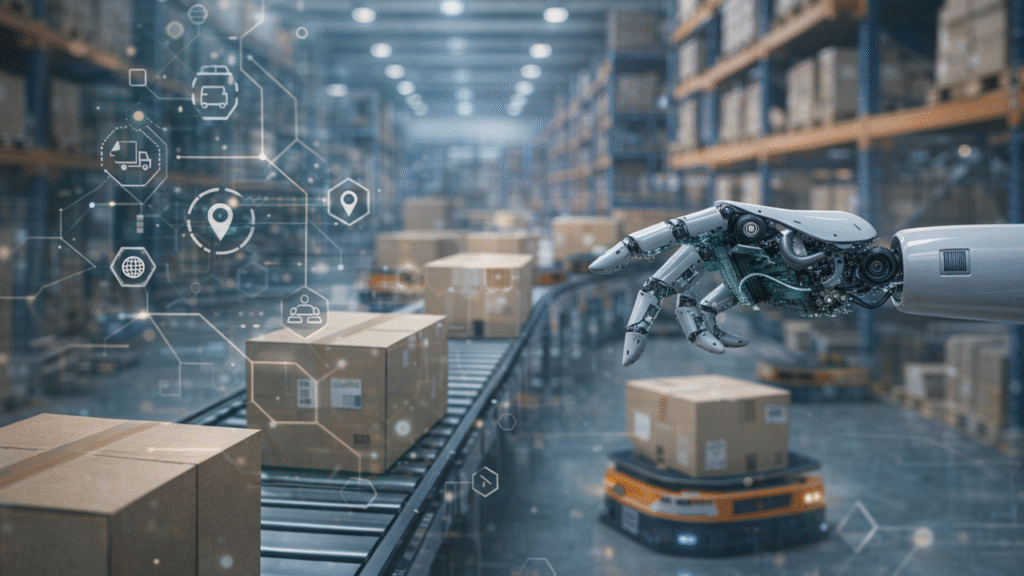
Microsoft has advanced its supply chain transformation into 'Supply Chain 2.0', deploying over 25 AI agents—including Demand Planning, Multi-Agent DC Spare-Part Space Solver, and CargoPilot—to automate forecasting, space optimization, and multimodal transport decisions. With ambitions to scale to 100+ agents by 2026, Microsoft leverages Azure Machine Learning, Microsoft Fabric, and NVIDIA Omniverse to power digital twins and physical AI in warehouses and logistics networks. Partners like paIQo, Cosmo Tech, and InstaDeep extend these capabilities via the Microsoft Marketplace. The shift underscores that unifying data estates is foundational—but true value emerges from AI-powered simulations, agentic workflows, and embodied intelligence integration.
According to www.microsoft.com, Microsoft is advancing a new operational paradigm—dubbed Supply Chain 2.0—centered on AI-powered simulations, autonomous agentic workflows, and physical AI integration across logistics infrastructure.
The agentic era is here
One year after introducing generative AI reference architectures for logistics—including adaptive cloud and AI-enhanced experiences—Microsoft reports rapid evolution into the agentic era, where AI agents perform reasoning, planning, and cross-system action. End-to-end agent hosting in Microsoft Foundry and open protocols like the Model Context Protocol (MCP) now enable agents to interoperate with enterprise tools, data, and systems. Parallel advances in 3D simulation, robotics, and embodied intelligence—powered by frameworks such as NVIDIA Cosmos and the OSMO edge-to-cloud compute framework on Azure—are expanding automation across warehouses, distribution centers, and transportation networks.
Microsoft’s supply chain as ‘customer zero’
Microsoft operates one of the world’s most extensive cloud supply chains: more than 70 Azure regions, over 400 datacenters, and a fiber network exceeding 600,000 km. Its hardware supply chains span Surface devices, Xbox consoles, and PC accessories. Over the past decade, this infrastructure evolved from Excel-based reporting and siloed data into an emerging autonomous, agentic model. In 2018, Microsoft consolidated more than 30 systems into a unified supply chain data lake on Azure; in 2022, it began generative AI experimentation, followed by development of a scalable AI platform for agents. Today, more than 25 AI agents and applications are deployed—including:
- The Demand Planning Agent, which drives AI-based demand–simulations for non-IT rack components—improving forecast accuracy and reducing manual reconciliation;
- The Multi-Agent DC Spare-Part Space Solver, using computer-vision monitoring and multi-agent reasoning to forecast spare-part storage needs and proactively mitigate space or stockout risks;
- The CargoPilot Agent, continuously analyzing transport modes, routes, cost structures, carbon impact, and cycle times to deliver optimized shipment recommendations balancing speed, sustainability, and efficiency.
The company aims to operate over 100 agents by end of 2026 and equip every employee with agentic support. Early results show AI in logistics saving Microsoft teams hundreds of hours each month.
Simulations: Digital twins powering resilience
As global supply chains grow more interconnected and volatile, discrete event-based simulations (DES) have become essential for risk reduction and resilience. Microsoft’s tools—including Azure Machine Learning and new machine learning models in Microsoft Fabric with Power BI semantic models—enable organizations to simulate demand patterns, shortages, and disruptions. Marketplace partners reinforce this capability: paIQo’s prognotix offers >70 algorithms for Azure-native forecasting; Cosmo Tech delivers dynamic digital twins for Advanced Supply Chain Risk Management; and InstaDeep uses Azure high-performance compute to optimize last-mile delivery, inventory, and fleet utilization via deep reinforcement learning.
The next frontier merges 3D physical simulations with DES to build comprehensive digital twins of warehouses, distribution centers, production lines, and logistics networks. These twins model both asset behavior and operational flow—enabling prediction, optimization, and prescriptive action. Use cases include warehouse planning (greenfield/brownfield), real-time monitoring (e.g., people movement heatmaps), improvement (e.g., trailer dwell time optimization, collision detection), and maintenance (e.g., real-time asset monitoring, quality issue detection).
In collaboration with NVIDIA, Microsoft provides access to NVIDIA Omniverse™, NVIDIA Isaac Sim™, and NVIDIA Omniverse Kit App Streaming. These libraries let developers integrate geometry data (2D/3D/point clouds), AI capabilities (including large language models and solvers), and IoT signals across OT environments. A reference architecture demonstrates GPU-accelerated Kubernetes clusters on Azure, enabling remote, real-time visualization and optimization of warehouse operations with enhanced situational awareness.
Source: www.microsoft.com
Compiled from international media by the SCI.AI editorial team.


